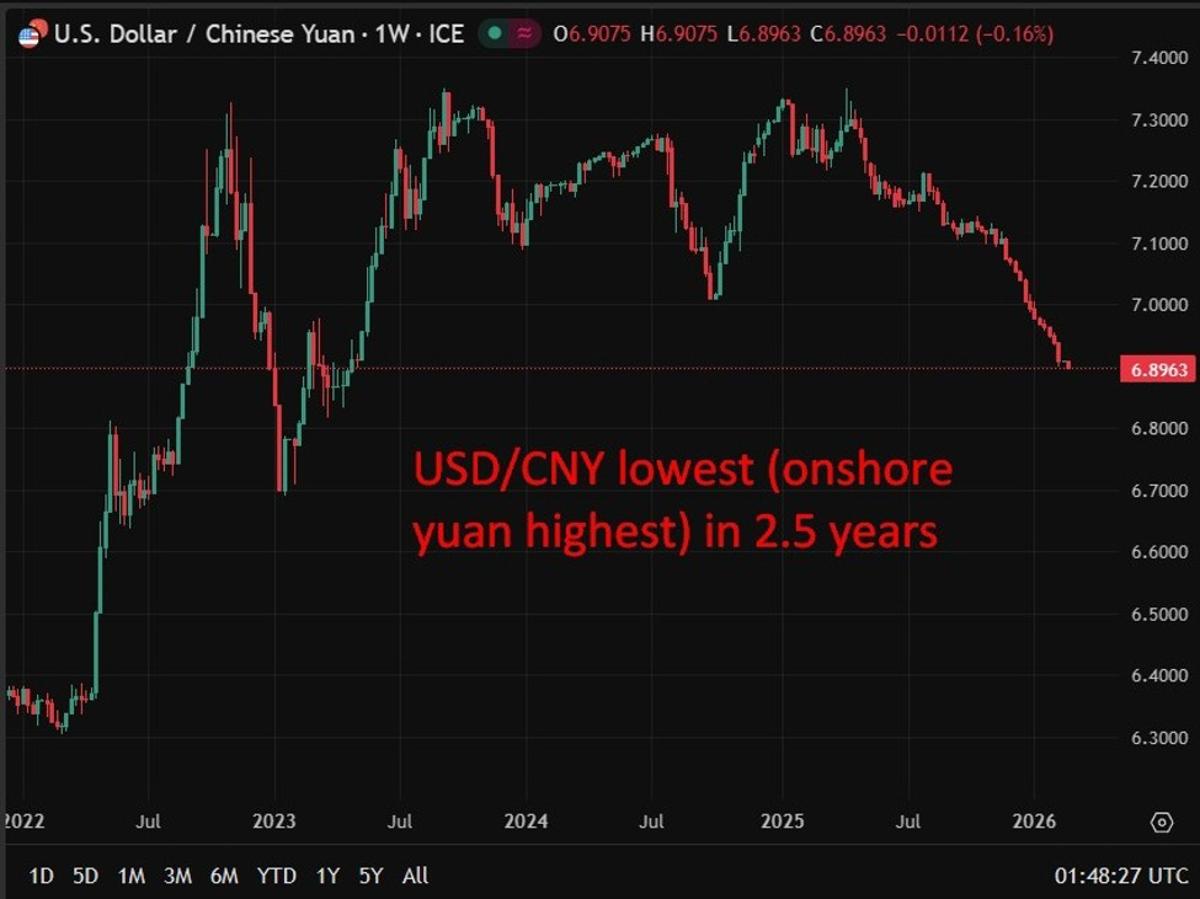
USD/CNY Drops to 2½-Year Low as Onshore Yuan Surges
•February 24, 2026
0
Why It Matters
A stronger yuan reshapes export competitiveness and capital‑flow dynamics, while indicating the PBOC’s shift toward market‑driven exchange‑rate management. This development influences investors, traders, and multinational firms with exposure to China’s currency and equity markets.
Key Takeaways
- •USD/CNY fell to 6.8954, 2½‑year low.
- •PBOC set firmer midpoint fix at 6.9414.
- •Damping reduced, forecast deviation narrowed.
- •Shanghai Composite rose 0.8% on market reopen.
- •Yuan strength reflects softer dollar and equity optimism.
Pulse Analysis
The latest dip of the U.S. dollar against the on‑shore yuan, pushing USD/CNY below the 6.90 threshold, signals a notable shift in China’s exchange‑rate management. By posting a slightly stronger daily midpoint of 6.9414 and trimming the artificial damping that traditionally cushions the fix, the People’s Bank of China is allowing market pricing to play a larger role. This subtle calibration suggests a growing tolerance for a gradual appreciation, a stance that contrasts with the more defensive posture the central bank adopted during periods of rapid yuan gains.
From a trade perspective, a stronger yuan narrows export margins but also reduces the cost of imported inputs, potentially easing inflationary pressure on Chinese manufacturers. The move coincides with a softer global dollar and a rebound in domestic equities, as evidenced by the Shanghai Composite’s 0.8 % gain after the holiday break. Investors are interpreting the reduced gap between forecast models and the official fix as a green light for capital inflows, especially into yuan‑denominated bonds and stock‑linked products. Consequently, risk‑on sentiment is feeding both currency appreciation and broader market optimism.
Looking ahead, the yuan’s trajectory will hinge on three variables: the Federal Reserve’s interest‑rate path, China’s export demand, and the PBOC’s willingness to intervene if the currency breaches key psychological levels. Should the U.S. dollar continue its recent weakening, further upside for the yuan appears plausible, but policymakers may re‑engage damping mechanisms to safeguard competitiveness. Market participants should monitor the daily midpoint, foreign‑exchange swap volumes, and any statements from senior PBOC officials for early signals of a policy pivot. In the meantime, the current environment favors investors with yuan‑linked exposure.
USD/CNY drops to 2½-year low as onshore yuan surges
0
Comments
Want to join the conversation?
Loading comments...