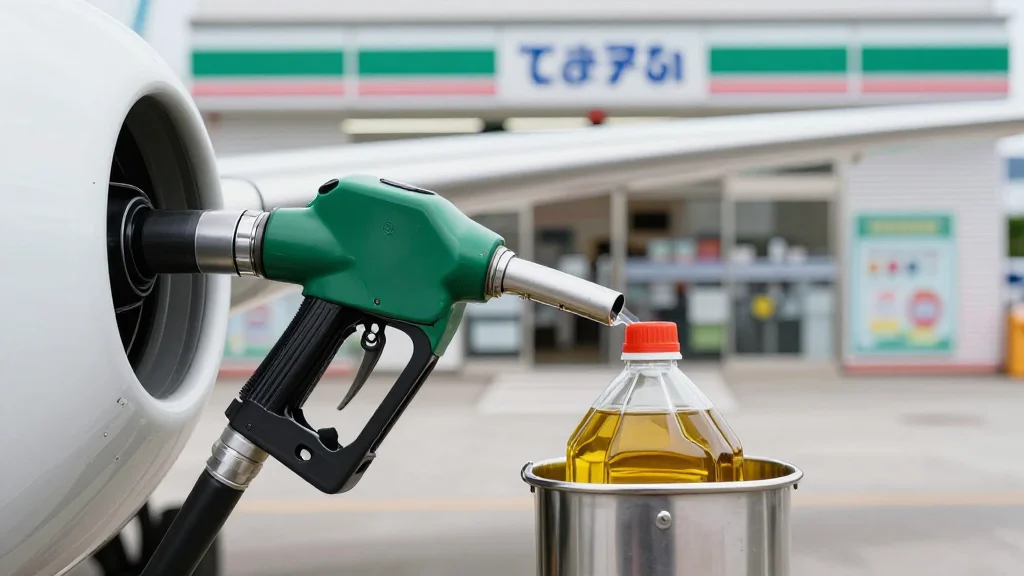
Fry to Fly: Japan Steps up Efforts on Cooking Oil in Race for Sustainable Aviation Fuel
Companies Mentioned
Why It Matters
Meeting the SAF target is critical for Japan’s carbon‑reduction commitments and to avoid steep cost penalties for airlines; failure would increase reliance on expensive imports and undermine global aviation decarbonisation efforts.
Key Takeaways
- •Japan needs 1.7 M kL SAF by 2030, 10% of jet fuel
- •Domestic used‑cooking‑oil could supply up to 550,000 kL, a quarter target
- •Current SAF output is 30,000 kL, only 0.3% of demand
- •Eneos, JGC, Aeon, 7‑Eleven join household oil collection drive
- •Refiners must decide by March 2024 to meet 2028‑2030 production
Pulse Analysis
Japan’s push for sustainable aviation fuel reflects a broader industry scramble to curb aviation‑related emissions. By 2030 the nation plans to blend a tenth of its jet fuel with SAF, a goal that translates to about 1.7 million kiloliters of low‑carbon jet fuel. While SAF can dramatically reduce lifecycle CO₂, its production remains costly and feedstock‑intensive, prompting policymakers to look for domestic, inexpensive sources. Used cooking oil (UCO) has emerged as the most viable feedstock, given Japan’s dense urban population and existing waste‑oil collection infrastructure.
The “Fry to Fly” initiative mobilises millions of households to funnel used oil into a nascent supply chain. Companies such as Eneos are weighing a joint venture with Mitsubishi Corp to produce 400,000 kiloliters of SAF after fiscal 2028, contingent on reliable UCO volumes. Meanwhile, retailers like Aeon, Ito‑Yokado and 7‑Eleven are installing drop‑boxes, and Fujifilm is harvesting oil from employee cafeterias. Even with aggressive collection, estimates suggest a ceiling of 550,000 kiloliters—roughly 25% of the 2030 requirement—highlighting the scale gap between ambition and reality.
If domestic feedstock falls short, Japan will have to import SAF or its precursors, driving up costs for airlines and potentially triggering regulatory penalties. The government has set a March decision deadline for refiners, underscoring the urgency of securing financing and expanding processing capacity. Success could position Japan as a model for integrating circular‑economy waste streams into aviation fuel, while failure would reinforce the sector’s dependence on costly overseas supply chains and slow progress toward global net‑zero aviation goals.
Fry to fly: Japan steps up efforts on cooking oil in race for sustainable aviation fuel
Comments
Want to join the conversation?
Loading comments...