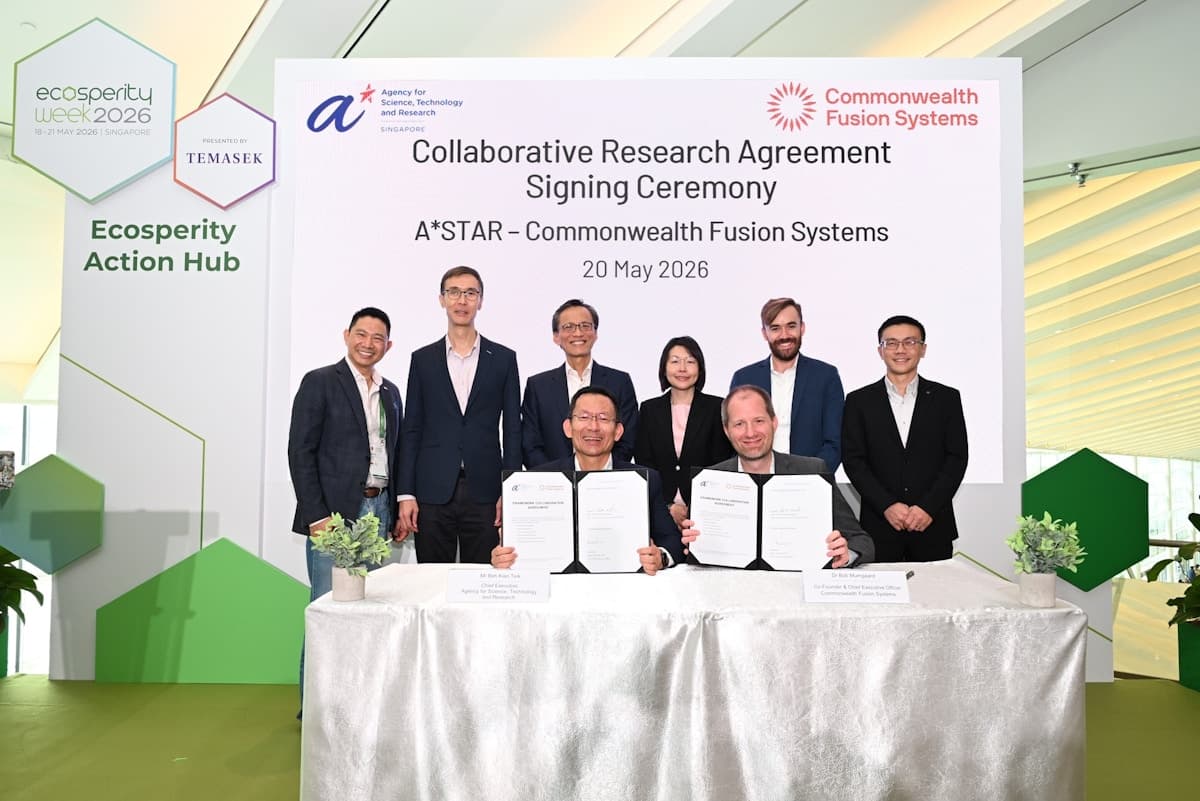
Singapore Partners with Nuclear Fusion Firm CFS in Push for Future Clean Energy Industry
Companies Mentioned

Why It Matters
The deal positions Singapore as an early player in the nascent fusion supply chain, offering a new low‑carbon energy pathway for a data‑intensive economy and signaling confidence from major tech investors.
Key Takeaways
- •Singapore signs 5‑year A*STAR‑CFS fusion partnership.
- •Collaboration targets commercial‑scale plant Arc in Virginia, early 2030s.
- •Google will purchase half of Arc’s electricity output.
- •Fusion seen as low‑carbon solution for AI‑driven data‑centre demand.
- •Global coalition seeks philanthropic funding for nuclear deployment by 2030s.
Pulse Analysis
Singapore’s ambition to hit net‑zero emissions by 2050 has taken a decisive step with a five‑year agreement between the Agency for Science, Technology and Research (A*STAR) and Commonwealth Fusion Systems (CFS). The deal expands an existing collaboration that already supplied hardware for MIT’s SPARC device, a $1 billion demonstration project slated to achieve net‑energy gain by 2027. By anchoring itself early in the commercial fusion supply chain, Singapore aims to diversify its energy mix, reduce reliance on imported fossil fuels, and position itself as a hub for high‑tech clean‑energy manufacturing in Southeast Asia.
The partnership will focus on technologies needed for CFS’s first commercial‑scale plant, Arc, planned for construction in Virginia in the early 2030s. Arc will build on lessons learned from SPARC, tackling the twin challenges of sustaining ultra‑hot plasma and developing materials that can survive neutron bombardment. Rising electricity demand from artificial‑intelligence workloads and data‑centre expansion—projected by the International Energy Agency to double to roughly 945 TWh by 2030—has accelerated interest in fusion as a stable, carbon‑free baseload source. While scientific breakthroughs have narrowed the physics gap, engineering scalability remains the critical hurdle.
Corporate backing underscores the commercial potential: Google has signed a contract to purchase half of Arc’s power, and other tech giants such as Amazon and Meta are similarly exploring nuclear options to secure low‑carbon electricity. At the same time, Singapore helped launch the Global Coalition for Nuclear Philanthropy, a fund‑raising effort backed by Temasek Trust and the Rockefeller Foundation to accelerate safe nuclear deployment worldwide. If the Singapore‑CFS collaboration succeeds, it could validate a supply‑chain model that other emerging economies replicate, hastening the industry’s goal of tripling global nuclear capacity by 2050.
Singapore partners with nuclear fusion firm CFS in push for future clean energy industry
Comments
Want to join the conversation?
Loading comments...