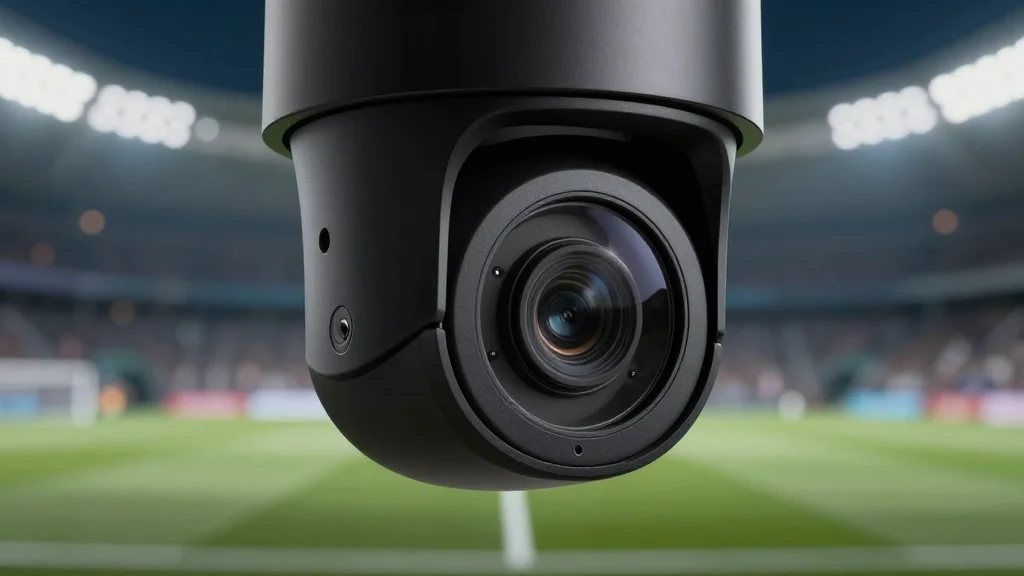
AI Video Surveillance Market Projected at $14.6 B, Transforming Enterprise Security

Companies Mentioned
Why It Matters
The projected $14.6 billion market signals that AI video analytics are moving from niche experiments to core components of enterprise security strategies. Real‑time insight can dramatically reduce response times, lower operational costs, and enable new use cases such as automated crowd management. However, the technology also amplifies privacy risks and forces organizations to confront the trade‑off between safety and civil liberties. If the performance gaps highlighted by industry insiders are not closed before large‑scale events like the FIFA World Cup, confidence in AI‑driven surveillance could stall, slowing broader adoption across sectors ranging from retail to critical infrastructure. Conversely, successful deployments could cement AI video analytics as a standard security layer, reshaping procurement priorities and driving further investment in specialized hardware and software.
Key Takeaways
- •Lumana projects the AI video surveillance market to exceed $14.6 billion by 2028.
- •AI video analytics revenue is forecast to reach $69 billion by 2028.
- •The FIFA World Cup 2026 will be a live test for AI‑enhanced surveillance at massive scale.
- •Major vendors Motorola Solutions, Axon and AI‑native startups are competing for contracts.
- •A gap between marketing hype and real‑world performance, plus privacy concerns, could affect adoption.
Pulse Analysis
The surge toward AI‑powered video surveillance reflects a broader enterprise trend: moving from data collection to instant, actionable intelligence. Historically, security operations have been hamstrung by the sheer volume of feeds, leading to missed incidents and operator burnout. AI promises to compress that data deluge into a handful of actionable alerts, effectively turning cameras into low‑cost sensors that can be scaled across campuses, factories, and public venues.
Yet the market’s rapid growth also exposes a classic technology‑adoption paradox. Early adopters—often large municipalities or multinational corporations—are willing to experiment despite uncertain ROI, creating a feedback loop that fuels vendor hype. This hype, however, can outpace the maturity of underlying models. As the sources note, many solutions are repurposed from generic computer‑vision frameworks rather than engineered for the unique demands of continuous, high‑resolution video streams. The upcoming World Cup will be the first real‑world litmus test; success could validate the technology’s scalability, while failure may trigger a regulatory backlash and a slowdown in procurement.
Privacy considerations add another layer of complexity. Continuous facial recognition, behavior analysis, and anomaly detection raise questions about consent, data storage, and algorithmic bias. Enterprises that integrate AI video analytics must now balance operational gains with compliance frameworks such as GDPR and emerging U.S. state laws. Companies that embed privacy‑by‑design principles—transparent data handling, audit trails, and bias mitigation—will likely win the trust of both regulators and customers, turning a potential liability into a competitive advantage. In short, the $14.6 billion market is not just a financial forecast; it is a bellwether for how enterprises will reconcile security efficiency with ethical responsibility in the AI era.
AI Video Surveillance Market Projected at $14.6 B, Transforming Enterprise Security
Comments
Want to join the conversation?
Loading comments...