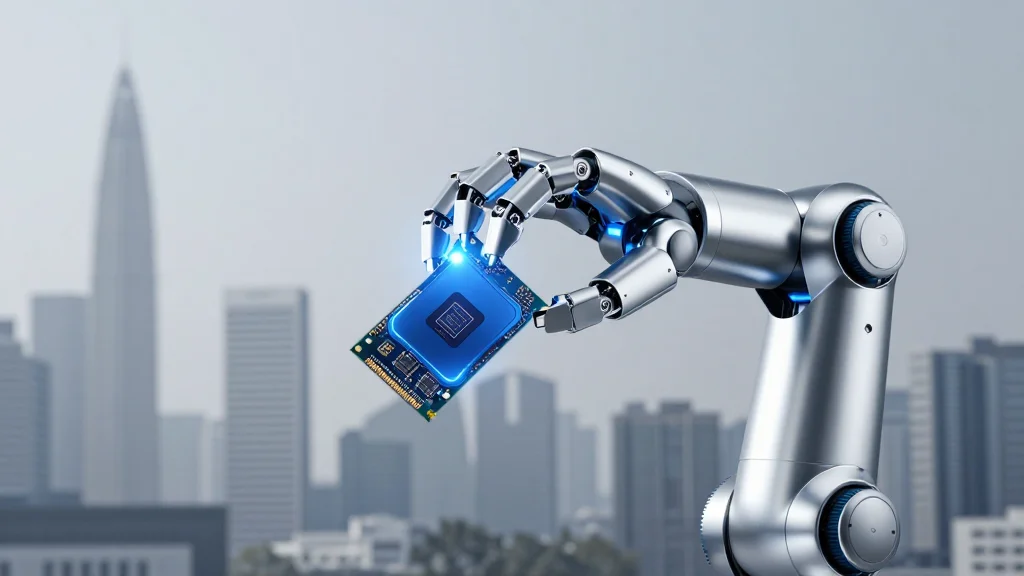
Nvidia and LG Group Launch AI Factory to Power Robotics and Data Centers in South Korea

Companies Mentioned
Why It Matters
The Nvidia‑LG AI factory represents the most ambitious enterprise‑level AI infrastructure deal in South Korea to date, linking world‑class GPU technology with a conglomerate that spans consumer electronics, automotive components and data‑center services. By providing a private, high‑performance compute environment, the partnership helps Korean firms keep proprietary AI models in‑house, a strategic advantage as data privacy regulations tighten worldwide. For the broader enterprise market, the collaboration signals a shift from cloud‑only AI training to hybrid on‑premise solutions that can deliver lower latency, higher security and tighter integration with physical production lines. Competitors such as Microsoft, Amazon and Google will need to offer comparable on‑premise stacks or risk losing enterprise customers that value data sovereignty and ultra‑fast inference at the edge.
Key Takeaways
- •Nvidia and LG Group announced a joint AI factory in Seoul to support robotics, autonomous driving, data‑center tech and GPU cloud services.
- •The AI factory will combine Nvidia’s full AI stack (GPU clusters, Omniverse, Isaac Sim/Lab, GR00T) with LG’s manufacturing and consumer‑electronics expertise.
- •LG aims to convert all 29 of its factories in 14 countries into AI‑enabled plants by 2030 using Nvidia’s digital‑twin platform.
- •Nvidia’s broader Korean strategy includes memory‑partner deals with SK Hynix and AI‑cloud projects with SK Telecom, reinforcing South Korea’s role in the global AI supply chain.
- •First production line of the AI factory is targeted for early 2027, with phased rollout across LG’s high‑value manufacturing segments.
Pulse Analysis
Nvidia’s partnership with LG Group is more than a technology tie‑up; it is a strategic play to lock down a complete AI value chain in a geopolitically sensitive region. By embedding its GPU and software stack directly into LG’s manufacturing DNA, Nvidia sidesteps the public‑cloud model that dominates the U.S. market and offers Korean firms a sovereign alternative that mitigates data‑privacy and export‑control risks. This mirrors a broader industry trend where chipmakers are becoming platform providers, bundling hardware, software and services to create sticky, high‑margin ecosystems.
Historically, enterprise AI deployments have suffered from a “data‑gravity” problem—massive datasets and compute resources tend to stay where they are first built. The Nvidia‑LG AI factory flips that paradigm by delivering a private, on‑premise supercomputing environment that can generate synthetic training data (via Nvidia Cosmos) and validate models in digital twins before any physical rollout. If LG can demonstrate measurable productivity gains—shorter time‑to‑market for new robot models, reduced defect rates in automotive parts, or lower energy consumption in data centers—other manufacturers will likely follow suit, accelerating the shift toward AI‑first factories worldwide.
From a competitive standpoint, the deal puts pressure on cloud‑only AI providers like Microsoft Azure and Amazon Web Services, which have been courting Korean enterprises with AI‑accelerator instances. Nvidia’s approach offers a differentiated value proposition: deep integration with the hardware supply chain (via SK Hynix memory) and a turnkey software stack that can be deployed behind corporate firewalls. As AI workloads continue to outstrip the capacity of public clouds, we can expect more chipmakers to replicate Nvidia’s model, forging exclusive partnerships with industrial conglomerates to capture the next wave of enterprise AI spend.
Nvidia and LG Group Launch AI Factory to Power Robotics and Data Centers in South Korea
Comments
Want to join the conversation?
Loading comments...