Transformation Capability Management: Why ERP Programs Drift Even with Good Change Management
Companies Mentioned
Why It Matters
TCM ensures ERP transformations build lasting internal capability and deliver value, protecting organizations from hidden structural risks that can inflate costs and erode post‑go‑live ownership.
Key Takeaways
- •ERP drift stems from upstream capital, capability, capacity gaps.
- •TCM makes structural constraints visible before they become delivery risks.
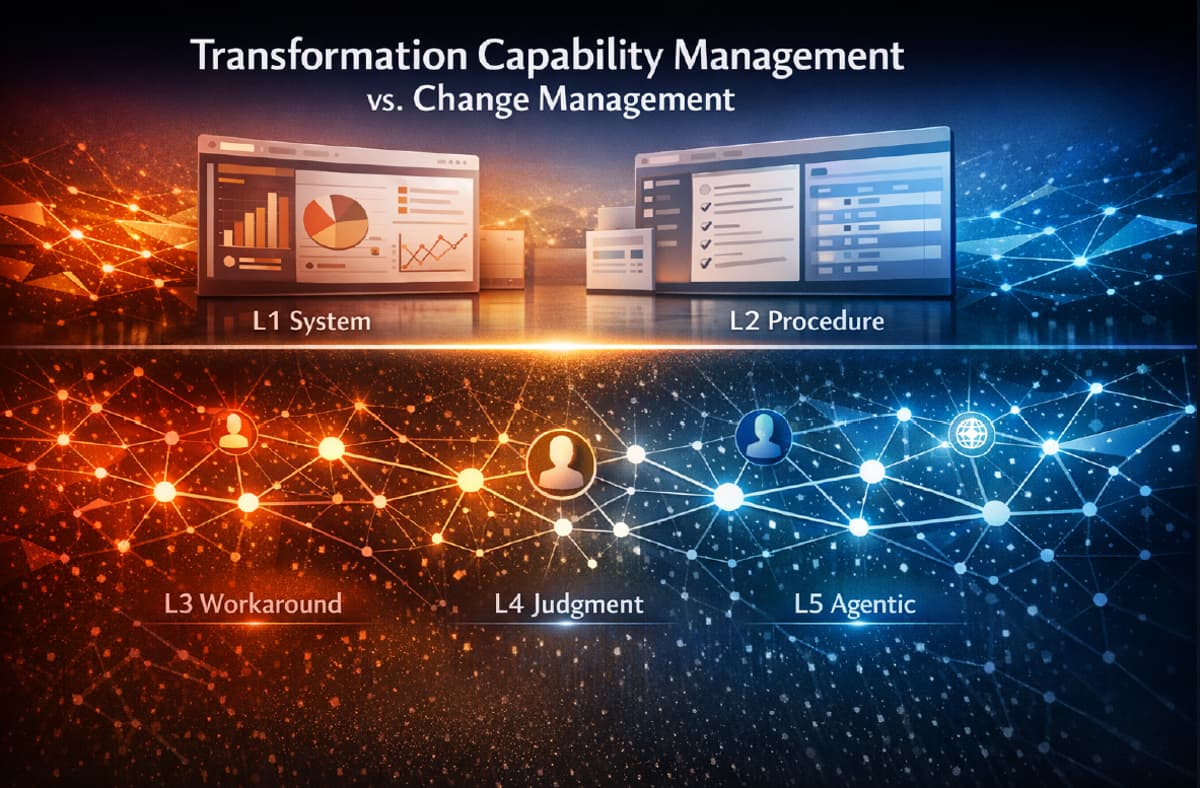
- •Change management drives adoption; TCM governs transformation architecture.
- •AI‑driven vendor proximity increases risk of rented capability.
- •TCM checklist ties spend to business value and internal ownership.
Pulse Analysis
The rise of AI‑enabled ERP tools is reshaping implementation economics, forcing vendors and system integrators to accelerate value delivery. While traditional change management excels at aligning users, communicating new processes, and training staff, it does not address the upstream decisions that dictate whether an organization can sustain the new system. Transformation Capability Management (TCM) fills this gap by making capital allocation, capability ownership, and execution bandwidth explicit early in the program, allowing leadership to make trade‑offs before they manifest as costly rework or reliance on external partners.
Recent market data underscores the urgency of this shift. Large‑scale SAP S/4HANA migrations now cost tens of millions of dollars and can span up to 18 months, with only a third of firms reporting full completion. Simultaneously, consulting giants like IBM and Accenture are highlighting AI‑driven bookings—$5.9 billion for Accenture’s generative AI services—signaling that vendors are leveraging AI to compress their own cost bases. This creates a paradox: customers receive faster, cheaper implementations, but risk deepening dependency on rented expertise if they do not govern capability ownership through TCM. By tying spend to measurable business outcomes and defining which functions must be internalized, TCM protects the "clean core" strategy and prevents hidden constraints from surfacing late in the rollout.
Practically, ERP leaders can adopt a simple TCM checklist at each steering meeting: verify that quarterly spend aligns with business value, confirm five critical capabilities are slated for internal ownership within a year, and assess whether decision‑makers have realistic capacity. When combined with traditional change‑management metrics—user readiness, sponsor alignment, and role‑based training—organizations gain a dual‑layered view of both adoption and structural viability. This integrated approach reduces late‑stage rework, accelerates decision cycles, and ultimately drives stronger post‑go‑live performance, making ERP transformations a strategic asset rather than a costly, partner‑dependent project.
Transformation Capability Management: Why ERP Programs Drift Even with Good Change Management
Comments
Want to join the conversation?
Loading comments...