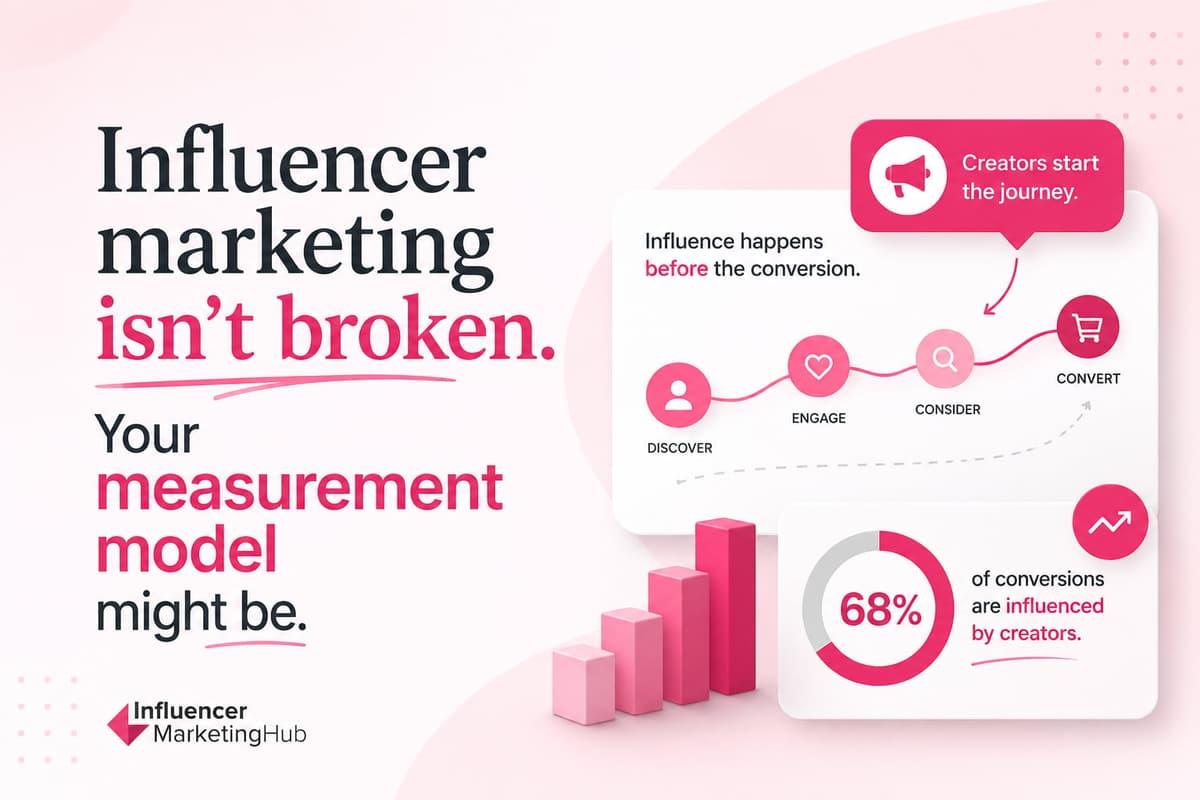
Influencer Marketing Isn’t Broken. Your Measurement Model Might Be
Why It Matters
Accurate measurement transforms influencer spend from a perceived gamble into a predictable, compounding channel, boosting overall marketing efficiency and revenue growth.
Key Takeaways
- •Influencer ROI suffers from premature KPI expectations and early program resets.
- •Last‑click attribution hides creators’ role; multi‑touch attribution reveals true impact.
- •Assign creators to discovery, consideration, or conversion stages for aligned metrics.
- •Track reach, engagement, branded search, and traffic growth alongside sales.
- •Use affiliate tracking to capture full consumer journey beyond the initial click.
Pulse Analysis
The influencer economy has matured technologically, yet many brands still evaluate campaigns through a narrow, last‑click lens. This approach discounts the multi‑touch nature of modern purchase journeys, where a creator’s post may spark awareness weeks before a consumer clicks a paid ad or enters a checkout flow. Marketers who adopt multi‑touch attribution—combining first‑touch, assisted‑conversion, and post‑click data—gain a holistic view of how influencer content seeds demand, ultimately improving budget allocation across channels.
A pragmatic framework begins by assigning each creator a clear funnel role: discovery creators drive reach and new‑to‑brand traffic; consideration creators deepen engagement and site interaction; conversion creators focus on direct actions such as affiliate clicks or discount‑code usage. Corresponding metrics—impressions, engagement rates, click‑through ratios, and revenue‑per‑click—should be tracked from day one, while allowing two to three content cycles for learning. Integrating robust affiliate tracking captures the full consumer arc, turning what appears to be a “last‑click” loss into a measurable contribution to downstream sales.
When measurement aligns with the influencer’s function, ROI becomes less volatile and optimization more data‑driven. Brands that recognize influence as a catalyst rather than a direct‑response channel can leverage the resulting lift in organic search, paid‑media efficiency, and overall site traffic. This strategic shift not only justifies influencer spend but also creates a compounding effect that amplifies other marketing investments, delivering sustainable growth in a competitive digital landscape.
Influencer marketing isn’t broken. Your measurement model might be
Comments
Want to join the conversation?
Loading comments...