10 Years Since Brexit, and the Results Are In
Companies Mentioned
Why It Matters
Brexit’s cumulative drag on investment, jobs and productivity signals lasting economic costs for the UK and warns other nations about the long‑term risks of abrupt trade policy shifts.
Key Takeaways
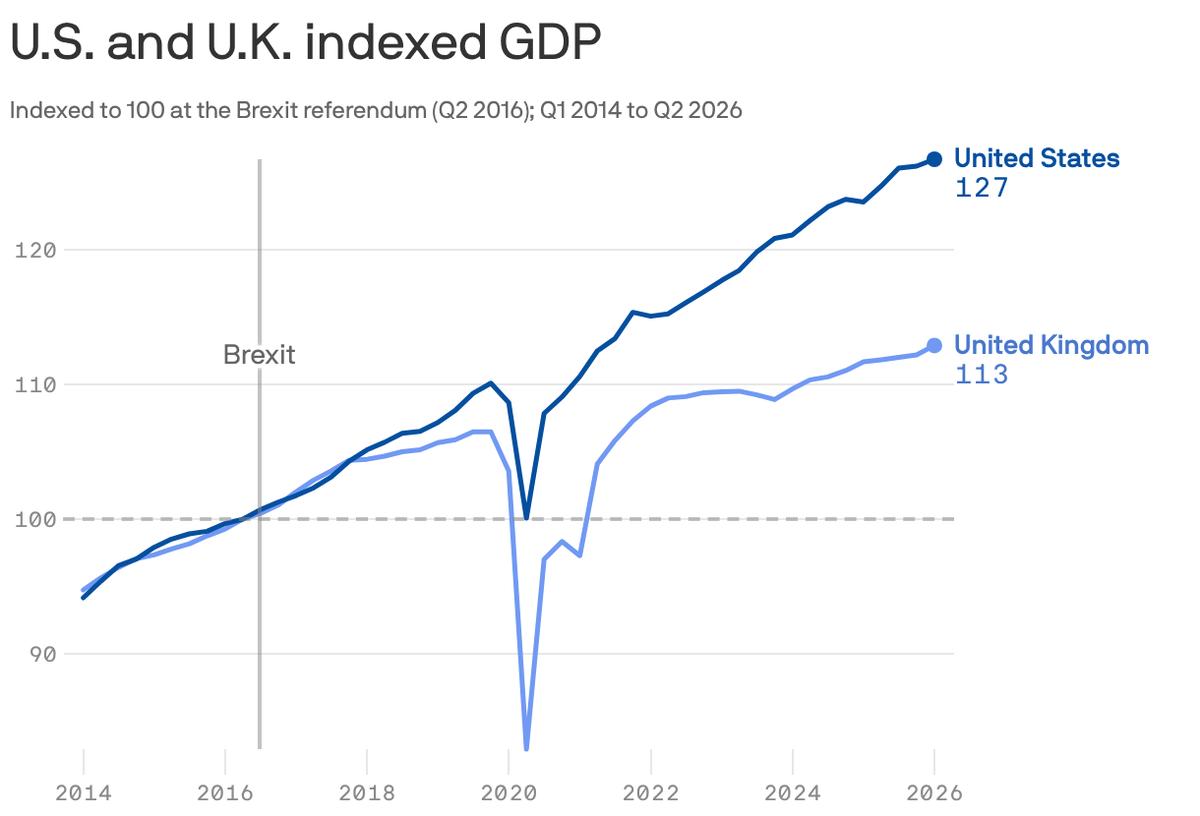
- •UK GDP grew 13% vs US 27% since 2016
- •Business investment down 12‑13% due to Brexit uncertainty
- •Employment and productivity each 4% lower than counterfactual
- •Firms most integrated with EU markets hit hardest
Pulse Analysis
Britain’s post‑Brexit trajectory offers a rare, real‑world case study of how a major economy fares when it voluntarily erects trade barriers and curtails labor mobility. The decade‑long data set, anchored by FactSet’s GDP index, shows the UK lagging far behind the United States, whose output index rose to 127 while Britain’s stalled at 113. This divergence reflects not only the immediate shock of leaving the single market but also the lingering policy ambiguity that discouraged capital deployment and strained supply chains.
The most striking metric comes from a new joint paper by Stanford, the Bank of England and leading UK universities, which quantifies the aggregate loss: a 6‑8% reduction in GDP by the end of 2025, a 12‑13% shortfall in business investment, and a 4% dip in both employment and productivity relative to a no‑Brexit scenario. These figures illustrate how uncertainty can depress corporate confidence, prompting executives to postpone expansion projects and reallocate resources to manage new customs procedures. Compared with the United States, which enjoyed a near‑doubling of growth, the UK’s muted performance highlights the cost of fragmented markets and the importance of regulatory clarity for sustaining investment flows.
Looking ahead, the analysis suggests that the economic scar tissue of Brexit will persist unless policy reforms can restore trade fluidity and boost productivity. For policymakers in other jurisdictions contemplating protectionist moves, the British experience serves as a cautionary tale: short‑term political gains may translate into long‑term structural weakness. Moreover, the political landscape in Britain—characterized by a hyper‑sensitive electorate—means that any remedial measures must be swift and visible to regain public confidence and re‑ignite growth momentum.
10 years since Brexit, and the results are in
Comments
Want to join the conversation?
Loading comments...