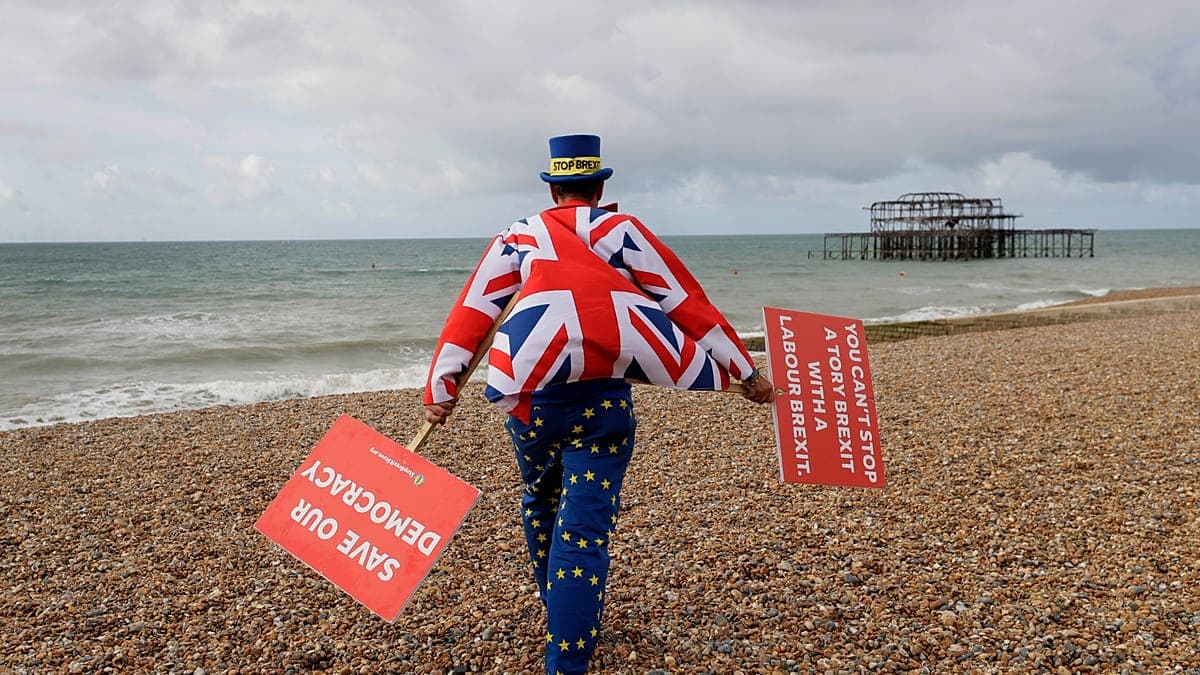
A Decade After Brexit, Britain Weighs Costs and Gains as It Searches for a New Leader
Companies Mentioned
Why It Matters
Understanding Brexit’s true cost informs policy choices and investor confidence, while the political instability underscores the urgency for stable leadership to capitalize on remaining economic opportunities.
Key Takeaways
- •Brexit cut UK‑EU goods trade by ~21%
- •GDP 2‑4% lower than without Brexit
- •Services offset losses; ICT exports to EU nearly doubled
- •Political instability: six prime ministers since 2016
- •EU cooperation could boost GDP 0.4‑0.8% over decade
Pulse Analysis
The ten‑year mark of Britain’s departure from the European Union has finally yielded rigorous, data‑driven assessments that move the debate beyond partisan rhetoric. Allianz Research and Deutsche Bank, using comparable‑economy models, converge on a modest but tangible output loss—roughly 2‑4% of GDP—while confirming that many dire predictions, such as a deep recession and soaring unemployment, never materialised. House prices rose, the labour market stayed tight, and the pound’s depreciation fed higher inflation, yet the overall macro picture shows a resilient economy that avoided the worst‑case scenarios forecast before the vote.
The deeper story lies in structural shifts. Trade with the EU fell by about one‑fifth, and business investment stalled, curbing productivity growth to near‑zero levels. Conversely, the UK leveraged its services advantage: financial‑services activity remains a global hub, handling roughly half of worldwide interest‑rate derivatives, and ICT exports to the continent have almost doubled. These gains illustrate how regulatory autonomy in high‑tech sectors like life sciences and artificial intelligence can partially offset the trade and investment deficits created by Brexit. Nonetheless, the reports warn that weak productivity, high energy costs, and chronic under‑investment are now entrenched challenges rather than temporary shocks.
Politically, the referendum’s legacy is evident in unprecedented turnover—six prime ministers in a decade—culminating in Keir Starmer’s resignation and the likely ascension of Andy Burnham. Such instability amplifies policy uncertainty, limiting the appetite for bold moves like re‑joining the EU. Yet both analysts highlight low‑hanging opportunities: tighter alignment on food standards, professional qualifications, and youth mobility could lift GDP by up to 0.8% over the next ten years. For businesses and investors, the key takeaway is that while Brexit’s economic scar is real, strategic engagement with the EU and focused domestic reforms can still deliver incremental growth in a post‑Brexit Britain.
A decade after Brexit, Britain weighs costs and gains as it searches for a new leader
Comments
Want to join the conversation?
Loading comments...