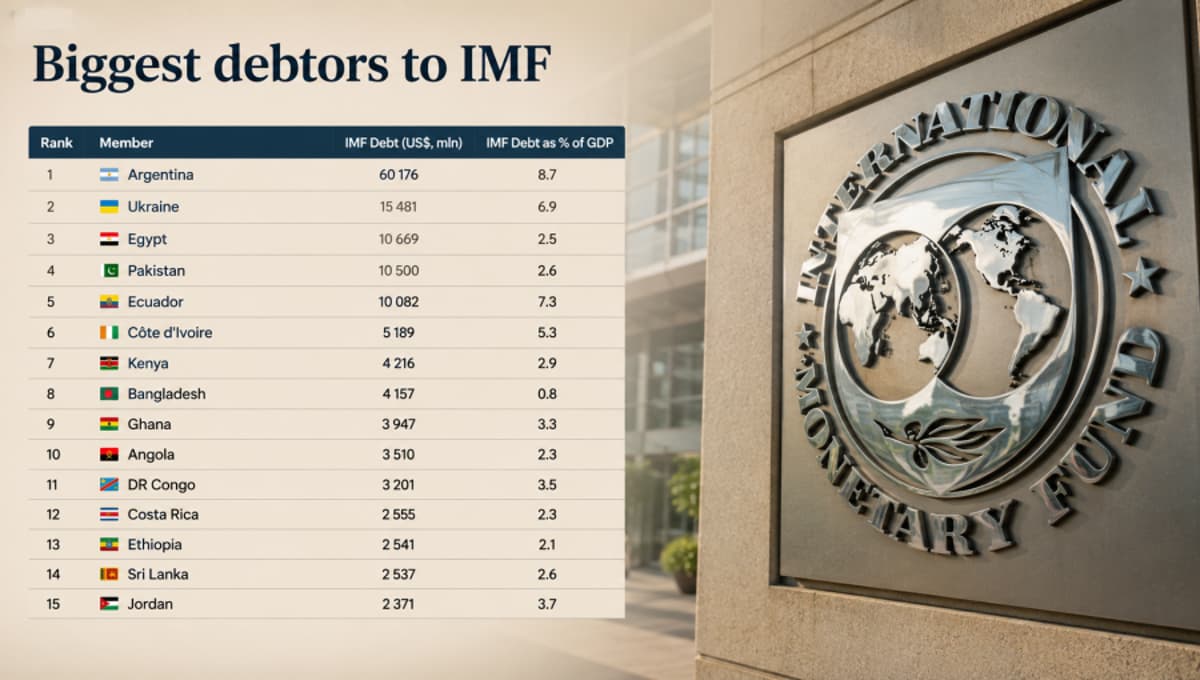
Argentina Is the IMF Biggest Debtor Followed by Ukraine
Why It Matters
The scale of IMF exposure signals persistent macro‑economic vulnerabilities and limits policy flexibility for these countries, while underscoring the Fund’s central role in global financial stability.
Key Takeaways
- •Argentina owes IMF $60.2 bn, 8.7% of GDP
- •Ukraine's IMF debt $15.5 bn, 6.9% of GDP
- •Egypt, Pakistan, Ecuador each carry ~ $10 bn IMF exposure
- •Sub‑Saharan nations like Kenya and Ghana owe $4‑5 bn
- •IMF reliance spans Asia, Latin America, Middle East, Africa
Pulse Analysis
Argentina’s $60.2 billion arrears to the International Monetary Fund represent the deepest sovereign exposure in the Fund’s history, equivalent to 8.7 % of the country’s GDP. The figure aggregates more than a decade of standby arrangements, extended fund facilities and a recent $44 bn program aimed at stabilising inflation and restoring fiscal credibility. Persistent fiscal deficits, a volatile peso and recurring balance‑of‑payments gaps have forced Buenos Aires to lean heavily on concessional financing, limiting its ability to pursue independent monetary policy and exposing it to conditionality that shapes budgetary priorities.
Ukraine’s $15.5 billion IMF balance, or 6.9 % of GDP, reflects the extraordinary financing needs of a nation at war. The funding underpins defense spending, reconstruction and the stabilization of a war‑torn economy, while also providing a safety valve for foreign‑exchange shortages. Beyond Ukraine, Egypt, Pakistan and Ecuador each sit near the $10 billion threshold, illustrating how IMF resources are spread across diverse crises—from conflict to pandemic recovery and commodity price shocks. Their debt‑to‑GDP ratios, ranging from 2.5 % to 7.3 %, reveal varying degrees of vulnerability.
The broader list of borrowers—Kenya, Bangladesh, Ghana, Côte d’Ivoire and Jordan—shows that IMF reliance is not confined to large economies. For many of these nations, $4‑5 billion in obligations represents a sizable share of fiscal space, often tied to structural reforms and social safety‑net adjustments. As global interest rates rise, the cost of servicing IMF loans could tighten budgets further, prompting governments to seek alternative financing or accelerate reform agendas. Monitoring this debt landscape offers investors and policymakers insight into where fiscal stress may translate into market volatility or policy shifts.
Argentina is the IMF biggest debtor followed by Ukraine
Comments
Want to join the conversation?
Loading comments...