China Retains Shipbuilding Crown in 2025
•February 4, 2026
0
Why It Matters
China’s dominance secures a steady revenue stream for its shipyards and reshapes global supply dynamics, pressuring rivals while supporting the nation’s green maritime agenda.
Key Takeaways
- •China produced 53.69 million dwt in 2025.
- •New orders fell 4.6% but still 69% global share.
- •Orders‑on‑hand grew 31.5% to 274.42 million dwt.
- •Six Chinese yards rank in global top ten.
- •Green, intelligent vessels drive high‑end transformation.
Pulse Analysis
China’s shipbuilding sector has entrenched its supremacy by filling orderbooks for the next three to four years and operating at full capacity. In 2025 the nation delivered 53.69 million deadweight tonnes (dwt), an 11.4 % year‑on‑year rise that captured 56.1 % of global output. Although new orders slipped 4.6 % to 107.82 million dwt, they still represented 69 % of worldwide demand, and the backlog swelled to 274.42 million dwt—a 31.5 % increase. These figures underscore a resilient domestic pipeline that shields Chinese yards from short‑term market volatility.
The scale advantage translates into tangible market power. Six Chinese shipyards now sit among the top ten globally across output, new orders, and order‑on‑hand metrics, squeezing competitors in Europe and South Korea. Moreover, China’s push toward green and intelligent vessels aligns with tightening environmental regulations, positioning its fleet for future charter premiums. The concentration of new orders in 16 of 18 ship categories further diversifies its product mix, reducing reliance on traditional bulk carriers and expanding into high‑value segments such as LNG carriers and offshore wind support ships.
Looking ahead, the industry’s outlook remains cautiously optimistic. Analysts expect stable growth as global trade rebounds and maritime decarbonisation accelerates, while China’s policy emphasis on high‑end transformation promises continued investment in automation and digital design. For investors, the sustained market share and expanding backlog suggest steady cash flows, yet exposure to geopolitical tensions and potential overcapacity warrants monitoring. Stakeholders should watch the evolution of Chinese state support, export financing, and the adoption of next‑generation vessel technologies that could reshape competitive dynamics worldwide.
China retains shipbuilding crown in 2025
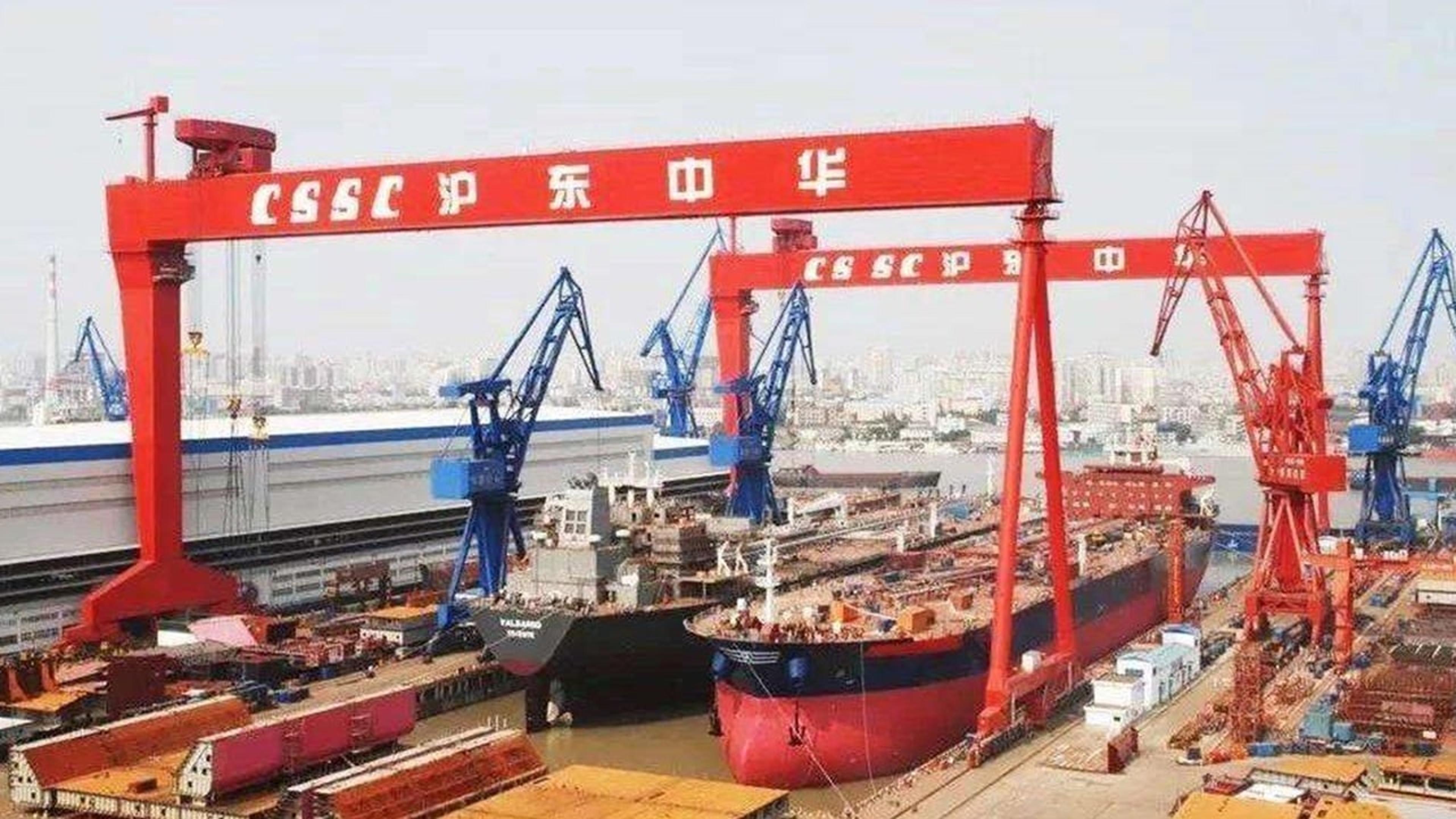
By Katherine Si, China Correspondent · February 4, 2026 · Image: Hudong Shipyard
The Chinese shipbuilding industry currently has its orderbooks filled for the next three to four years, operating at full production capacity.
According to data from the China Ministry of Industry and Information, China has maintained its position as the world’s first shipbuilding nation in terms of newly‑received orders, order‑book‑on‑hand, and completed tonnage for 2025.
From January to December 2025, China’s shipbuilding output reached 53.69 million dwt, an increase of 11.4 % year‑on‑year, accounting for 56.1 % of the global total.
New orders amounted to 107.82 million dwt, a decrease of 4.6 % year‑on‑year, making up 69.0 % of the world’s total. By the end of December, the orders‑on‑hand stood at 274.42 million dwt, a growth of 31.5 % year‑on‑year, representing 66.8 % of the global share.
All three major shipbuilding indicators have maintained the world’s leading position in international market share for 16 consecutive years.
“In 2025, China’s shipbuilding industry delivered remarkable results, with all three key performance indicators surpassing expectations. The market is projected to maintain relatively stable growth going forward. Therefore, it is essential for China’s shipbuilding sector to continue capitalising on market opportunities, securing orders proactively, and guaranteeing on‑time vessel deliveries.”
— Li Yanqing, vice‑president of the China Association of the National Shipbuilding Industry
China’s leading shipbuilding enterprises saw their global competitiveness continue to strengthen in 2025, with six domestic shipyards securing positions among the world’s top ten across three key metrics: shipbuilding output, new orders received, and orders‑on‑hand.
Among the 18 major ship types, China earned the largest share of new orders in 16 categories. A number of world‑class green and intelligent vessels were delivered as China pursues a high‑end transformation of the shipbuilding industry.
0
Comments
Want to join the conversation?
Loading comments...