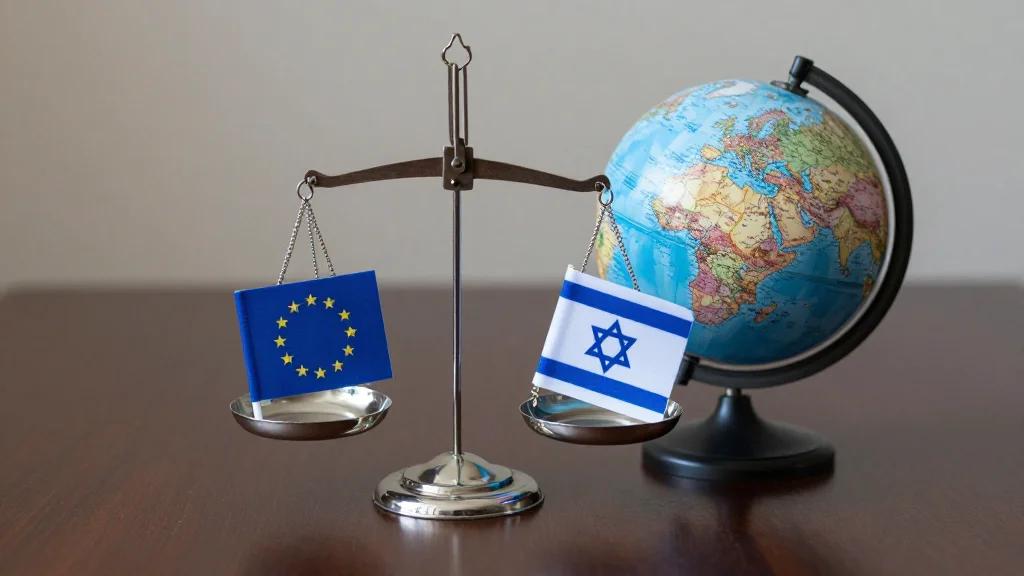
EU Foreign Ministers Divided on Sanctioning Israel
Why It Matters
The stalemate hampers the EU’s ability to leverage its $46 bn trade relationship with Israel to influence settlement policy, affecting credibility on human‑rights standards.
Key Takeaways
- •Spain, Ireland demand partial suspension over settlements and death‑penalty law
- •Commission proposal targets €5.8 bn ($6.3 bn) of Israeli export ties
- •Germany, Italy block consensus, citing dialogue and broader population impact
- •Full suspension requires unanimity; qualified majority not yet reached
- •EU‑Israel trade totals €42.6 bn ($46 bn) in 2024
Pulse Analysis
The Luxembourg gathering of EU foreign ministers highlighted a deepening rift over the bloc’s 2000 association agreement with Israel. While the European Commission has floated a limited suspension of trade‑related clauses—targeting roughly €5.8 bn ($6.3 bn) of Israeli exports—the proposal stalls short of the qualified‑majority needed to act. The agreement underpins a $46 bn (2024) trade flow, making any curtailment a significant economic lever. Yet the divergent stances of member states reflect competing priorities between human‑rights advocacy and preserving strategic commercial ties.
Spain and Ireland have taken a hard line, urging at least a partial suspension in response to West Bank settlement expansion, the humanitarian crisis in Gaza, and Israel’s recent death‑penalty legislation. Germany and Italy, however, argue that punitive measures would punish ordinary Israelis and undermine dialogue aimed at a two‑state solution. The procedural hurdle is steep: a full suspension demands unanimity, while a partial trade freeze requires the backing of 15 out of 27 members representing 65 % of the EU population. With Berlin and Rome holding the balance, the vote remains elusive.
The impasse carries weight beyond diplomatic posturing. EU businesses that rely on the seamless flow of goods—ranging from automotive components to high‑tech equipment—face uncertainty if sanctions materialize. Moreover, the EU’s credibility on enforcing international norms is at stake, especially as member states like Sweden and France push for stricter commercial disengagement from illegal settlements. Observers note that a change in Hungary’s government could unlock unanimous support for targeted sanctions on violent settlers, offering a narrower path to pressure Israel without dismantling the broader economic relationship.
EU foreign ministers divided on sanctioning Israel
Comments
Want to join the conversation?
Loading comments...