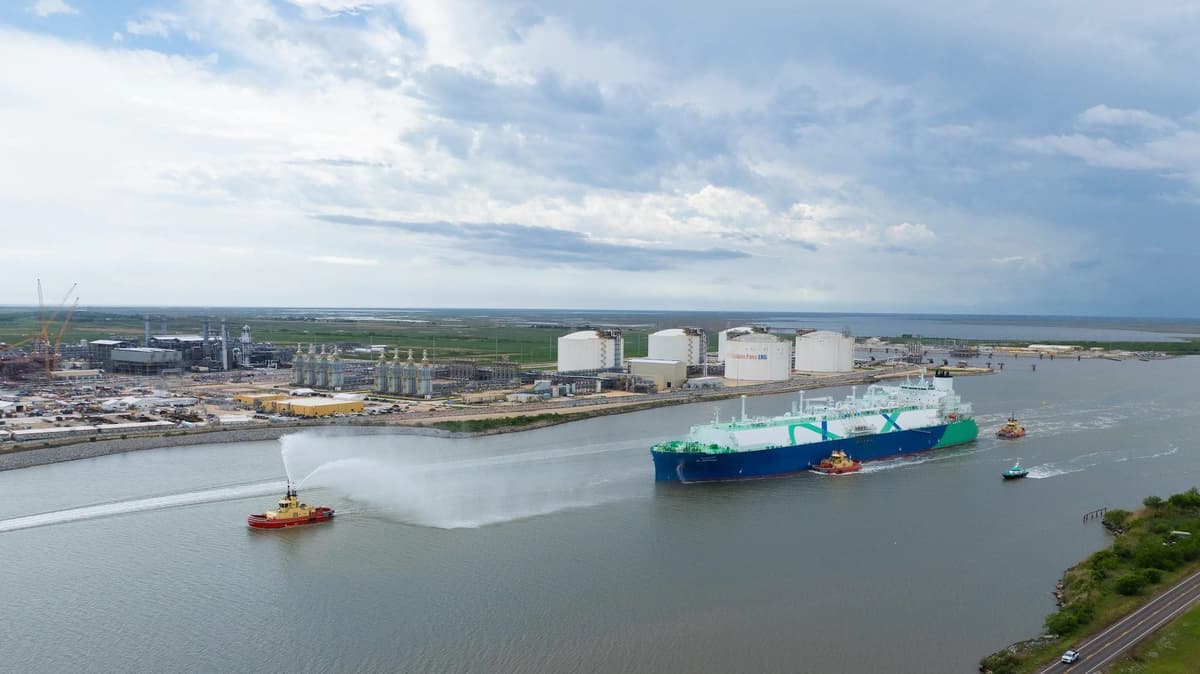
Golden Pass Ships First LNG Cargo, Launching Major New U.S. Export Supply
Why It Matters
The inaugural shipment expands global LNG supply, offering buyers an alternative to Middle‑East routes and strengthening the United States’ role as a swing supplier. It also gives QatarEnergy export capacity outside the Persian Gulf, mitigating geopolitical risk.
Key Takeaways
- •Golden Pass shipped inaugural LNG cargo from Sabine Pass, Texas.
- •Facility targets 18 mtpa, becoming one of North America’s largest exporters.
- •QatarEnergy gains export capacity outside Persian Gulf, reducing Hormuz risk.
- •Project’s $10 bn investment marks a milestone in U.S. LNG boom.
- •Additional trains will boost capacity, solidifying U.S. swing‑supplier role.
Pulse Analysis
The debut of Golden Pass LNG’s first cargo signals the culmination of a decade‑long effort to bring a $10 billion, three‑train complex online. While the project faced construction delays, its successful loading demonstrates that the Sabine Pass facility is now ready to feed the global market. With an anticipated 18 million tonnes per year, the terminal will rank alongside the world’s largest LNG exporters, reinforcing the United States’ rapid ascent in the liquefied natural gas arena.
Beyond sheer volume, Golden Pass introduces strategic route diversity that is increasingly valuable to importers. Unlike shipments from Qatar’s Ras Laffan, which must navigate the Strait of Hormuz—a chokepoint vulnerable to regional conflict—U.S. cargoes depart from the Gulf of Mexico, bypassing that risk entirely. This geographic advantage, combined with QatarEnergy’s stake, gives the venture a unique selling point for buyers hedging against supply disruptions, especially as Iranian attacks have highlighted the fragility of traditional Middle‑East pipelines.
Golden Pass joins a broader wave of U.S. export expansions, including upgrades at Corpus Christi and Plaquemines. As the nation cements its status as a swing supplier, analysts expect tighter global LNG pricing and greater negotiating power for U.S. producers. The phased activation of Trains 2 and 3 will further lift capacity, enabling the United States to meet growing demand in Europe and Asia while providing a reliable alternative to geopolitically exposed sources. This momentum is likely to accelerate investment in downstream infrastructure and lock in long‑term contracts that shape the next decade of energy trade.
Golden Pass Ships First LNG Cargo, Launching Major New U.S. Export Supply
Comments
Want to join the conversation?
Loading comments...