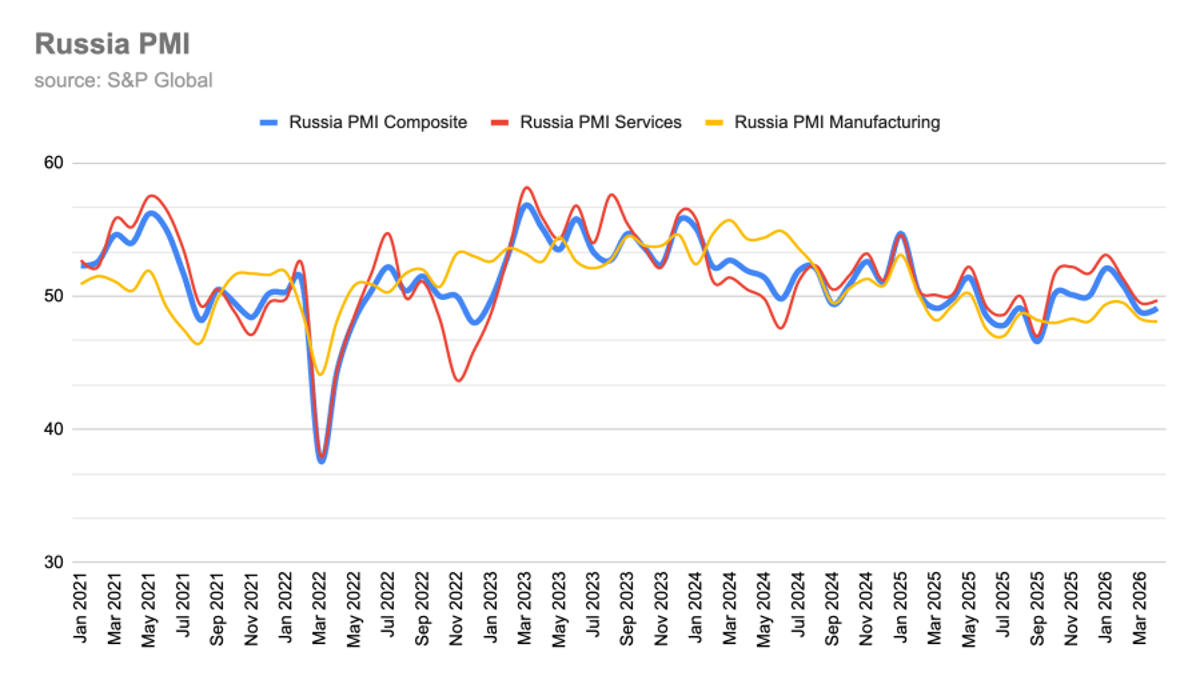
Russian Services and Manufacturing PMI Both Contract as Economy Struggles Under Weight of War
Why It Matters
The persistent contraction across services and manufacturing signals that Russia’s wartime economy remains structurally weak despite record oil earnings, raising concerns for fiscal stability and labor market health. Investors and policymakers must reckon with a lagging real‑sector recovery that could limit growth prospects.
Key Takeaways
- •Services PMI at 49.7, still in contraction
- •Manufacturing PMI fell to 48.1, 11th month down
- •Composite PMI improved to 49.1 but remains below 50
- •Oil revenues hit $19 bn in March, yet activity stalls
- •Unemployment at 2.1%, described as Russia’s worst labour crisis
Pulse Analysis
The latest PMI data paints a stark picture of Russia’s economy under the sustained strain of its war effort. While oil revenues surged to roughly $19 billion in March, the service sector’s PMI of 49.7 and the manufacturing PMI of 48.1 reveal that the windfall has yet to invigorate private‑sector demand. New orders have slipped in both sectors, and employment is being trimmed as firms curb costs, indicating that the fiscal boost is largely confined to the state budget rather than the broader economy.
Policy makers, led by Central Bank Governor Elvia Nabiullina, have pursued a controversial growth‑slowdown strategy to tame inflation, which has indeed softened to its lowest pace in 2026. However, this approach coincides with a deepening labour crisis; the official unemployment rate of 2.1% masks a widening gap between job availability and workforce needs. Input‑cost and output‑charge inflation have eased, yet they remain elevated, reflecting lingering price pressures that could erode consumer purchasing power if not managed carefully.
Looking ahead, the prolonged manufacturing contraction—now at an eleven‑month streak—suggests that any recovery will be incremental at best. Investors should monitor the trajectory of oil prices, as further windfalls could provide fiscal breathing room, but without structural reforms or a de‑escalation of geopolitical tensions, real‑sector growth may stay muted. Companies operating in Russia may need to adjust staffing and capital plans, while foreign firms will weigh the risk‑reward balance of continued exposure to a market where headline fiscal strength masks underlying weakness.
Russian services and manufacturing PMI both contract as economy struggles under weight of war
Comments
Want to join the conversation?
Loading comments...