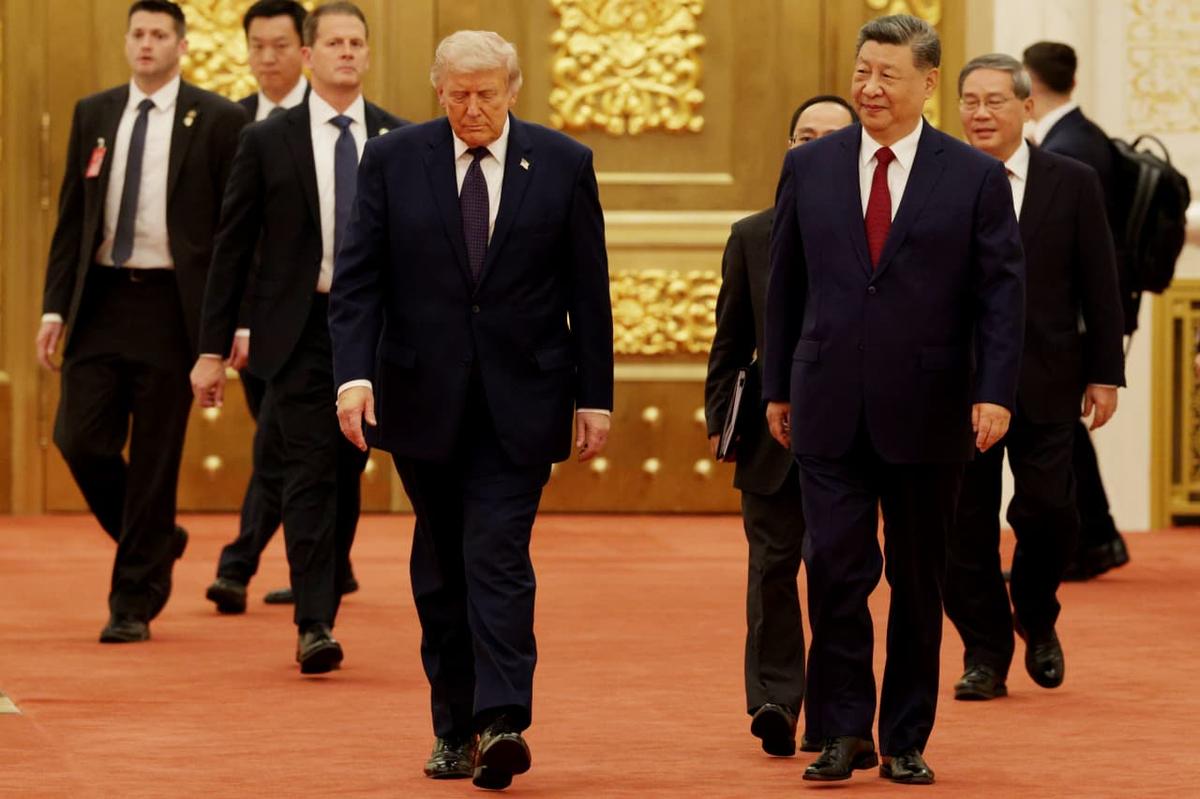
Trump’s Best China Trade Deal Is the One He Doesn’t Make
Companies Mentioned
Why It Matters
A hard‑no‑deal approach would cement the U.S. advantage in strategic industries and accelerate decoupling, reshaping the competitive balance with China. It signals to Beijing that American prosperity now depends on domestic resilience, not diplomatic bargaining.
Key Takeaways
- •Phase One deal delivered <60% of promised $200 billion purchases
- •Bilateral goods deficit fell 50% to $221 billion by 2025
- •Chinese exports to US dropped $109 billion after 2025 tariffs
- •Mexico now overtakes China as US’s top goods‑trading partner
- •US AI chips five times stronger than Huawei’s, gap to widen
Pulse Analysis
Decades of U.S. attempts to bind China through trade concessions have produced scant results, from Reagan’s optimism about market reforms to Clinton’s conditional MFN status that Beijing ignored. The 2020 Phase One pact, which promised $200 billion in additional American purchases, fell dramatically short—delivering less than 60% of its target. In contrast, the tariff regime introduced in 2025 has proven a blunt but effective tool, slashing China’s export volume to the United States by $109 billion and prompting a 50% reduction in the bilateral goods deficit. These figures underscore that coercive trade measures, rather than diplomatic overtures, are reshaping the economic relationship.
The data also reveal a broader restructuring of supply chains. As tariffs made Chinese goods less competitive, roughly 61% of the lost export value rerouted to third‑country markets, while Mexico eclipsed China as America’s largest goods‑trading partner. Concurrently, U.S. manufacturing investment has surged—construction spending in the sector has tripled since 2021, fueled by the CHIPS Act, the Inflation Reduction Act’s 45X credit, and strategic Section 301 investigations in shipbuilding and semiconductors. This domestic resurgence is not merely a reaction to Beijing’s policies; it reflects a deliberate pivot toward reshoring critical technologies, from AI chips that already outpace Huawei’s by a factor of five to emerging rare‑earth production.
For the Trump administration, the path forward lies in cementing this momentum. Completing pending Section 301 probes, reversing the recent licensing of Nvidia’s H200 chips, and establishing strategic stockpiles of rare‑earth minerals would lock the U.S. market against further Chinese intrusion. By prioritizing home‑grown manufacturing and technology leadership, the United States can convert tariff‑induced discipline into lasting competitive advantage, signaling to Beijing that America’s growth engine now runs on domestic, not diplomatic, fuel.
Trump’s best China trade deal is the one he doesn’t make
Comments
Want to join the conversation?
Loading comments...