US "Reciprocal" Trade Deals Are Designed to Constrain China to Varying Degrees
Why It Matters
ARTs create a legal framework that limits China’s economic reach by reshaping how U.S. partners source and export goods, influencing global supply‑chain dynamics and investment flows. Companies must adapt to new compliance requirements that could affect market access and cost structures.
Key Takeaways
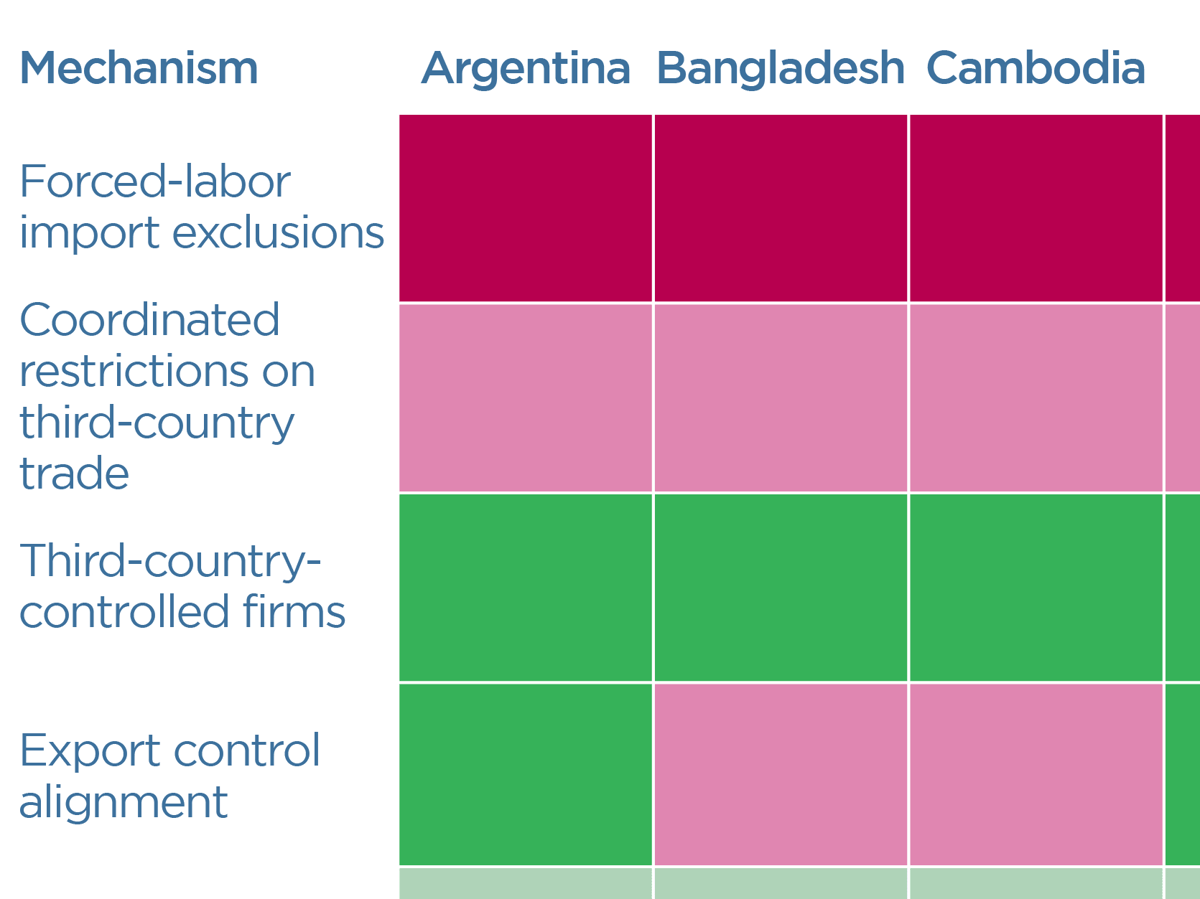
- •Nine countries signed ARTs, each with seven control mechanisms.
- •Taiwan's ART includes the toughest export‑control alignment requirements.
- •Indonesia, Cambodia, Malaysia must enforce rules of origin to curb transshipment.
- •Argentina and El Salvador ARTs lack penalty clauses for non‑compliance.
- •Commitment depth varies, shaping partner reliance away from China.
Pulse Analysis
The United States’ Agreements on Reciprocal Trade represent a coordinated effort to embed strategic safeguards into bilateral commerce. By attaching seven levers—forced‑labor exclusions, third‑country trade restrictions, control over foreign‑owned firms, export‑control alignment, investment security, rules of origin, and penalty clauses—the administration seeks to ensure that partner nations prioritize U.S. market access while limiting China’s foothold in critical supply chains. The nine signatories, spanning Latin America, Southeast Asia and East Asia, illustrate a broad geographic sweep aimed at diversifying sources of goods and technology.
While the ARTs stop short of naming China, their language targets “third countries” and “countries of concern,” effectively channeling trade away from Chinese entities. Export‑control alignment, especially stringent in Taiwan’s pact, forces partners to synchronize black‑list lists and licensing regimes with Washington, curbing the flow of dual‑use technologies to Beijing. Rules‑of‑origin enforcement in Indonesia, Cambodia and Malaysia tackles transshipment routes that have historically rerouted Chinese components through third‑party ports to evade tariffs. Together, these mechanisms tighten the regulatory perimeter around U.S. imports, compelling firms to reassess sourcing strategies and compliance costs.
The depth of each agreement varies, creating a tiered landscape of obligations. Nations like Argentina and El Salvador enjoy more lenient terms, lacking penalty clauses that could trigger trade sanctions for non‑compliance. Conversely, Taiwan’s extensive commitments signal a high‑trust partnership but also raise the bar for exporters. For multinational corporations, the ART framework signals a shift toward greater geopolitical risk management in supply‑chain planning. Monitoring the evolution of these deals—and any future expansions—will be essential for businesses seeking to navigate the increasingly politicized terrain of global trade.
US "reciprocal" trade deals are designed to constrain China to varying degrees
Comments
Want to join the conversation?
Loading comments...