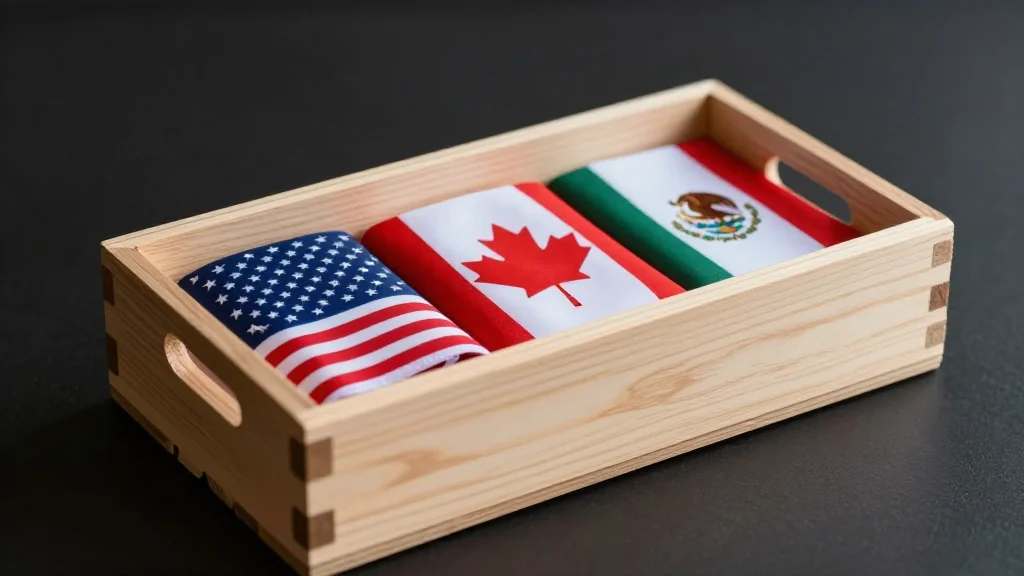
"We Don't Need Anything that Canada Has," Trump Says of CUSMA
Why It Matters
CUSMA’s renewal or restructuring will affect supply‑chain costs, sectoral competitiveness, and the broader US‑Canada economic relationship, influencing billions in trade flows.
Key Takeaways
- •CUSMA protects ~90% of Canadian exports from US tariffs
- •Deal expires 2036; renewal options: 16‑year extension or annual reviews
- •US farm groups deem CUSMA critical for soybean and grain markets
- •Canada seeks relief from US tariffs on steel, aluminum, autos, lumber
Pulse Analysis
The Canada‑U.S‑Mexico Agreement, known as CUSMA, has become the backbone of North American trade, covering roughly $1.6 trillion in annual exchanges. By insulating about 90 percent of Canadian shipments from US duties, it sustains a balanced flow where Canada exported $127 billion to the United States in 2026 while importing $114 billion, leaving a modest $13 billion trade deficit. These figures underscore the pact’s role in stabilizing key sectors such as energy, where 95 percent of Canadian oil reaches U.S. refineries, and in maintaining a competitive environment for manufacturers on both sides of the border.
Trump’s recent comments, dismissing the need for Canadian or Mexican products, are widely viewed as a negotiating lever rather than a concrete policy shift. The administration’s preferred path—annual reviews instead of a 16‑year renewal—creates uncertainty for industries that rely on predictable tariff regimes. Canada’s negotiating team is pressing for relief on long‑standing grievances, notably US tariffs on steel, aluminum, automobiles and softwood lumber, while US farm lobbies argue that CUSMA is essential for soybean and grain markets. The upcoming bilateral talks in Washington and Mexico City will test whether the parties can reconcile these divergent priorities without triggering the six‑month exit clause.
The outcome will reverberate beyond bilateral trade balances. A shift to annual reviews could introduce more frequent renegotiations, potentially raising compliance costs and prompting firms to diversify supply chains. Conversely, a 16‑year extension would preserve the status quo, offering stability for investors and reinforcing North America’s position as a cohesive economic bloc amid rising competition from China and Europe. Stakeholders across energy, agriculture, and manufacturing are closely monitoring the negotiations, aware that even modest tariff adjustments can translate into billions of dollars in revenue or cost savings.
"We don't need anything that Canada has," Trump says of CUSMA
Comments
Want to join the conversation?
Loading comments...