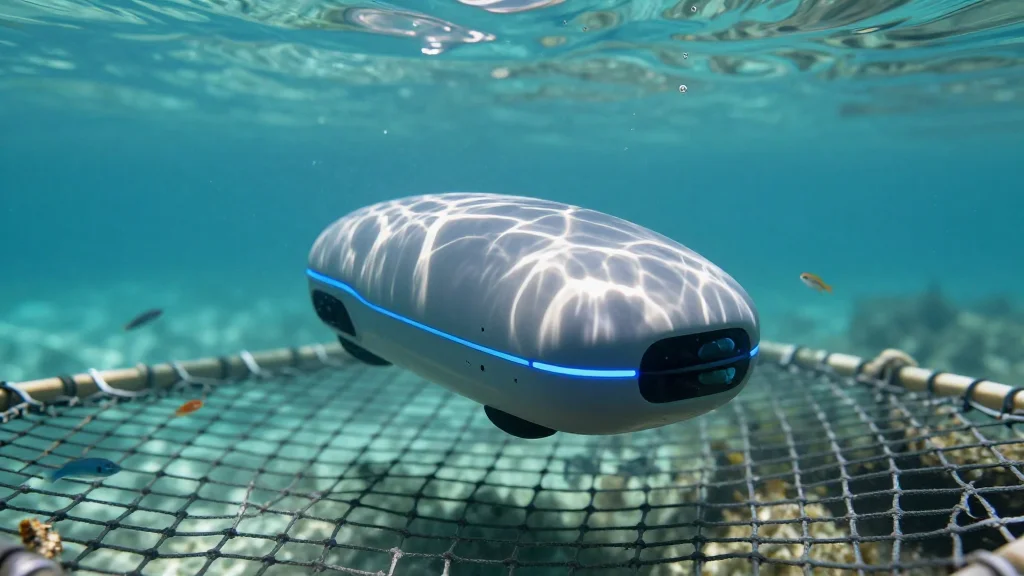
China's Underwater Robot Challenge Wins $14 Million in Orders

Why It Matters
The deployment of autonomous underwater robots addresses a critical bottleneck in China’s marine ranching industry: the high cost and safety risks of human divers. By automating anchor retrieval, net cleaning and shellfish harvesting, the technology promises to boost productivity, reduce operational losses and improve ecological stewardship. On a broader scale, the competition demonstrates how government‑sponsored challenges can fast‑track commercialization of emerging technologies, creating a replicable model for other public‑sector domains such as infrastructure inspection, disaster response and environmental monitoring. If the pilot deployments meet performance expectations, the ripple effect could be substantial. A more efficient marine ranching sector would increase domestic seafood supply, lower market prices and reduce reliance on imports, aligning with China’s food‑security goals. Moreover, the success of this GovTech initiative could encourage other ministries to adopt similar challenge‑based procurement strategies, accelerating the adoption of AI‑driven solutions across the public sphere.
Key Takeaways
- •16 teams competed in real‑sea trials off Zhuhai
- •Over 100 million yuan ($14 million) in preliminary contracts signed
- •150‑million‑yuan (≈$21 million) opportunity list released for marine‑ranch needs
- •China’s underwater‑robotics market projected to hit 40 billion yuan ($5.6 billion) by 2027
- •Typhoon Ragasa caused >700 lost anchors, ≈1 million yuan ($145 k) in damages
Pulse Analysis
The Zhuhai robot challenge illustrates a strategic shift in China’s GovTech playbook: rather than funding isolated research labs, the state is orchestrating market‑pull mechanisms that align academic innovation with immediate industry demand. By bundling a sizable opportunity list with guaranteed procurement pathways, Beijing reduces the classic ‘valley of death’ that often stalls deep‑tech commercialization. This approach mirrors successful models in the U.S. defense sector, where challenge prizes have spurred rapid advances in autonomous systems.
Historically, China’s marine‑resource management has relied on labor‑intensive practices, limiting scalability and exposing operations to weather‑related disruptions. The integration of AI‑enhanced robotics promises to transform this paradigm, delivering data‑rich insights that can feed into broader ocean‑governance frameworks, such as real‑time biodiversity monitoring and climate‑impact assessments. The projected quadrupling of market size by 2027 suggests that the technology will soon move beyond niche ranches into national fisheries, coastal infrastructure and even offshore energy.
Looking ahead, the key risk lies in the transition from prototype to sustained field operation. Early adopters must demonstrate that the robots can withstand the South China Sea’s harsh conditions over multi‑year cycles while delivering cost savings that justify the upfront investment. If they succeed, the model could be exported to other maritime nations, positioning China not only as a hardware supplier but also as a standard‑setter for autonomous marine governance. The next six months will be a litmus test for whether this GovTech initiative can deliver on its promise of a smarter, more resilient ocean economy.
China's Underwater Robot Challenge Wins $14 Million in Orders
Comments
Want to join the conversation?
Loading comments...