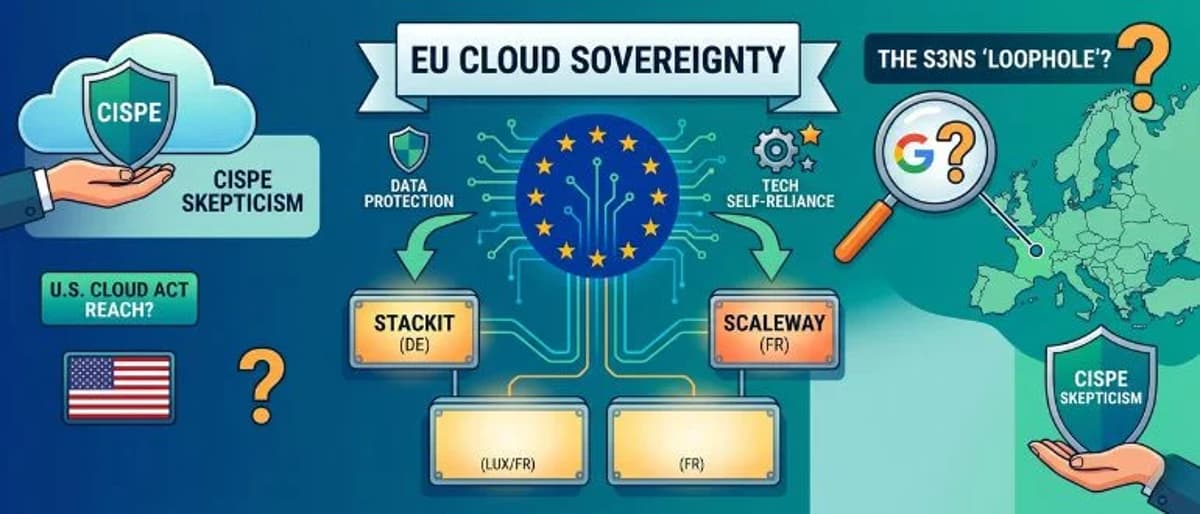
European Commission Awards New Sovereign Cloud Contracts To ‘Mostly’ EU Clouds
Companies Mentioned
Why It Matters
The contracts create a sizable funding stream for European cloud providers, strengthening EU data sovereignty while testing the limits of U.S. legal reach. Success or failure will shape future market competition and the regulatory framework for cross‑border cloud services.
Key Takeaways
- •EU awards €180M in sovereign cloud contracts over six years
- •Contracts go to STACKIT, Scaleway, OVHcloud/POST/CleverCloud, Proximus/S3NS
- •S3NS combines Thales ownership with Google Cloud infrastructure
- •Critics warn framework may favor incumbents over agile local providers
- •CLOUD Act could still expose EU data to US authorities
Pulse Analysis
The European Commission is intensifying its cloud‑sovereignty agenda by signing four multi‑year contracts worth roughly €180 million ($210 million). The deals, spanning six years, aim to keep sensitive public‑sector data within the bloc and reduce reliance on non‑European hyperscalers. By earmarking funds for locally controlled services, the Commission signals a strategic shift toward digital autonomy, echoing broader EU policies that seek to safeguard data from foreign legal reach while fostering a home‑grown cloud ecosystem. The initiative also aligns with the EU’s Digital Services Act, reinforcing regulatory cohesion across member states.
The awarded contracts go to Germany’s STACKIT, France’s Scaleway, a Franco‑Luxembourg consortium led by OVHcloud, POST and CleverCloud, and a Belgian‑French‑Luxembourg alliance anchored by Proximus that will use S3NS – a joint venture between Thales and Google Cloud. S3NS exploits a “localisation loophole” that lets Google’s infrastructure operate under a French‑controlled entity, raising questions about the applicability of the U.S. CLOUD Act. While Thales asserts full European control, critics argue the framework still favours incumbents and may not guarantee true data isolation. The partnership illustrates how European firms can leverage global tech while retaining legal ownership, a model likely to be scrutinized in future tenders.
From a market perspective, the €180 million spend creates a sizable runway for European providers to scale secure, compliant services, potentially accelerating competition with Amazon, Microsoft and Google. Regulators will watch how the contracts balance sovereignty goals with the technical advantages of partnering with a U.S. hyperscaler. If the EU can demonstrate that data remains under European jurisdiction, the model could become a template for other regions seeking digital self‑reliance. Moreover, the contracts include provisions for regular audits and transparency reports, giving public agencies clearer visibility into data handling practices. However, lingering legal ambiguities around cross‑border data requests may keep enterprises cautious when selecting sovereign‑cloud options.
European Commission Awards New Sovereign Cloud Contracts To ‘Mostly’ EU Clouds
Comments
Want to join the conversation?
Loading comments...