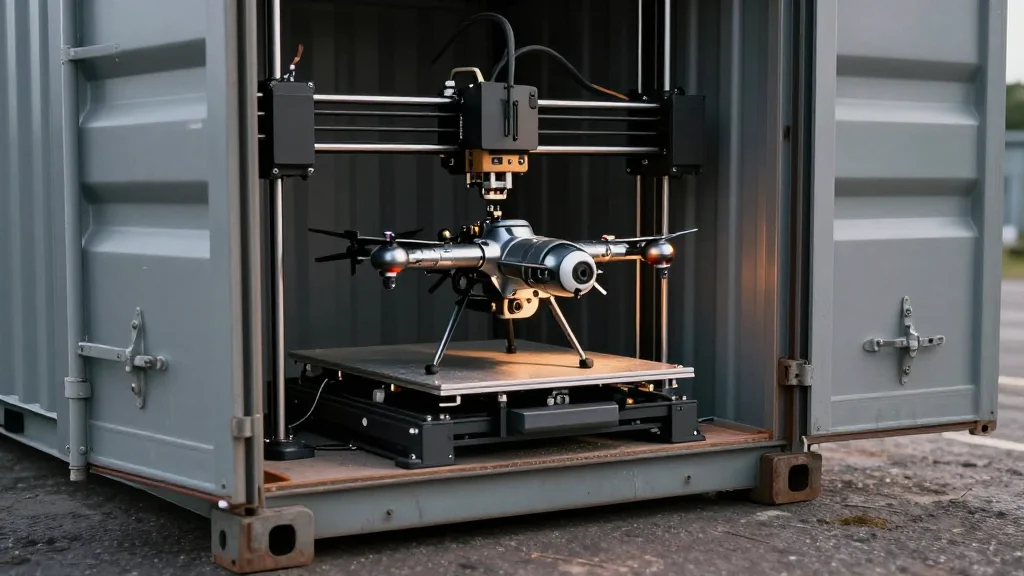
Firestorm Labs Secures $82 Million to Deploy Containerized Drone Factories

Companies Mentioned

FIRESTORM LABS, INC.
Washington Harbour
HP
HPQ

In‑Q‑Tel
Lockheed Martin
LMT
Motley Fool Ventures
Ondas Holdings
ONDS
Geodesic
Booz Allen Hamilton
BAH
NEA
Why It Matters
Containerized drone factories could fundamentally alter how the U.S. government procures and fields autonomous systems. By compressing the design‑to‑deployment timeline to under 24 hours, Firestorm’s xCell platform promises to keep pace with the rapid iteration cycles seen in modern warfare, where adversaries can field new UAV variants within days. This agility reduces reliance on distant, vulnerable supply chains and may lower overall acquisition costs by shifting spend from large, upfront production runs to on‑demand manufacturing. The technology also raises policy questions about oversight, export controls, and the integration of 3‑D‑printed components into lethal platforms. If successful, the model could be replicated across other critical domains—such as electronic warfare kits or sensor suites—expanding the government’s ability to field cutting‑edge capabilities at the point of need, while challenging traditional defense industrial base structures.
Key Takeaways
- •Firestorm Labs raised $82 million in Series B funding, total capital now $153 million.
- •xCell platform can 3‑D print a complete combat drone in under 24 hours inside a shipping container.
- •Pentagon Air Force contract has a $100 million ceiling; $27 million already obligated.
- •Two xCell units are active in the U.S.; additional units deployed in the Indo‑Pacific region.
- •Goal: full operational deployment in the Indo‑Pacific within two years.
Pulse Analysis
Firestorm Labs is betting on a logistics‑first paradigm shift that could redefine defense acquisition. Historically, the U.S. military has relied on a tiered industrial base, with large, fixed factories feeding a steady stream of equipment to forward units. That model, while efficient in peacetime, proved brittle in high‑intensity conflicts where supply lines are contested. By colocating production with the user, Firestorm not only shortens lead times but also creates a feedback loop where battlefield operators can request design tweaks in near real‑time, a capability that mirrors commercial rapid‑prototype ecosystems.
The infusion of venture capital and strategic investors like In‑Q‑Tel signals a convergence of commercial tech financing with national security priorities. This hybrid funding model may accelerate innovation but also introduces market pressures that could clash with the slower, compliance‑heavy procurement cycles of the Department of Defense. If Firestorm can demonstrate reliable, repeatable performance under combat conditions, it could unlock a new class of “manufacturing‑as‑a‑service” contracts, prompting the DoD to rethink its acquisition frameworks to accommodate modular, subscription‑style agreements.
However, the approach is not without risk. Scaling containerized factories requires robust supply chains for raw materials, stringent quality‑assurance processes, and clear regulatory pathways for 3‑D‑printed airframe components. Moreover, the integration of lethal capabilities into a mobile, potentially proliferable platform raises export‑control and ethical concerns that policymakers will need to address. The next two years will be a litmus test: success could usher in a wave of forward‑deployed manufacturing across the defense sector, while setbacks may reaffirm the resilience of the traditional, centralized industrial base.
Firestorm Labs Secures $82 Million to Deploy Containerized Drone Factories
Comments
Want to join the conversation?
Loading comments...