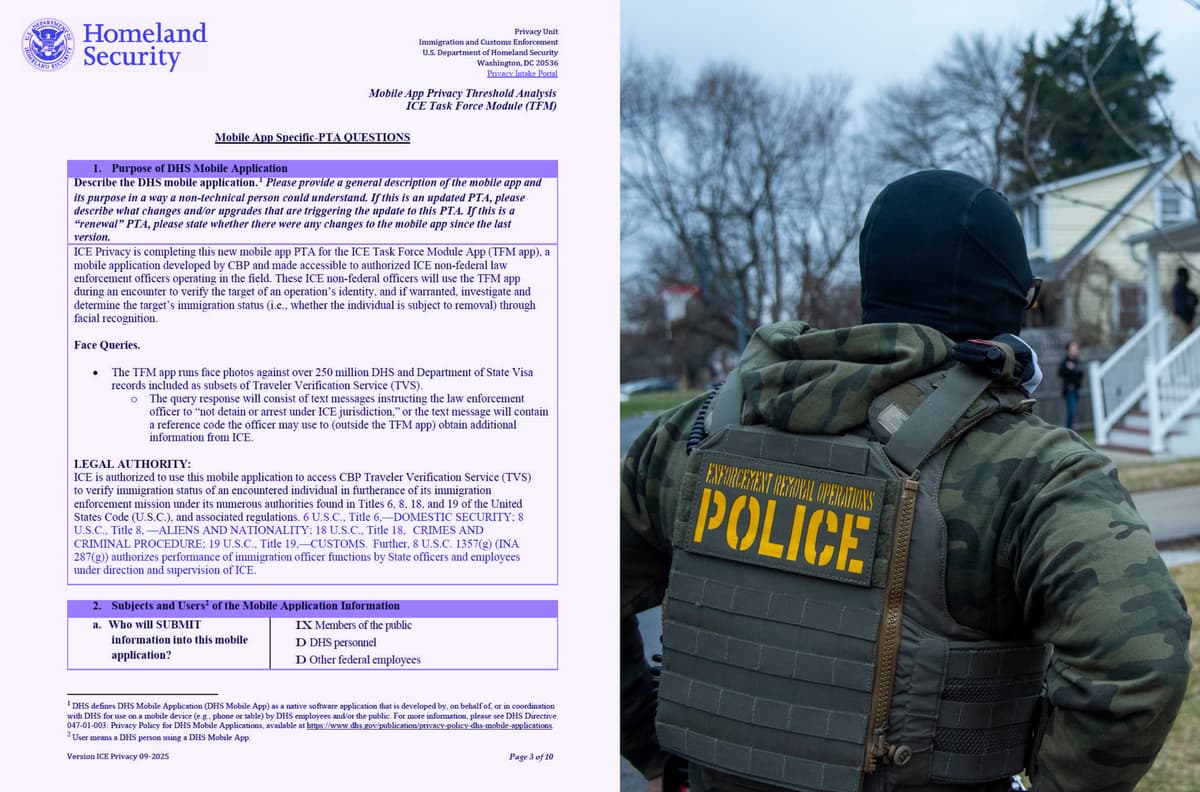
ICE’s Plan to Let Cops Around the Country Scan Faces to Verify Immigration Status
Companies Mentioned
Why It Matters
By placing federal immigration‑enforcement technology in the hands of local police, the app could expand deportations, erode community trust, and raise significant privacy and civil‑rights challenges.
Key Takeaways
- •ICE plans to give 1,000+ local police a facial‑recognition app.
- •App queries >250 million DHS and State Department images to check immigration status.
- •Technology extends 287(g) program, effectively turning local officers into ICE agents.
- •Prior ICE apps misidentified individuals and scanned U.S. citizens, raising civil‑rights concerns.
- •Six Democratic lawmakers introduced a bill to block the app’s rollout.
Pulse Analysis
The federal government’s push to embed facial‑recognition tools in local policing marks a new phase in immigration enforcement. ICE’s existing Mobile Fortify platform, already deployed on streets and used more than 200,000 times, demonstrated both the operational reach and the technology’s flaws—false matches and scans of U.S. citizens. The upcoming Task Force Module app amplifies this capability by tapping a massive repository of 250 million biometric records, promising near‑instant status checks but also magnifying the risk of erroneous detentions.
Legal scholars warn that the app leverages the 287(g) partnership, which contracts local agencies to act as ICE extensions, blurring the line between federal immigration duties and community policing. Civil‑rights advocates argue that the technology’s inaccuracy, combined with its 15‑year data retention policy, threatens constitutional protections and could chill lawful activity in immigrant neighborhoods. Past incidents—misidentifications that led to wrongful arrests—underscore the potential for widespread civil‑liberties violations when untrained officers wield such surveillance tools.
Congressional response has been swift: six Democratic lawmakers have introduced legislation to prohibit the app’s distribution to local forces, reflecting growing bipartisan unease over unchecked biometric surveillance. The debate highlights broader questions about the governance of AI‑driven law‑enforcement tools, data privacy, and the balance between national security and individual rights. As the September 2025 launch date approaches, stakeholders from tech watchdogs to state attorneys general will likely intensify scrutiny, shaping the future of facial‑recognition use in America’s immigration landscape.
ICE’s Plan to Let Cops Around the Country Scan Faces to Verify Immigration Status
Comments
Want to join the conversation?
Loading comments...