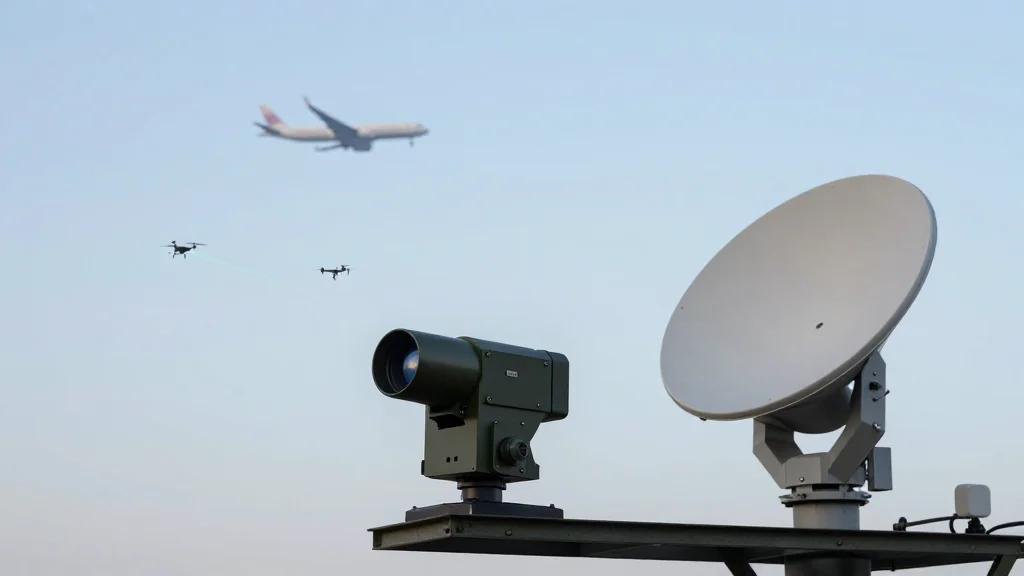
Pentagon, FAA Validate Laser Counter‑Drone System in First Safe Trial

Why It Matters
The Pentagon‑FAA validation signals a turning point for domestic counter‑drone strategy, shifting the balance from kinetic interceptors to directed‑energy solutions that mitigate debris hazards and reduce civilian risk. By confirming safety for passenger aircraft, the government can now deploy the technology at high‑traffic airports and critical infrastructure sites without disrupting commercial operations. Beyond immediate security benefits, the endorsement could accelerate commercial adoption of laser‑based drone mitigation, prompting private airports, stadiums and energy facilities to consider similar systems. The move also positions the United States as a leader in low‑cost, high‑precision directed‑energy defense, potentially influencing allied procurement decisions and shaping global standards for civilian airspace protection.
Key Takeaways
- •Pentagon and FAA completed safety assessment on April 10, confirming no added risk to passenger aircraft.
- •Assistant Secretary of War Mike Dodd called the system a "game‑changer" for national security.
- •General Matt Ross highlighted the test as a major advancement for homeland defense.
- •LOCUST laser achieved 100 % success in a live‑fire exercise on USS George H.W. Washington in Oct 2025.
- •Five pilot installations announced for 2026, spanning Army, Navy and Air Force bases.
Pulse Analysis
The validation of AV’s LOCUST laser marks the first time a directed‑energy counter‑drone system has cleared the FAA’s stringent safety criteria, effectively bridging the gap between military research labs and civilian airspace regulators. Historically, the U.S. has relied on kinetic solutions—nets, projectiles, and radio‑frequency jammers—that carry inherent risks of debris and unintended interference with commercial flights. By demonstrating a low‑risk, high‑precision alternative, the Pentagon and FAA are setting a new operational baseline that could reshape procurement priorities across the defense and transportation sectors.
From a market perspective, the endorsement unlocks a sizable revenue pipeline for AV and its supply chain. The system’s modular design and vehicle‑mountable form factor make it attractive to state and local agencies that lack the budget for larger laser platforms. Moreover, the integration with existing C2 architectures reduces implementation friction, allowing rapid rollout at the five pilot sites and potentially beyond. Competitors in the directed‑energy space will now need to match not only performance metrics but also regulatory compliance, raising the bar for future entrants.
Looking ahead, the key challenge will be scaling the technology while maintaining safety margins. As the laser network expands, coordination with the FAA’s NextGen air‑traffic management system will be essential to prevent inadvertent illumination of civilian aircraft. Internationally, allies may seek similar approvals, prompting a wave of policy harmonization. If the U.S. can successfully navigate these technical and regulatory hurdles, the LOCUST system could become the de‑facto standard for point‑defense against rogue drones, reshaping the security architecture of both the public and private sectors.
Pentagon, FAA Validate Laser Counter‑Drone System in First Safe Trial
Comments
Want to join the conversation?
Loading comments...