Red Hat Digital Sovereignty Take: Red Hat Confirmed Sovereign Support
Companies Mentioned

Red Hat
SUSE
SUSE
Why It Matters
RHCSS gives EU customers a legally compliant, locally controlled support model, reducing regulatory risk and enhancing trust in open‑source cloud solutions. It positions Red Hat as a key player in the emerging digital‑sovereignty market, challenging rivals like SUSE.
Key Takeaways
- •RHCSS offers EU‑only support with data staying in‑region.
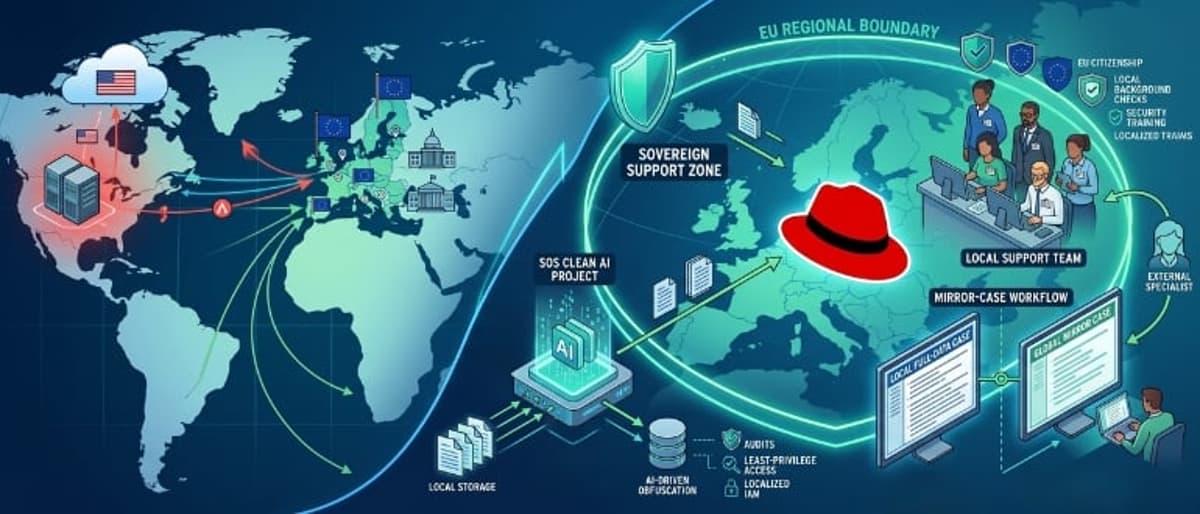
- •Support workflow isolates diagnostics, preventing cross‑border data leakage.
- •AI‑driven SOS Clean scrubs logs before any external escalation.
- •Engineers must be locally vetted and legally authorized in each jurisdiction.
- •Red Hat’s model competes with EU‑focused rivals like SUSE.
Pulse Analysis
The push for digital sovereignty has accelerated as European regulators tighten data‑localization rules and geopolitical tensions raise concerns about U.S. cloud providers. Enterprises now demand that their IT stacks—not just data—remain under domestic jurisdiction, a trend amplified by AI‑driven workloads that process sensitive information. Red Hat’s response, the Confirmed Sovereign Support service, directly addresses these pressures by guaranteeing that all support interactions, from diagnostics to telemetry, occur within the customer’s chosen region, initially the EU, thereby aligning with GDPR and upcoming EU AI regulations.
RHCSS operationalizes Red Hat’s three‑pillar sovereignty framework: technology control, localized support, and physical location. Under the hood, case diagnostics are routed to isolated regional boundaries, while global ticket metadata is protected by strict role‑based access controls. The standout feature is the SOS Clean AI project, which automatically scrubs logs using region‑hosted AI models, ensuring no personally identifiable or location‑specific data leaves the jurisdiction. Senior engineers, vetted and authorized to work locally, handle cases, and a mirror‑case workflow allows global expertise to be consulted without exposing raw data. This blend of technical safeguards and human controls creates a transparent, auditable support experience.
For the market, RHCSS signals Red Hat’s commitment to competing in the sovereign‑cloud niche against pure‑EU players like SUSE. While the service mitigates many compliance concerns, the lingering reach of the U.S. CLOUD Act means some customers may still prefer wholly European providers. Nonetheless, Red Hat’s open‑source foundation and hybrid‑cloud portfolio give it a unique advantage, potentially attracting multinational firms that need both global reach and regional compliance. As more governments codify data‑localization mandates, services like RHCSS could become a baseline offering rather than a differentiator, reshaping how enterprise support is delivered worldwide.
Red Hat Digital Sovereignty Take: Red Hat Confirmed Sovereign Support
Comments
Want to join the conversation?
Loading comments...