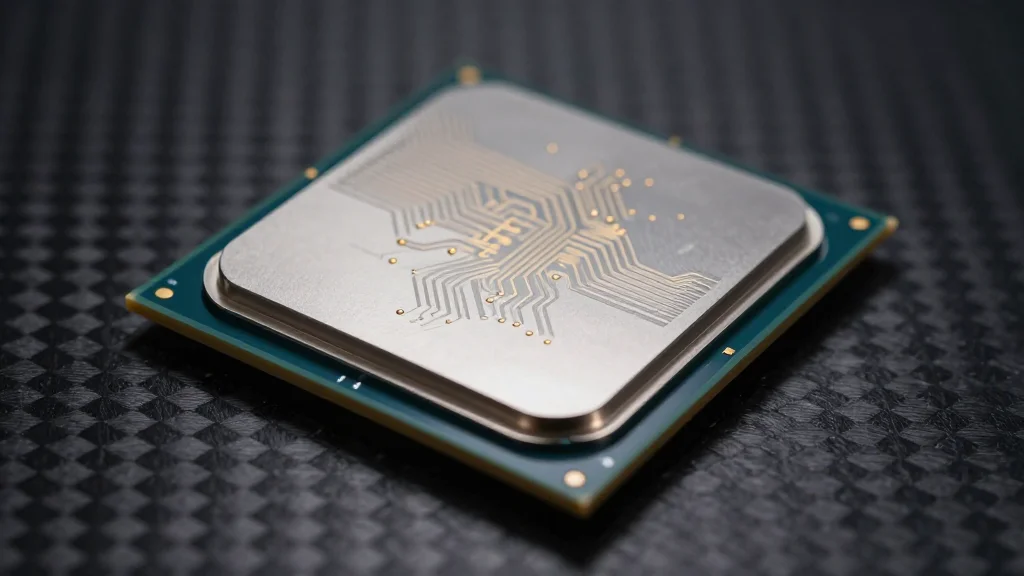
Nvidia Launches Vera CPU to Power AI‑agent Workloads, Marking a Push Into General‑purpose Processors

Companies Mentioned


Why It Matters
Vera represents Nvidia’s strategic bet that AI agents will become the largest consumers of compute resources, a view echoed by industry leaders who predict a transition from human‑centric to agent‑centric computing. By delivering a processor that tightly integrates GPU acceleration with CPU control logic, Nvidia aims to reduce latency and improve utilization in data‑center clusters, potentially lowering total cost of ownership for hyperscalers. If Vera gains traction, it could erode the market share of Intel and AMD in the high‑performance server segment, forcing those incumbents to accelerate their own AI‑focused CPU roadmaps. The move also deepens Nvidia’s reliance on advanced packaging and memory technologies, reinforcing the importance of Taiwan’s semiconductor ecosystem and Korean memory suppliers in the global AI supply chain.
Key Takeaways
- •Vera CPU entered full production and is already deployed by Anthropic, OpenAI, xAI, Dell, Oracle and CoreWeave.
- •Nvidia claims Vera delivers twice the efficiency and 50% faster throughput than traditional rack‑scale CPUs.
- •Jensen Huang labeled Nvidia an "infrastructure company" and announced a $150 billion annual investment in Taiwan.
- •Order pipeline for Blackwell and Vera Rubin processors exceeds $1 trillion for 2026‑27.
- •Nvidia fiscal‑2026 revenue hit $215.9 billion with net income of $120.1 billion, funding its CPU expansion.
Pulse Analysis
Nvidia’s Vera CPU is more than a product launch; it is a strategic pivot that could redefine the economics of AI workloads. By embedding a high‑performance Arm‑based core alongside its Blackwell GPU, Nvidia eliminates the classic “CPU‑GPU bottleneck” that has limited agentic AI efficiency. This integration mirrors the industry’s broader move toward heterogeneous compute, where the line between general‑purpose and accelerator blurs. For hyperscalers, the promise of higher utilization translates directly into lower power and capital expenditures, a compelling value proposition amid rising energy costs.
The competitive response will be critical. Intel’s upcoming Sapphire Rapids‑based Xeon processors and AMD’s EPYC Genoa line are both being re‑engineered for AI, but they lack Nvidia’s tightly coupled software stack—CUDA, NIM micro‑services and the broader ecosystem that locks in developers. Nvidia’s advantage lies in its ability to sell a complete solution: silicon, interconnect (NVLink), and software. However, this also raises antitrust and supply‑chain concerns, especially given Nvidia’s heavy reliance on Taiwan’s TSMC and Korean HBM suppliers. Any disruption in those regions could delay Vera’s ramp‑up and give rivals a window to capture market share.
Looking ahead, Vera’s success will hinge on adoption beyond the early‑adopter cohort of AI labs. If enterprise customers begin to replace legacy CPUs in mixed‑workload servers, Nvidia could capture a sizable slice of the $200 billion server CPU market. Conversely, if performance gains do not materialize at scale, or if AMD’s open‑source initiatives win developer favor, Nvidia may find its CPU ambitions constrained to niche AI workloads. The next six months—marked by Vera’s mass‑production rollout and the launch of RTX Spark laptops—will be the litmus test for Nvidia’s vision of an agent‑centric computing era.
Nvidia launches Vera CPU to power AI‑agent workloads, marking a push into general‑purpose processors
Comments
Want to join the conversation?
Loading comments...