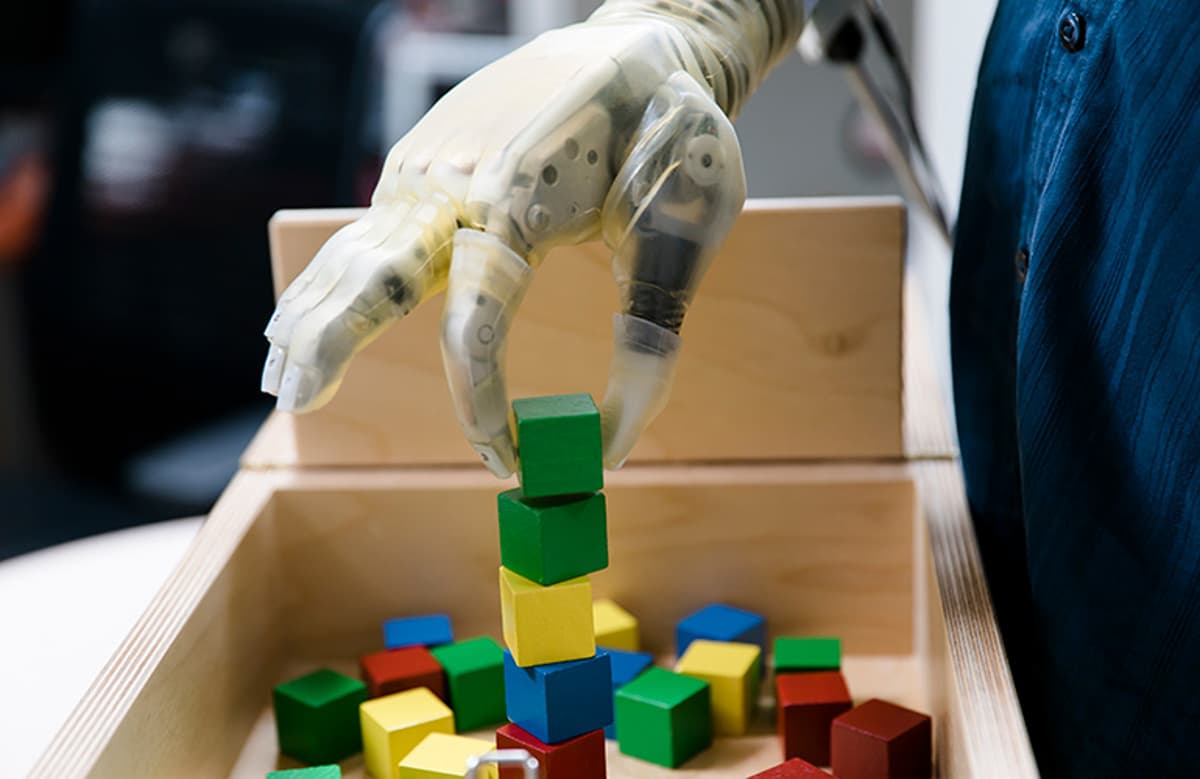
Blue Arbor Technologies Raises $5M Series A Investment From Ottobock
•February 28, 2026
•Feb 28, 2026
0
Why It Matters
The breakthrough offers truly intuitive, volitional prosthetic control, potentially redefining patient independence and setting a new performance benchmark for the limb‑loss market.
Key Takeaways
- •First‑in‑human RESTORE ESU implanted in Vienna, Dec 2025
- •$5 million Series A investment led by Ottobock
- •Implanted electrodes amplify nerve signals for prosthetic control
- •External Sensing Unit enables simultaneous finger and wrist movements
- •Early feasibility trials show stable signal capture over five years
Pulse Analysis
Prosthetic technology has long wrestled with the gap between human intent and machine response. Traditional myoelectric devices rely on surface electrodes that capture noisy signals, limiting dexterity and requiring extensive user training. Neuromuscular interface research aims to bridge this divide by tapping directly into peripheral nerves, offering higher fidelity and faster response times. Recent advances in bio‑electronics, wireless data transmission, and machine‑learning algorithms have set the stage for a new generation of devices that can interpret nuanced motor commands in real time.
Blue Arbor’s RESTORE system capitalizes on these trends by implanting fine‑wire electrodes into muscle grafts attached to residual nerves, then routing amplified signals to a compact, wearable External Sensing Unit. The ESU processes multiple channels simultaneously, allowing users to execute independent finger and wrist motions without the cumbersome calibration typical of older systems. Clinical observations from the Vienna trial show that patients can translate intent into movement within hours, a speed that could dramatically shorten rehabilitation timelines and improve quality of life for amputees.
The $5 million infusion from Ottobock signals strong industry confidence and provides a strategic pathway to market. Ottobock’s global distribution network and regulatory expertise can accelerate product certification across Europe and North America, while the partnership promises joint development of a fully implantable Internal Sensing Unit. If Blue Arbor scales its technology successfully, it could shift the competitive landscape, prompting incumbents to invest in comparable neuromuscular solutions and driving broader adoption of bio‑integrated prosthetics across the healthcare ecosystem.
Deal Summary
Blue Arbor Technologies announced the first‑in‑human implant of its RESTORE External Sensing Unit and secured a $5 million investment from German prosthetics company Ottobock, the lead investor in its Series A round. The funding will support further development and clinical validation of the neuromuscular interface technology. The implant was performed at the Medical University of Vienna in December 2025.
0
Comments
Want to join the conversation?
Loading comments...