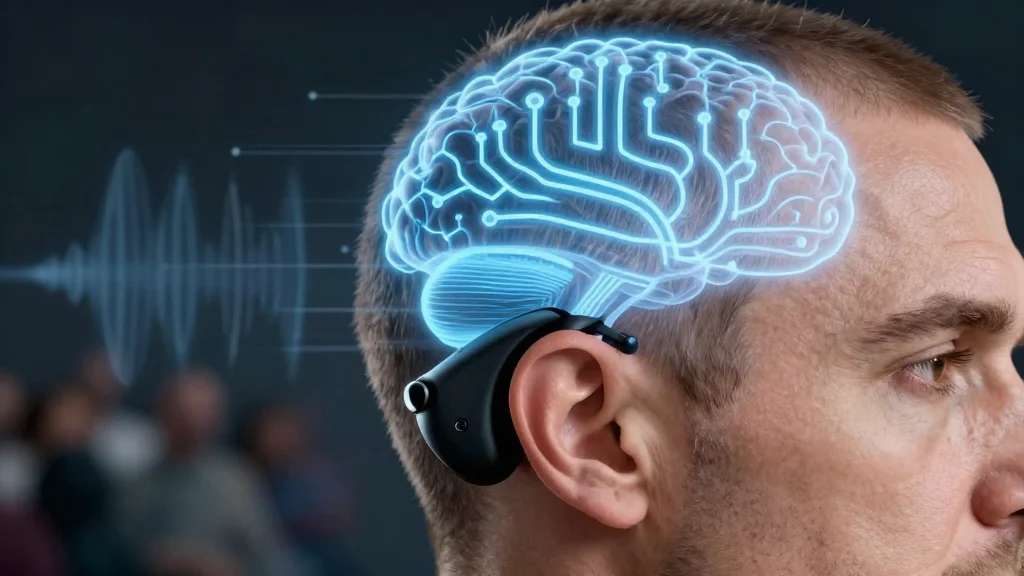
Columbia Team Demonstrates Brain‑Controlled Hearing System That Isolates Speech in Crowds

Why It Matters
Selective hearing is a long‑standing blind spot for assistive listening technology. By tapping directly into the brain’s attention signals, the Columbia system promises to reduce the mental load that users of conventional hearing aids endure in noisy environments. If scaled, it could improve communication outcomes for millions of people with hearing impairment, lower healthcare costs associated with social isolation, and open a new frontier for brain‑computer interfaces in consumer health. Beyond hearing aids, the underlying decoding algorithms could be repurposed for other neuro‑prosthetic applications, such as speech‑to‑text devices for the deaf or attention‑guided audio for virtual reality. The research therefore sits at the intersection of neuroscience, signal processing, and consumer health‑tech, highlighting the growing relevance of invasive and non‑invasive neural data streams in everyday devices.
Key Takeaways
- •Columbia researchers demonstrated a brain‑controlled hearing system that isolates a target voice in real‑time.
- •The prototype was tested on 12 epilepsy patients with implanted electrodes.
- •Published in *Nature Neuroscience*, the study shows millisecond‑scale tracking of auditory attention.
- •Current hearing‑aid market is roughly $8 billion; neural‑guided devices could capture a sizable share.
- •Next step: non‑invasive pilot trials and industry partnerships slated for late 2026.
Pulse Analysis
The Columbia breakthrough arrives at a moment when the hearing‑aid industry is grappling with stagnating growth and user dissatisfaction. Traditional devices have incrementally improved microphone arrays and noise‑reduction algorithms, but they still rely on the wearer’s cognitive effort to separate speech. By outsourcing that filtering to the brain itself, the new system flips the paradigm: the device becomes a passive conduit, amplifying what the user already intends to hear. This could dramatically lower abandonment rates, a chronic problem that has plagued the sector for decades.
Historically, brain‑computer interfaces have been confined to motor restoration or communication for locked‑in patients. Extending BCI to sensory augmentation signals a maturation of the field, moving from niche clinical tools toward mainstream consumer health. The key challenge will be translating invasive electrode performance to a non‑invasive platform without sacrificing latency or accuracy. Companies that can solve that engineering puzzle will likely command premium pricing and secure regulatory pathways faster than incumbents stuck with legacy hardware.
From a market‑structure perspective, the technology could catalyze a wave of M&A activity. Large hearing‑aid manufacturers—such as Sonova, William Demant, and GN Store Nord—have already invested in AI‑driven sound processing. Adding a neural layer would give them a defensible moat against emerging startups focused on purely algorithmic solutions. Conversely, neuro‑tech firms may seek acquisition by these giants to accelerate commercialization. Investors should watch for seed‑stage funding rounds targeting non‑invasive neural decoding, as they may signal the next wave of health‑tech disruption.
Columbia Team Demonstrates Brain‑Controlled Hearing System That Isolates Speech in Crowds
Comments
Want to join the conversation?
Loading comments...