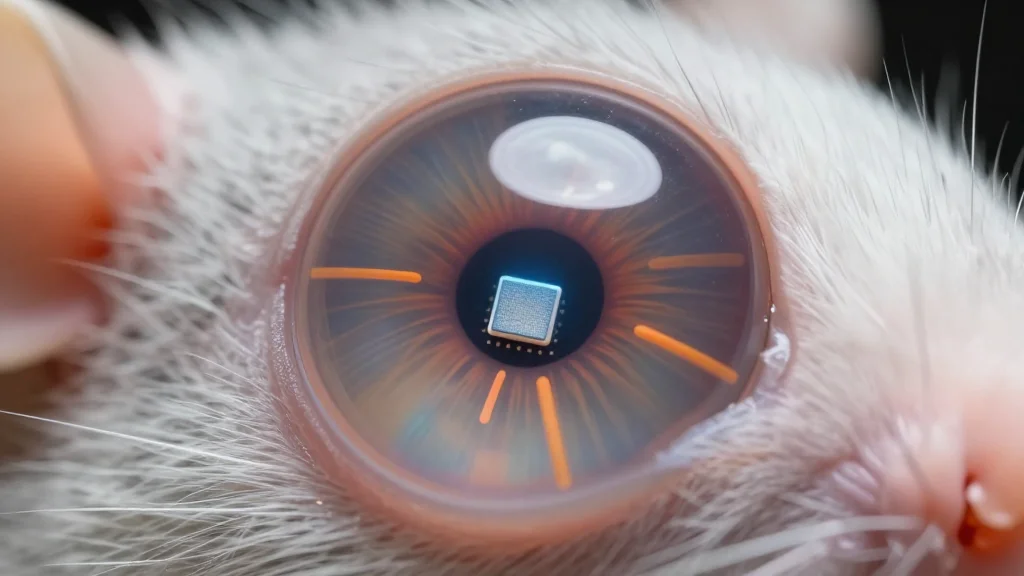
Residual Photoreceptors Affect the Response of a Degenerate Retina to Electrical Stimulation
Why It Matters
Understanding photoreceptor‑mediated interference is critical for designing high‑resolution retinal prostheses that deliver uniform, high‑quality vision to AMD patients.
Key Takeaways
- •Dark‑adapted photoreceptors near implant can be directly stimulated
- •Light‑adapted photoreceptors lower bipolar cell thresholds within ~100 µm
- •Bipolar‑pixel arrays with local returns confine electric fields better
- •Monopolar designs risk non‑uniform percepts due to residual activation
- •Implant placement a few hundred µm from scotoma edge reduces artifacts
Pulse Analysis
Retinal prostheses have emerged as a promising solution for patients blinded by age‑related macular degeneration, yet achieving high visual acuity remains constrained by pixel size and electric‑field spread. Smaller pixels demand broader fields to reach target bipolar cells, but this can inadvertently engage surviving photoreceptors at the lesion margin, creating mixed natural‑prosthetic percepts. The new PNAS research clarifies how both dark‑ and light‑adapted residual photoreceptors interact with subretinal photovoltaic arrays, providing a mechanistic foundation for the next generation of implants.
Using monopolar and bipolar photovoltaic arrays in rats with localized photoreceptor loss, the investigators recorded visually evoked potentials under scotopic and photopic conditions and applied neurotransmitter blockers to isolate pathways. They identified two distinct mechanisms: direct activation of dark‑adapted rods by the negative potential of the common return electrode, and a threshold‑lowering effect of light‑adapted cells on nearby bipolar neurons. Computational modeling confirmed that bipolar‑pixel configurations with local returns generate more confined fields, reducing the likelihood of unintended photoreceptor stimulation. These findings explain why monopolar designs often produce non‑uniform prosthetic vision in patients with residual retinal islands.
For clinicians and device engineers, the study’s design principles are actionable. Prioritizing bipolar‑pixel arrays and positioning implants several hundred micrometers beyond the scotoma edge can mitigate perceptual artifacts while preserving the high‑resolution benefits of smaller pixels. Moreover, the work underscores the need for patient‑specific mapping of residual photoreceptor distribution before surgery. As retinal prosthesis technology advances toward commercial deployment, integrating these insights will be essential for delivering consistent, high‑fidelity visual experiences to the growing AMD population.
Residual photoreceptors affect the response of a degenerate retina to electrical stimulation
Comments
Want to join the conversation?
Loading comments...