
Review: Box Facilitates Secure Collaboration for Healthcare Workers
•February 11, 2026
0
Why It Matters
Box gives regulated health organizations a secure, interoperable hub that cuts content‑handling time and cost while meeting compliance mandates, accelerating digital transformation in the sector.
Key Takeaways
- •Zero‑trust encryption protects data at rest and in transit.
- •Over 1,500 integrations unify disparate healthcare IT ecosystems.
- •Admins master advanced features within days; users need one session.
- •Built‑in e‑signature and automation accelerate approval workflows.
- •Supports SaaS and appliance deployments for flexible implementation.
Pulse Analysis
Healthcare providers face mounting pressure to digitize records while safeguarding patient data under stringent regulations such as HIPAA. Traditional file‑sharing tools often require multiple platforms, creating silos and increasing compliance risk. Box Intelligent Content Management addresses this gap by offering a cloud‑native repository that encrypts data both at rest and in motion, applying a zero‑trust model that grants access only when needed. The platform’s metadata controls and audit trails simplify policy enforcement, making it easier for compliance teams to demonstrate adherence during audits.
Beyond security, Box’s extensive ecosystem of more than 1,500 integrations bridges the divide between legacy systems and modern productivity suites. In real‑world testing, teams using Microsoft Office 365 and Google Workspace collaborated effortlessly through Box, sharing and editing files without leaving their preferred environments. Administrators reported that mastering advanced workflow automation and e‑signature capabilities required only a few days of training, while end‑users became productive after a single onboarding session. This ease of adoption reduces IT overhead and accelerates the rollout of standardized content processes across disparate clinical departments.
The business impact is tangible: automated routing and electronic signatures shave days off approval cycles, translating into faster patient‑care initiatives and lower operational expenses. By offering both SaaS and appliance deployment models, Box accommodates varied IT strategies, from fully cloud‑first hospitals to those retaining on‑premise controls. As the healthcare sector continues its digital transformation, platforms that combine robust security, seamless integration, and workflow efficiency—like Box—are poised to become foundational components of modern health‑system infrastructure.
Review: Box Facilitates Secure Collaboration for Healthcare Workers
Feb 11 2026
Carlos Soto – award‑winning reviewer and journalist with 20 years of experience covering technology and business.
A content management program in healthcare needs to be fully secure, protecting data at rest and in transit, with varying security levels for content being held and managed by the platform. Ideally, data should be standardized so that multiple platforms are not required, and users should be trained on a single content management platform, regardless of which department they work in.
The cloud‑based Box Intelligent Content Management platform was created to meet the needs of even the most rigorously regulated and protected environments. I recently tested Box in a lab environment, and right from the start, I saw the platform’s value for streamlining, automating and enabling collaboration on a variety of content‑creation projects.
Advanced Functions for Healthcare Workflows
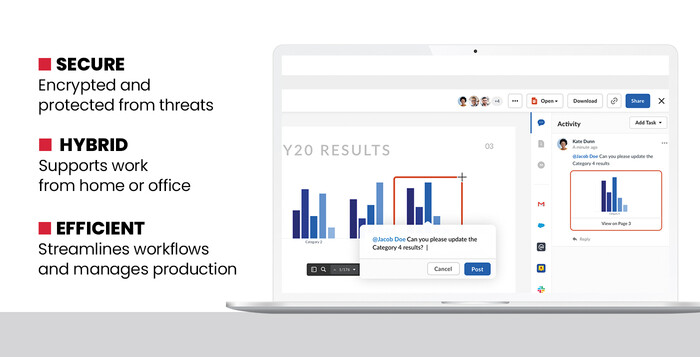
At its heart, Box is a cloud‑based file‑sharing platform that enables organizations to store, access and collaborate on just about any kind of document or file type, regardless of a user’s physical location. It supports many functions, such as secure file storage, real‑time collaboration (with full integration to most other collaboration programs a health system might use), productivity tools, workflow automation and even agentic artificial intelligence.
None of those functions are difficult for administrators or users to learn. Administrators can learn the most advanced features with a few days of training. Users probably need just a single session to learn how to work within their part of the platform.
Almost all content‑related tasks a user might perform for their daily work can be accomplished within the Box interface. This includes managing content, hosting collaborative meetings, adding electronic signatures to documents, and web publishing. Box also fully integrates with over 1,500 platforms, which means content made outside Box can be accessed, protected and edited within the platform.
A Zero‑Trust Solution for Healthcare
Security is paramount in healthcare, and Box provides that with a zero‑trust environment that ensures users are given access only to what they need for their work, and only for the time they need it. All data is encrypted and secured, both in storage and during collaboration sessions. For the most part, this security is hidden from regular users. I never felt that the security features were hindering me from using the platform, and it should fit in easily with other security frameworks.
For my testing, I simulated three small workgroups set up in different locations. I was pleasantly surprised to see how easily Box was able to tie all those groups together. For example, even though one group used Microsoft Office 365 and another standardized on Google Workspace, they were easily able to read, edit and share content with one another natively using Box. All changes made by the groups could be saved, shared and synced using Box.
I was able to set up workflows that automatically sent content from one group to another for collaboration or approval. Box’s fully functional e‑signature module made for a streamlined approval process that should speed up content delivery at organizations where everything requires permissions before deployment.
Regardless of how complex a provider’s IT environment or workflows are, Box can enable seamless collaboration and workforce automation. It can streamline the often‑laborious content‑creation process, save time and money, and deploy content more quickly than ever.
Specifications
-
Software Type: Cloud‑based content management platform
-
Deployment: Through Software as a Service or an appliance
-
Features: Collaboration, file‑sharing, storage, automation, e‑signatures, metadata management
-
Integrated Services: 1,500 integrations, including ServiceNow, Salesforce, Google Cloud, Microsoft Azure and AWS
-
License: 50 users, annual recurring or perpetual
0
Comments
Want to join the conversation?
Loading comments...