Hedge Funds Videos
Hedge Funds Videos
Hedge Funds Pulse
EMAIL DIGESTS
Daily
Every morning
Weekly
Tuesday recap
EMAIL DIGESTS
Daily
Every morning
Weekly
Tuesday recap

John Ciampaglia explains why gold is being sold even as prices climb, emphasizing that the current wave of outflows stems from institutional risk‑off mandates rather than a shift in the metal’s fundamental appeal. He notes that risk managers are instructing portfolio teams to "take bets off the table," a de‑risking move prompted by market unpredictability, not by a bearish outlook on gold itself. The speaker points out that gold’s recent two‑year rally has turned it into a highly liquid, appreciated asset that institutions can quickly convert to cash. When hedge funds and other large investors need liquidity, they turn to gold ETFs, triggering sizable outflows. These flows, Ciampaglia argues, reflect a tactical cash‑raising exercise rather than a broader retail or advisory‑channel sell‑off. Key remarks include the phrase "drisk, degross," meaning to unwind positions, and the observation that gold’s liquidity makes it a preferred cash source. He also stresses that ETF outflows are a barometer of institutional sentiment, not necessarily indicative of retail demand, underscoring the distinction between profit‑taking and fundamental valuation. The implication for investors is clear: institutional de‑risking can depress gold prices temporarily, even in a bull market, and monitoring ETF flow data offers early warning of such shifts. Retail investors should differentiate between short‑term risk‑off moves and the longer‑term bullish thesis that continues to support gold’s price trajectory.

The video examines the sharp rout in UK and European government bond markets triggered by the Middle East conflict, which has injected a sudden inflation shock into the region. Rising oil and gas prices have driven short‑term inflation expectations higher,...

David Elms of Janus Henderson explained why the current market turbulence—driven by geopolitical tension, equity sell‑offs and rising bond yields—creates a fertile environment for multi‑strategy funds that can offer neutral, low‑correlation exposure. He highlighted the Global Multi‑Strategy Fund’s design, emphasizing...

The conversation centers on Harris Kupperman’s “inflection investing” thesis, arguing that the U.S. market is wildly overvalued as excess savings have inflated prices, while Wall Street remains blind to longer‑term structural shifts. Kupperman explains his top‑down, macro‑driven approach: identify political or...

The episode centers on Kieran Goodwin, partner at Saba Capital, warning that the private‑credit market’s rapid expansion has created structural asset‑liability mismatches that could spark a liquidity crunch and, subsequently, a broader credit squeeze. Goodwin explains how redemption spikes, real...

Abacus Global Management reported record 2025 results, deploying over $600 million of capital and generating nearly $180 million in gains. The firm’s CEO, Jay Jackson, highlighted that these figures represent only a fraction of a roughly $14 trillion market opportunity tied to life‑insurance...

Obex, the stablecoin incubator backed by Framework Ventures, announced a $2.5 billion mandate from the Sky ecosystem and the immediate deployment of $1 billion into a cohort of eight companies. The rollout, described as the largest single‑cohort capital injection in crypto, positions...

The Capital Allocators episode features Jeremy Grantham, co‑founder of GMO, discussing his lifelong view of market bubbles, value investing and the current AI‑driven frenzy. Grantham traces his upbringing in wartime Yorkshire, where scarcity bred frugality, to early stock‑picking experiments that taught...

Biotech investing is portrayed as a lottery ticket, yet specialist investors argue persistent alpha exists. The conversation with DA Wallak explores how early‑stage biotech firms are valued using a “bag of options” framework that sums the net present value of...

Bill Ackman is returning to the public markets with a fresh offering: Pershing Square USA, a closed‑end fund slated to raise as much as $7 billion. The IPO will bundle the fund with a newly created parent, Pershing Square Inc., which...
Divya Nettimi of Avala Global highlighted a nascent strategy where hedge funds deploy a dedicated AI agent for every publicly traded stock. Each agent would ingest real‑time news, filings, social sentiment and market data, then filter out noise to surface...

Bloomberg Invest’s Day 2 mainstage brought together senior leaders from Temasek, State Street Global Advisors, Apollo Global Management, Clearlake Capital and KKR to discuss the evolving investment landscape. The panel highlighted a shift toward private assets, emphasized Asia’s growth potential, and...

Bloomberg Invest’s Day 1 Mainstage PM Sessions featured a lineup of senior leaders from leading asset managers and exchanges, including Sixth Street’s Alan Waxman, Brookfield’s Connor Teskey, Invesco’s Andrew Schlossberg, NYSE’s Lynn Martin, BlackRock’s Samara Cohen, and Ariel Investments’ John W. Rogers Jr. The session focused on private‑market strategies,...
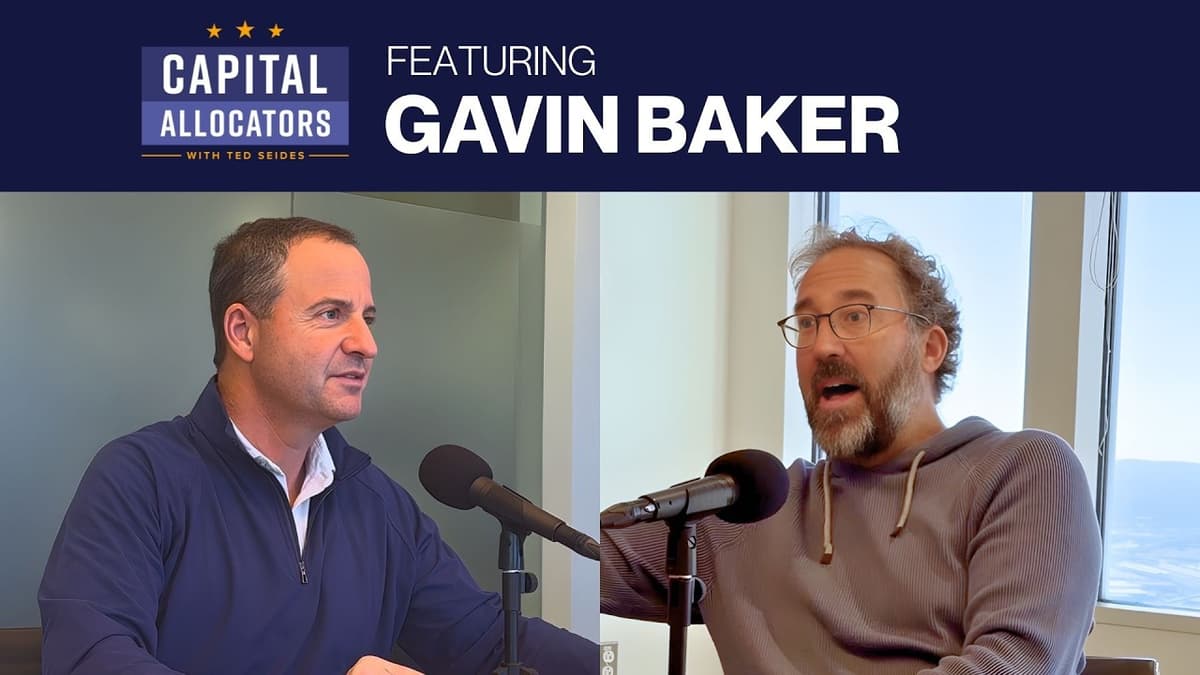
The Capital Allocators episode spotlights Gavin Baker, managing partner and CIO of Atreides Management, which oversees roughly $7 billion across public, private and crossover strategies focused on technology and consumer sectors. Baker recounts his unconventional path—from a book‑filled childhood and rock‑climbing...

The video highlights a fundamental shift in global capital dynamics: after twenty years of massive foreign investment into the United States, those flows are now reversing. The speaker stresses that this reversal is not a classic capital flight scenario,...


