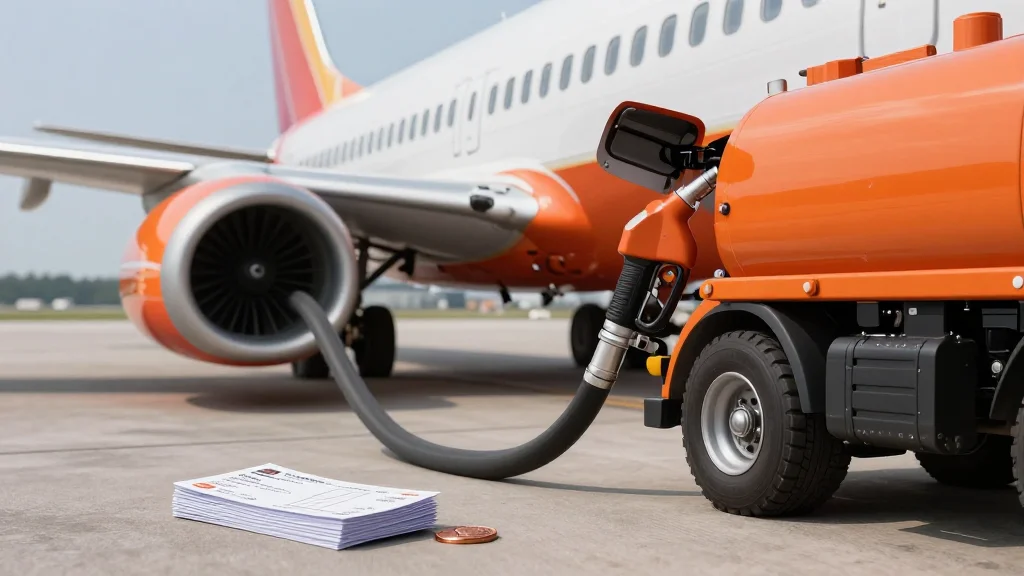
Southwest Airlines Posts Record $7.2B Q1 Revenue, but Fuel Surge Clouds Outlook

Companies Mentioned
Why It Matters
Southwest’s Q1 performance illustrates a pivotal moment for the U.S. airline industry: legacy carriers are increasingly relying on ancillary revenue and product segmentation to offset rising operating costs. The airline’s record revenue validates its strategic shift, but the loss of fuel hedging exposes a vulnerability that could reverberate across the sector, especially as geopolitical tensions keep jet‑fuel prices volatile. Analysts will watch how Southwest’s pricing strategy and cost management evolve, as the outcomes will set a benchmark for other low‑cost carriers navigating similar headwinds. The broader market impact extends beyond Southwest. Higher ticket prices driven by fuel costs could suppress demand, affecting tourism flows and ancillary businesses tied to air travel. If Southwest’s model proves resilient, it may accelerate a wave of fare‑class diversification across the industry, reshaping the competitive landscape between legacy carriers and ultra‑low‑cost rivals.
Key Takeaways
- •Southwest reported record Q1 operating revenue of $7.2 billion, up 12.8% YoY.
- •Passenger revenue rose 13.4% to $6.6 billion, boosted by upgraded fare mix.
- •Fuel expense increased $164 million, with Q1 price at $2.73 per gallon.
- •CEO Bob Jordan warned higher ticket prices may be needed to offset fuel costs.
- •Guidance for Q2 EPS set at 35‑65 cents, with no update to full‑year $4.00 target.
Pulse Analysis
Southwest’s earnings underscore a broader industry inflection point: the classic low‑cost model, built on uniform pricing and minimal frills, is giving way to a more nuanced revenue architecture. By layering assigned seating and premium legroom options, Southwest has tapped a higher‑margin segment without abandoning its core price‑sensitive customers. The 60% upgrade rate suggests that travelers are willing to pay for added comfort when the price differential is modest, a behavior that could become a new norm as airlines seek to offset cost pressures.
However, the abandonment of fuel hedging is a double‑edged sword. Historically, Southwest’s hedging shield insulated it from fuel volatility, allowing it to maintain lower fares. The decision to exit the hedge reflects confidence in a stable fuel outlook, yet the rapid escalation from $2.40 to $2.73 per gallon—and forward‑curve projections above $4 per gallon—highlights the risk of that confidence being misplaced. If fuel prices remain elevated, the airline may be forced to raise base fares, eroding its price advantage and potentially triggering a demand contraction.
Looking ahead, Southwest’s ability to sustain its revenue growth hinges on two factors: the elasticity of its upgraded‑fare customers and its capacity to manage fuel cost exposure. Should the airline successfully pass on higher costs without alienating price‑sensitive travelers, it could set a template for other carriers. Conversely, a misstep could accelerate a shift toward consolidation, as financially strained airlines explore mergers to achieve economies of scale. The upcoming August earnings call will be a litmus test for whether Southwest’s strategic pivot can weather the fuel storm while preserving its low‑cost identity.
Southwest Airlines Posts Record $7.2B Q1 Revenue, but Fuel Surge Clouds Outlook
Comments
Want to join the conversation?
Loading comments...