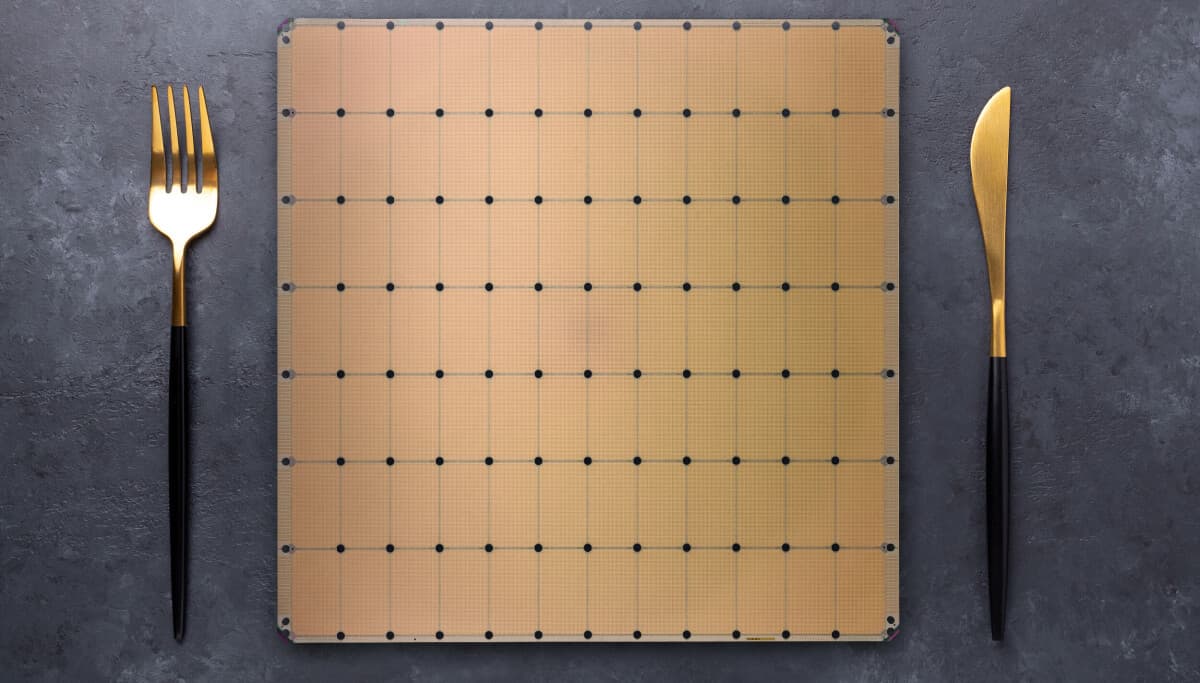
Cerebras Risked It All on Dinner Plate-Sized AI Accelerators a Decade Ago. Today It’s Worth $66 Billion

Companies Mentioned


Why It Matters
The IPO provides unprecedented capital for a semiconductor startup, positioning Cerebras to scale its inference services and challenge Nvidia’s dominance in AI workloads. Its unique wafer‑scale design could reshape how large language models are deployed, influencing the broader AI hardware market.
Key Takeaways
- •Cerebras IPO raised $5.5 B, valuing firm at $66 B.
- •Wafer‑scale engine uses 44 GB SRAM, delivering 125 petaFLOPS sparse compute.
- •Inference platform now serves AWS, OpenAI, Meta, boosting token throughput.
- •G42 accounts for 87 % of revenue, but diversification is growing.
- •Next‑gen WSE‑4 expected to adopt FP8/FP4 and 3D‑stacked SRAM.
Pulse Analysis
Cerebral‑scale chips have long been a niche curiosity, but Cerebras has turned the concept into a commercial reality. By etching an entire wafer into a single die, the company sidesteps the latency penalties of inter‑chip communication that plague traditional GPU clusters. The result is a processor with unprecedented memory bandwidth—over 21 petabytes per second—and a massive on‑chip SRAM pool that accelerates both training and inference. This architectural leap differentiates Cerebras from Nvidia’s GPU roadmap, which relies on external HBM stacks and more conventional scaling.
The financial market rewarded that differentiation. Raising $5.55 billion in its IPO, Cerebras entered the public arena with a $66 billion market cap, a rare feat for a semiconductor startup. While early revenue was dominated by the UAE‑based cloud provider G42, recent contracts with AWS, OpenAI, Meta, and other AI‑focused firms signal a broader customer base. The company’s inference‑as‑a‑service offering now delivers over 2,200 tokens per second on a 120‑billion‑parameter model, outpacing many GPU‑based clouds. This diversification reduces reliance on a single client and positions Cerebras as a viable alternative for enterprises seeking low‑latency, high‑throughput AI serving.
Looking ahead, the pressure to innovate is intense. The current WSE‑3 silicon, built on TSMC’s 5 nm process, is approaching its performance ceiling, and competitors like Nvidia (through its acquisition of Groq) are closing the SRAM gap. Analysts anticipate a WSE‑4 that embraces emerging low‑precision formats such as FP8 and FP4, possibly leveraging 3D‑stacked SRAM to expand capacity beyond the existing 44 GB. Such advances could enable efficient deployment of trillion‑parameter models and keep Cerebras competitive in the rapidly evolving AI hardware landscape.
Cerebras risked it all on dinner plate-sized AI accelerators a decade ago. Today it’s worth $66 billion
Comments
Want to join the conversation?
Loading comments...