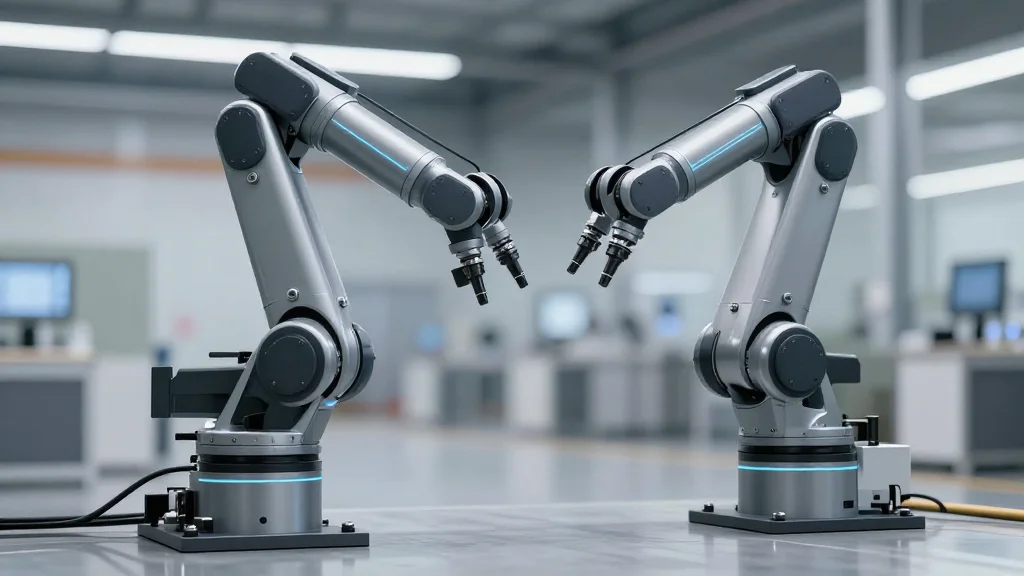
Flexiv to Unveil Next-Generation Adaptive Robots at Automate 2026
Companies Mentioned

Why It Matters
The robots’ human‑like tactile perception and modular design enable manufacturers to automate complex, low‑volume tasks that were previously uneconomical, accelerating adoption of flexible automation across industries.
Key Takeaways
- •Enlight offers seven-axis whole-body touch sensitivity for adaptive automation
- •MICO combines two Enlight arms for modular dual‑arm humanoid capabilities
- •Flexiv showcases robots at Automate 2026 with NVIDIA Isaac Sim integration
- •Plug‑and‑play configurations (Armor, Core, Plus, Ultra) enable scalable deployments
- •Robots target unstructured, constrained environments, reducing programming complexity
Pulse Analysis
Flexiv’s unveiling of Enlight and MICO at Automate 2026 signals a watershed moment for general‑purpose robotics. Enlight’s seven‑axis architecture embeds multi‑dimensional force‑torque sensors in every joint, delivering whole‑body touch sensitivity that rivals human perception. This level of tactile feedback enables robots to detect single‑touch events, track multiple contact points, and recognize patterns, opening the door to tasks previously reserved for skilled operators. In an industry still dominated by rigid, pre‑programmed arms, such adaptive capability promises to shrink deployment cycles and expand automation into low‑volume, high‑variability production lines.
MICO builds on the Enlight platform by pairing two arms under a single control box, creating a humanoid‑style dual‑arm system that can perform coordinated, human‑like motions. The modular hardware—offered in Armor, Core, Plus and Ultra configurations—lets integrators add sensors, grippers or tool changers without redesigning the chassis, a crucial advantage for fast‑moving factories. Flexiv’s partnership with NVIDIA brings Isaac Sim’s physics‑accurate environment to the demo floor, showcasing how AI‑driven simulation can accelerate programming and validation. This blend of embodied intelligence and plug‑and‑play scalability positions MICO as a strong contender in the collaborative‑robot market.
The arrival of tactile, force‑controlled robots could reshape cost structures across sectors ranging from automotive to consumer electronics. By handling parts with delicate force thresholds, manufacturers can reduce scrap rates and lower the need for specialized end‑effectors. However, widespread adoption will hinge on software accessibility; Flexiv’s claim of simpler programming must be backed by intuitive development tools and robust safety certifications. Competitors such as Universal Robots and ABB are already investing in force feedback, but Flexiv’s whole‑body sensing differentiates it on a technical level. If the market embraces these capabilities, the next wave of automation may finally extend to the most variable, human‑centric tasks.
Flexiv to Unveil Next-Generation Adaptive Robots at Automate 2026
Comments
Want to join the conversation?
Loading comments...