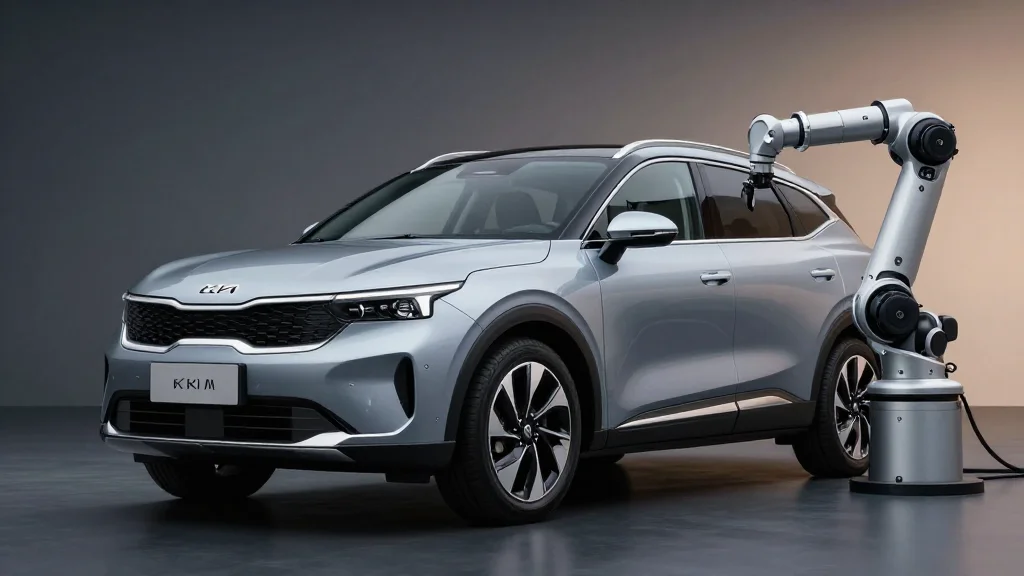
Kia Commits $38 Billion to Manufacturing Overhaul, Targets 4.1 M Global Sales by 2030

Companies Mentioned
Why It Matters
Kia’s $38 billion manufacturing commitment marks one of the largest capital allocations in the automotive sector this year, signaling a decisive shift toward electrified and autonomous mobility. By investing in next‑generation production lines and expanding its EV portfolio, Kia aims to secure a foothold in the rapidly growing global EV market, which analysts project will account for over 30% of new vehicle sales by 2030. The plan also has ripple effects on suppliers, from battery manufacturers to semiconductor firms, potentially reshaping supply‑chain dynamics and influencing component pricing across the industry. Furthermore, Kia’s balanced strategy—maintaining ICE and hybrid offerings while scaling EV capacity—addresses divergent regional regulatory environments and consumer preferences. This approach could set a template for other legacy automakers seeking to hedge against policy risk while capitalizing on the accelerating demand for clean‑energy vehicles.
Key Takeaways
- •Kia pledges KRW 49 trillion (~$38 billion) investment for 2026‑2030 manufacturing expansion
- •Atlas® production system to debut at HMGMA in 2028, then at Kia AutoLand Georgia in 2029
- •Target of 4.13 million global vehicle sales and 4.5% market share by 2030
- •EV lineup to grow to 14 models, aiming for 1 million EV sales annually by 2030
- •KRW 21 trillion (~$16 billion) earmarked for future businesses such as autonomous driving and robotics
Pulse Analysis
Kia’s manufacturing roadmap reflects a pragmatic blend of ambition and risk mitigation. By allocating the bulk of its capital to tangible factory upgrades—namely the Atlas® system—Kia is betting on operational efficiency gains to offset the higher unit costs of EVs and batteries. This mirrors a broader industry trend where automakers are retrofitting existing plants rather than building greenfield factories, a strategy that reduces capital intensity and accelerates time‑to‑market.
The decision to split the rollout between South Korea and the United States also serves a geopolitical purpose. With ongoing supply‑chain disruptions tied to geopolitical tensions in East Asia, a U.S.‑based high‑tech line provides a hedge against export controls and tariff volatility. Moreover, the Georgia plant positions Kia within the burgeoning North American battery ecosystem, potentially unlocking partnerships with domestic cell manufacturers and reducing reliance on Asian suppliers.
However, Kia’s continued investment in ICE and hybrid models may dilute its EV focus, especially as competitors like BYD and Tesla double down on pure‑electric platforms. The success of Kia’s hybrid expansion will hinge on consumer acceptance of incremental electrification versus a full shift to BEVs. If regulatory pressure accelerates, Kia could face a strategic inflection point where its ICE inventory becomes a liability. In that scenario, the flexibility built into the Atlas® system—designed for rapid retooling—will be critical to pivot production toward pure‑electric models without incurring prohibitive re‑engineering costs.
Overall, Kia’s $38 billion manufacturing push is a bold statement of intent that could reshape its competitive standing. If execution aligns with the outlined timelines, Kia may emerge as a diversified mobility provider capable of serving both legacy and emerging market segments, reinforcing its claim to be a "Sustainable Mobility Solutions Provider" in a decarbonizing world.
Kia Commits $38 Billion to Manufacturing Overhaul, Targets 4.1 M Global Sales by 2030
Comments
Want to join the conversation?
Loading comments...