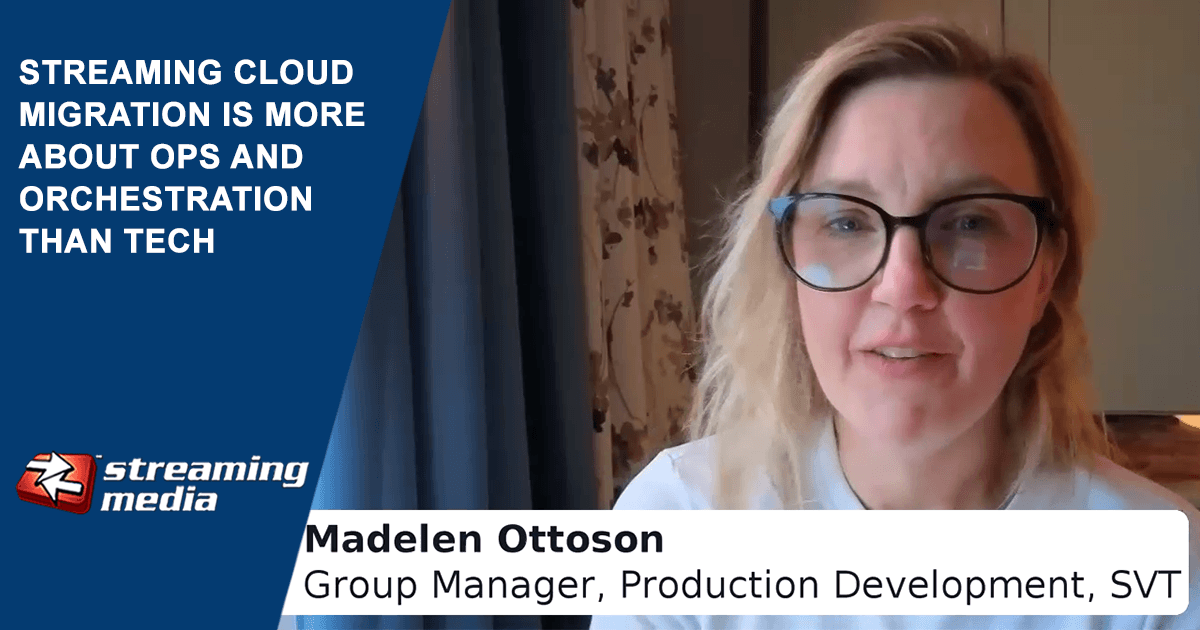
Streaming Cloud Migration Is More About Ops and Orchestration than Tech
Why It Matters
The insight reframes cloud migration as an ops‑first challenge, prompting broadcasters to invest in orchestration tools and security rather than just virtualizing hardware. This shift influences budgeting, talent roles, and competitive advantage in live‑sports streaming.
Key Takeaways
- •SVT emphasizes operational change over hardware replacement in cloud migration.
- •Remote production gains flexibility, but on‑prem security remains critical.
- •Orchestration complexity, not software, is the biggest cloud migration hurdle.
- •AI automation is explored to speed up large‑scale infrastructure provisioning.
Pulse Analysis
The streaming industry has long marketed cloud migration as a straightforward hardware‑to‑software swap, but the conversation at Streaming Media Connect 2026 revealed a deeper reality. Broadcasters like SVT are discovering that the true value lies in how teams collaborate across dispersed control rooms and on‑site studios. By decoupling workflows from physical racks, organizations gain the agility to assign talent wherever they are most effective, while still preserving on‑prem assets that satisfy stringent public‑service security standards. This operational flexibility is becoming a differentiator in a market where live content must be delivered instantly and reliably.
Beyond flexibility, the dominant pain point is orchestration. As Jef Kethley of Live Sports LLC noted, scaling from a handful of machines to hundreds in minutes is trivial without a robust automation layer; connecting each node, ensuring low latency, and maintaining security can consume hours. The industry is therefore turning to AI‑driven orchestration platforms that can auto‑configure networks, provision compute, and monitor performance in real time. Such solutions promise to collapse the span‑hours traditionally required for large‑scale deployments, turning what was once a logistical bottleneck into a repeatable, cost‑effective process.
For executives, the takeaway is clear: future investments should prioritize orchestration frameworks, security‑by‑design architectures, and AI automation over merely shifting workloads to the cloud. Companies that embed these capabilities will not only reduce operational overhead but also unlock new production models—remote camera control, virtual studios, and hybrid on‑prem/cloud pipelines—that keep them competitive in the fast‑moving live‑sports arena. As the line between on‑prem and cloud blurs, the real competitive edge will be the ability to orchestrate resources instantly, securely, and at scale.
Streaming Cloud Migration is More About Ops and Orchestration than Tech
Comments
Want to join the conversation?
Loading comments...