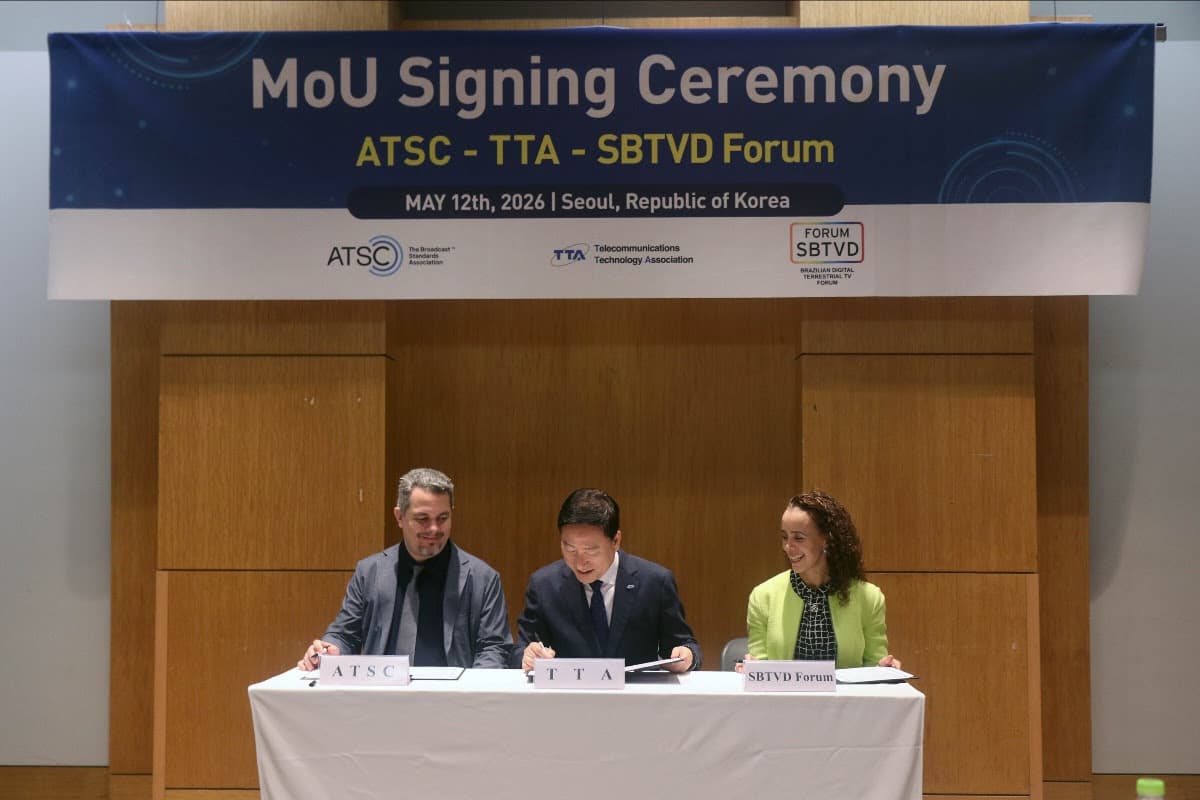
U.S., Brazilian and Korean ATSC 3.0 Leaders Sign ‘MOU’
Why It Matters
The partnership streamlines technical alignment across three major markets, reducing duplication and speeding up rollout of ATSC 3.0’s advanced video, audio, and data services. This collaboration strengthens the global ecosystem, making the standard more attractive to broadcasters, advertisers, and device makers.
Key Takeaways
- •ATSC, Brazil's SBTVD Forum, and Korea's TTA sign MOU
- •Agreement targets harmonization of ATSC 3.0 worldwide
- •Collaboration aims to accelerate next-gen terrestrial broadcast deployment
- •Formal framework fosters joint research and standard promotion
- •Signing ceremony in Seoul underscores global commitment to interoperable standards
Pulse Analysis
The Advanced Television Systems Committee (ATSC) 3.0 standard represents the most ambitious upgrade to over‑the‑air broadcasting since the transition to digital TV. By combining high‑efficiency video coding, IP‑based delivery, and robust data services, ATSC 3.0 enables 4K UHD, immersive audio, targeted advertising, and interactive applications on conventional antennas. While the United States has begun commercial roll‑outs in major markets, adoption in Europe, Asia, and Latin America remains fragmented, creating a clear need for coordinated standards work.
The newly signed Memorandum of Understanding between ATSC, Brazil’s SBTVD Forum, and Korea’s Telecommunications Technology Association (TTA) establishes a formal cooperation framework to align technical specifications and promote worldwide interoperability. Brazil’s SBTVD has already deployed a hybrid version of ATSC 3.0 for its massive free‑to‑air audience, and Korea’s TTA is advancing a next‑generation terrestrial platform that rivals Europe’s DVB‑T2. By sharing test results, spectrum strategies, and market data, the three bodies can reduce duplicate engineering effort and accelerate commercial launches across their respective regions.
Broadcasters stand to gain faster access to advanced features such as addressable ads and emergency alerting, while device manufacturers benefit from a single, globally recognized chipset architecture. For advertisers, the convergence of broadcast and broadband opens new revenue streams through precise audience segmentation. The Seoul signing ceremony signals a shift toward a more unified global ecosystem, where standards harmonization becomes a competitive advantage rather than a barrier. Continued collaboration could see ATSC 3.0 become the de‑facto benchmark for terrestrial TV worldwide within the next five years.
U.S., Brazilian and Korean ATSC 3.0 Leaders Sign ‘MOU’
Comments
Want to join the conversation?
Loading comments...