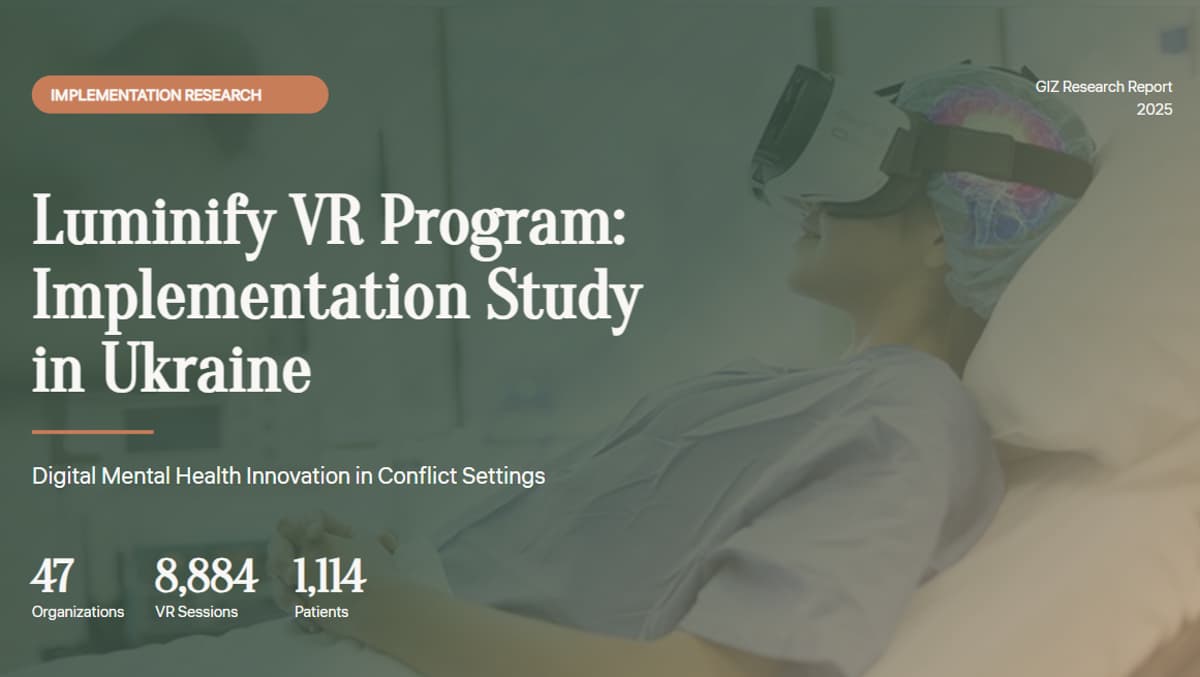
Aspichi Study Shows Mixed Reality Helps Ukrainians Cope with Wartime Strain
Why It Matters
The findings demonstrate a scalable, technology‑enabled approach to mental‑health support in conflict zones, offering a model for overstretched health systems worldwide. By lowering barriers and reducing stigma, mixed reality could augment traditional therapy and improve outcomes for millions facing trauma.
Key Takeaways
- •1,114 patients completed 8,884 mixed-reality sessions in six months.
- •162 headsets deployed across 47 Ukrainian hospitals, veteran centers, mobile teams.
- •Luminify improved emotional regulation, reduced stigma, and increased care entry.
- •Successful scaling requires infrastructure, clinician training, and workflow integration.
- •Aspichi joins PwC Scale Program to broaden medical resilience use.
Pulse Analysis
The mental‑health fallout from wars and natural disasters is a growing global concern. The World Health Organization estimates that nearly every individual exposed to emergencies experiences psychological distress, and one in five develops serious conditions requiring professional care. Traditional therapy models struggle to meet demand in resource‑constrained settings, prompting a search for digital tools that can extend reach without compromising safety.
Aspichi’s six‑month Luminify study provides concrete evidence that mixed‑reality can fill that gap. Across 47 Ukrainian hospitals, veteran centers and mobile units, 1,114 patients completed 8,884 structured sessions using 162 headsets. The program blends evidence‑based techniques—cognitive‑behavioral therapy, mindfulness, and trauma‑informed design—into immersive scenarios that patients control while clinicians monitor progress. Participants reported better emotional regulation, reduced stress, and a willingness to engage in further treatment, positioning the headset as a low‑barrier entry point that mitigates stigma.
The broader implication is a blueprint for scaling mental‑health interventions in any high‑stress environment. Success hinges on more than hardware; it requires reliable infrastructure, clinician training, and seamless integration into existing care pathways. Aspichi’s selection for PwC’s Scale Program signals confidence that the model can be adapted for civilian and military health systems across Europe and NATO allies. As health providers grapple with rising demand, mixed‑reality tools like Luminify could become a cornerstone of resilient, cost‑effective mental‑health delivery.
Aspichi study shows mixed reality helps Ukrainians cope with wartime strain
Comments
Want to join the conversation?
Loading comments...