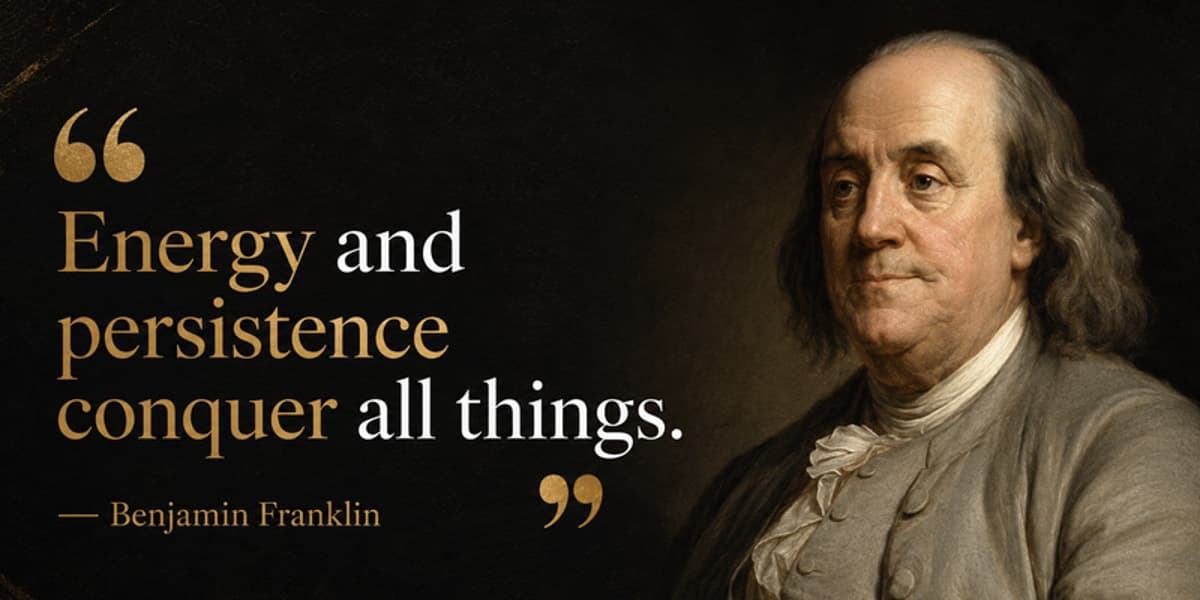
Energy and Persistence Conquer All Things — Benjamin Franklin
Why It Matters
In an era of constant distraction, the framework provides a scalable method to convert limited attention into measurable progress, helping individuals and teams achieve sustainable results.
Key Takeaways
- •Energy means purposeful focus, not endless hustle
- •Persistence is disciplined repetition, not stubbornness
- •Block 90 minutes daily for high-leverage work
- •Track controllable inputs like deep‑work minutes, not vanity metrics
- •Small, consistent steps compound into lasting impact
Pulse Analysis
Benjamin Franklin’s 18th‑century maxim feels surprisingly prescient amid today’s “always‑on” culture. While many modern self‑help narratives glorify relentless hustle, Franklin’s distinction between energy and persistence invites a more nuanced view. Energy, in this context, is the deliberate allocation of mental bandwidth—supported by sleep, nutrition, and clear priorities—rather than frantic multitasking. Persistence, meanwhile, is the disciplined repetition of high‑impact actions, not the stubborn refusal to adapt. This separation helps professionals cut through the noise and focus on the activities that truly move core metrics.
Translating the philosophy into daily workflow starts with two practical levers: protected focus time and input‑based metrics. Executives who shield a 90‑minute block each morning for deep work consistently deliver higher‑value output than those who react to every email. Similarly, tracking controllable inputs—minutes of uninterrupted work, number of iteration cycles—provides immediate feedback, sidestepping vanity metrics like likes or short‑term wins. By treating each input as a data point, teams can iteratively tighten the loop between effort and outcome, fostering a culture where small, repeatable actions compound into measurable momentum.
The broader impact extends beyond individual productivity. Leaders who institutionalize brief, regular reviews and document decisions build trust and accelerate execution across the organization. Learners who adopt spaced, 20‑minute practice sessions retain information far better than those who cram. Even personal relationships benefit from consistent, low‑friction check‑ins. A simple 30‑minute daily experiment—tracking focused minutes and attempts for a month—offers a tangible entry point. Over time, the quiet compounding of energy and persistence transforms modest effort into lasting influence, echoing Franklin’s timeless insight.
Energy and Persistence Conquer All Things — Benjamin Franklin
Comments
Want to join the conversation?
Loading comments...