CRE: Constraints, Moats and Value
•March 10, 2026
0
Key Takeaways
- •AI cuts analytical cost, enabling rapid scenario analysis
- •Information asymmetry collapses as data becomes universally accessible
- •Verification and liability emerge as critical new competitive moats
- •Scale advantage erodes; lean firms can match large players
- •Governance frameworks differentiate firms that can deploy AI at scale
Summary
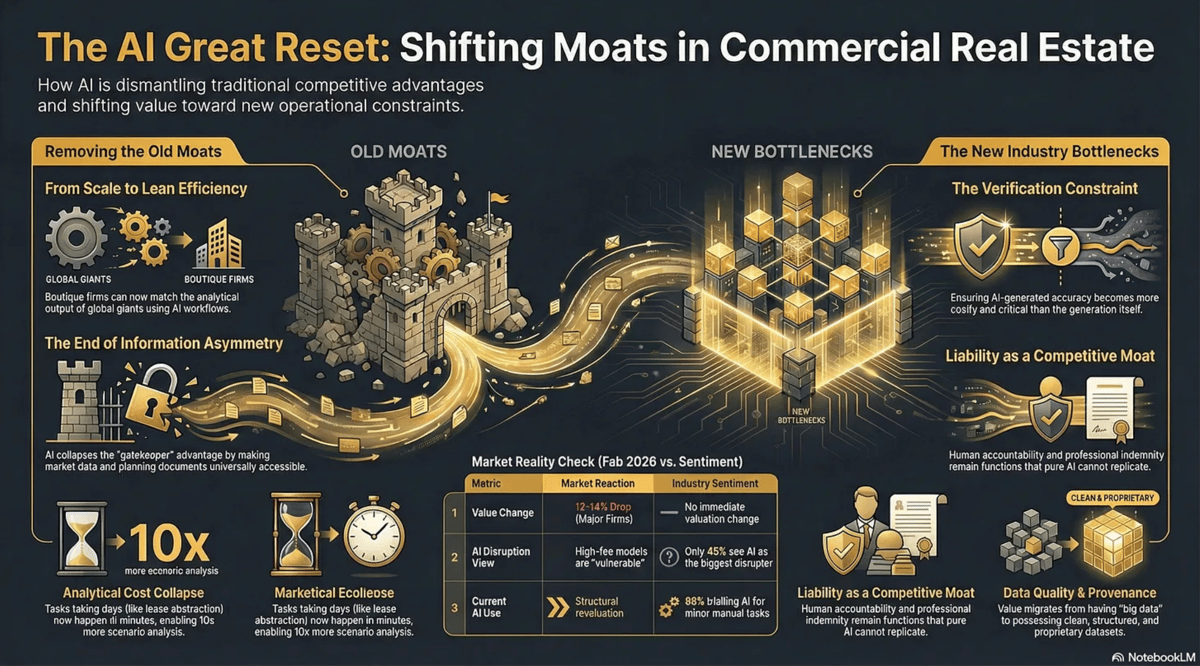
Wall Street wiped 12‑14% off the market caps of CBRE, JLL and Cushman & Wakefield after analysts warned that high‑fee, labor‑intensive CRE models are vulnerable to AI disruption. At the same time, Yardi’s research with AREF found only 45% of industry respondents view AI as the top tech threat, though 88% are already trialing AI for routine tasks. The article argues that AI is stripping away traditional CRE constraints—analytical cost, knowledge access, coordination, talent scaling and geographic expertise—while creating new bottlenecks such as verification, liability, data quality and governance. Consequently, long‑standing moats like scale, relationships and proprietary data are rapidly eroding, forcing firms to rethink value creation.
Pulse Analysis
The commercial real‑estate sector is at a crossroads as AI technology simultaneously fuels market panic and quiet adoption. On February 11, equity analysts slashed the valuations of the industry’s giants, citing exposure to AI‑driven cost compression, while a Yardi‑AREF survey revealed that most practitioners still see AI as a tool rather than a threat. This disconnect underscores a broader narrative: AI is no longer a futuristic add‑on but a force reshaping core business economics, prompting investors to reassess the durability of traditional CRE moats.
AI’s impact is best understood through the lens of constraint mapping. Tasks that once required teams of analysts—lease abstraction, financial modelling, due‑diligence reviews—can now be executed in minutes, eroding the analytical cost advantage of large firms. Knowledge asymmetry, once protected by proprietary databases, is collapsing as AI democratizes access to market data, planning records and regulatory filings. At the same time, new constraints surface: verification of AI outputs, liability for erroneous recommendations, data‑quality challenges, and the need for robust governance frameworks. These emerging bottlenecks become the fresh sources of competitive advantage, rewarding firms that can certify accuracy, manage risk and orchestrate AI‑augmented workflows.
For CRE operators, the strategic imperative is clear: shift focus from scale‑driven analytics to mastering the new constraints. Value will migrate to organizations that embed verification checkpoints, assume liability responsibly, and maintain pristine proprietary datasets. Building governance structures and upskilling staff to oversee AI outputs will differentiate winners from laggards. In practice, this means investing in clean data pipelines, establishing clear audit trails, and developing liability‑aware AI products—steps that transform AI from a disruptive bug into a sustainable feature of the CRE value chain.
Comments
Want to join the conversation?