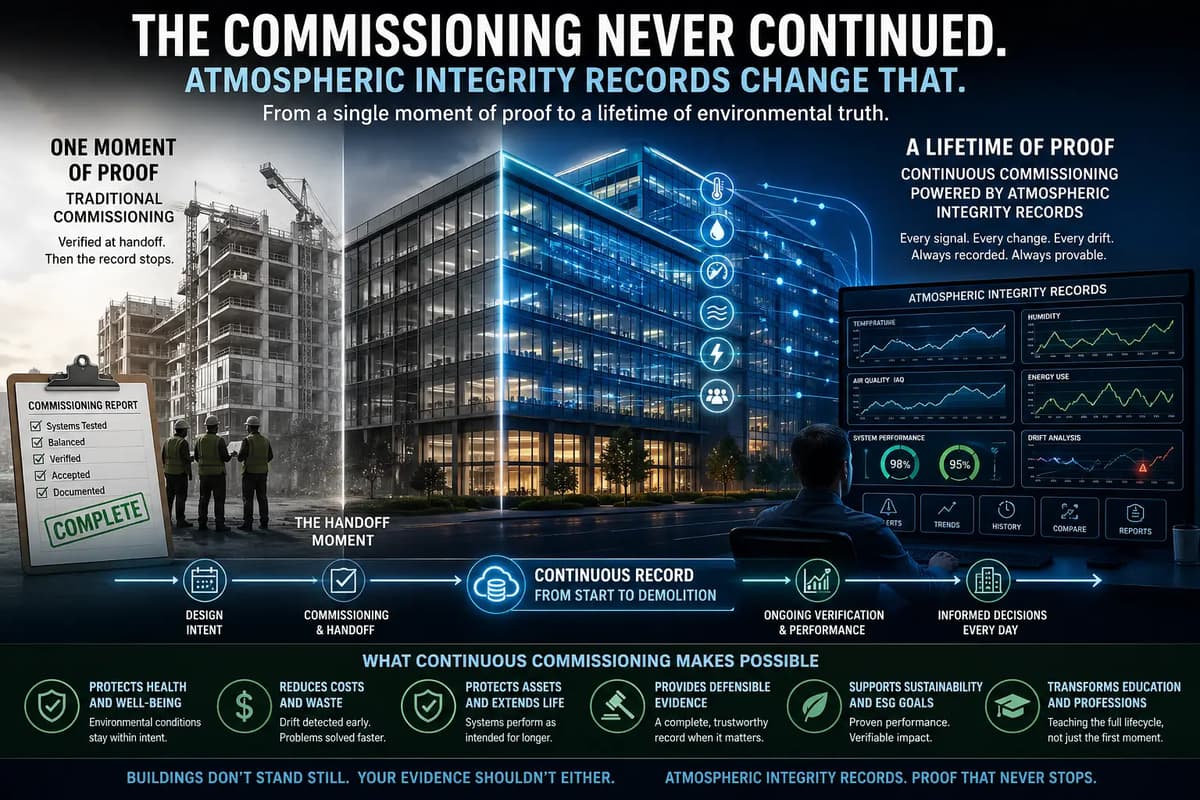
The Commissioning Never Continued
Key Takeaways
- •Commissioning ends at handoff, leaving performance unverified over time
- •Atmospheric Integrity Records create a continuous environmental history
- •Continuous commissioning requires evidence, not just monitoring data
- •Drift becomes visible early, reducing costly repairs
- •Start-to-demolition commissioning boosts asset value and occupant health
Pulse Analysis
Traditional building commissioning has long been treated as a project milestone—a checklist completed before keys are handed over. While this ensures a building meets design intent at turnover, it provides no guarantee that systems continue to perform as intended once occupants move in, filters age, or schedules shift. The industry’s reliance on periodic monitoring or reactive retro‑commissioning leaves a critical evidence gap, making it difficult to pinpoint when and why performance drifts occur. This gap has become more pronounced as owners demand tighter energy targets and higher indoor‑air‑quality standards.
Atmospheric Integrity Records (AIR) address the gap by establishing a governed, time‑stamped record of both environmental conditions and machine behavior. Unlike dashboards that merely display real‑time data, AIR captures temperature, humidity, CO₂, particulate levels, equipment vibration, amp draw, and control actions in a continuous, auditable format. This “atmospheric memory” allows facility teams to compare current performance against the original commissioning baseline, seasonal trends, and historical drift patterns. Early detection of deviations—such as a slowly leaking damper or a sensor calibration shift—prevents costly repairs, improves occupant comfort, and ensures compliance with evolving regulations.
The shift to start‑to‑demolition commissioning reshapes the business case for building owners and the professional training of commissioning specialists. A continuous record enhances asset valuation by providing transparent performance history to investors, insurers, and future owners. It also supports regulatory compliance, especially in sectors like healthcare and education where indoor‑air quality is critical. As the concept gains traction, commissioning curricula must evolve from a handoff‑focused discipline to one that teaches lifelong evidence stewardship, ensuring the next generation of professionals can leverage AIR to keep buildings operating safely and efficiently throughout their entire lifecycle.
The Commissioning Never Continued
Comments
Want to join the conversation?