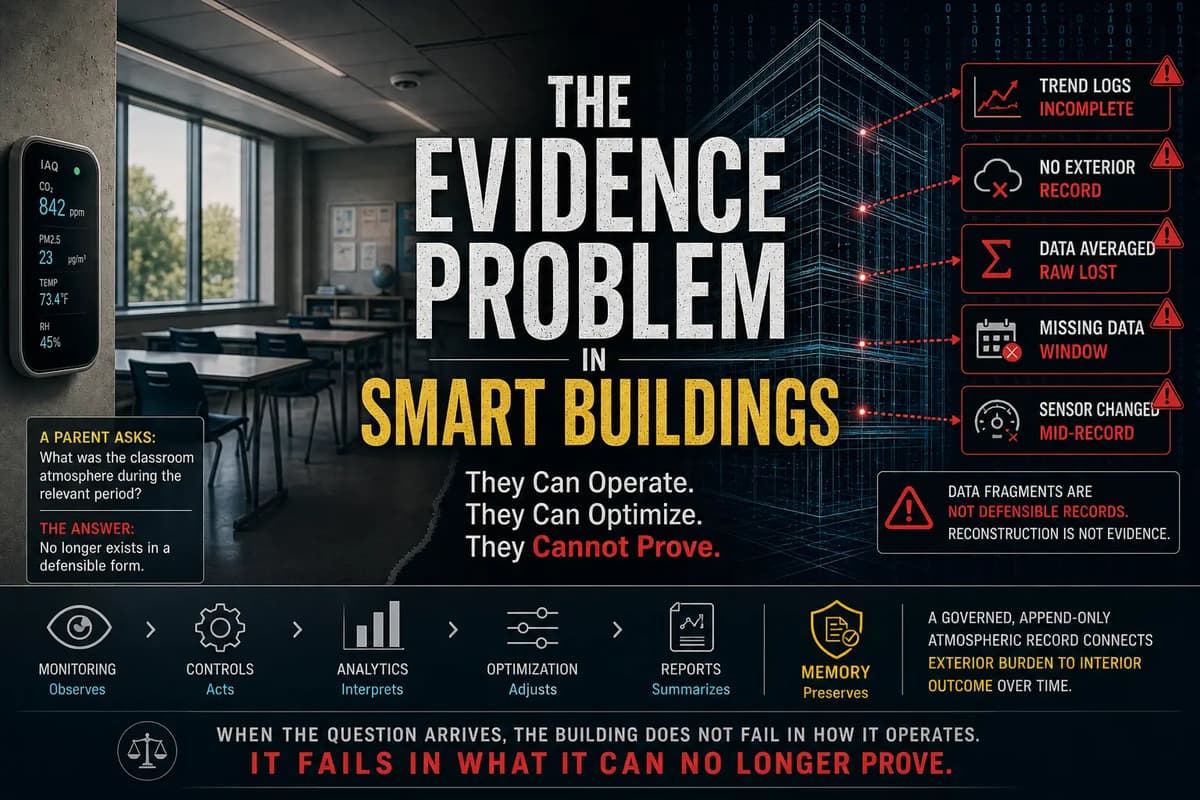
The Smart Building’s Evidence Problem
Key Takeaways
- •Current building data often lacks continuous, source‑attributed records.
- •Governed atmospheric records enable defensible IAQ and energy claims.
- •Separate observation layer from control systems to preserve evidence integrity.
- •Exterior atmospheric data must be recorded alongside indoor conditions.
- •Continuous records reduce costly reconstruction during disputes or regulatory reviews.
Pulse Analysis
The rapid adoption of IoT sensors, analytics dashboards, and AI‑driven controls has given building operators unprecedented visibility into temperature, humidity, CO₂, and particulate levels. Yet that visibility stops short of proof when a parent demands a week‑long air‑quality log, an insurer questions a mold claim, or a regulator audits ventilation performance. The core issue is not a lack of data but the absence of a governed, append‑only record that captures every measurement with timestamp, source attribution, and continuity. When data lives only in dashboards or compressed trend logs, it cannot withstand legal scrutiny or serve as reliable evidence.
Atmospheric Integrity Records (AIR) address this gap by establishing a separate, immutable layer that records both indoor conditions and the corresponding outdoor burden in real time. The record must be append‑only, time‑sequenced, and include metadata about sensor calibration, data gaps, and system limitations. By decoupling the observation archive from control and optimization engines, facilities prevent the same system that acts on the building from rewriting its own history. Standards such as ISO 16484‑5 for building automation and emerging data‑governance frameworks provide a blueprint for implementing AIR, while cloud‑based immutable storage and blockchain‑style hashing can ensure tamper‑evidence.
For owners and operators, adopting governed atmospheric records transforms risk management. Defensible IAQ documentation supports warranty claims, insurance underwriting, and tenant satisfaction, while linking energy consumption to verified indoor outcomes prevents “green‑washing” of efficiency metrics. Market‑facing benefits include differentiated leasing propositions and compliance with tightening indoor‑environment regulations. In practice, a modest investment in data‑governance infrastructure—metadata tagging, continuous export to immutable storage, and integration of outdoor weather feeds—pays dividends by eliminating costly post‑event reconstruction and by turning the building into a documented, auditable asset rather than a black‑box of fleeting readings.
The Smart Building’s Evidence Problem
Comments
Want to join the conversation?