What Makes a Record Admissible Before a Building Can Act on It?
Key Takeaways
- •Admissibility separates usable data from actionable evidence
- •Seven criteria define an admissible building record
- •Unbound action risks accountability and performance validation
- •Optimization without admissibility amplifies unreliable decisions
Pulse Analysis
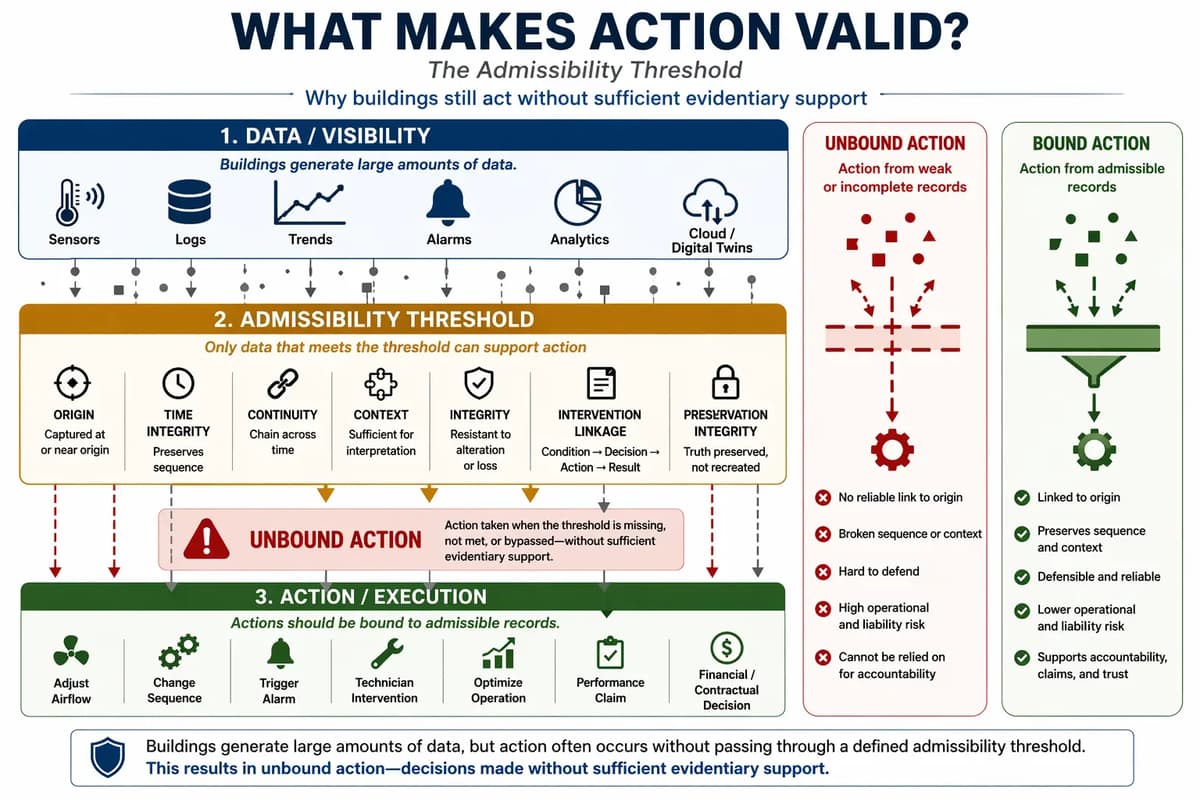
Smart buildings today boast a flood of sensors, dashboards, and analytics, but visibility alone does not guarantee reliability. Operators can see temperature trends, alarm histories, and occupancy counts, yet these snapshots often lack the structural integrity needed for decision‑making. The industry’s focus on "seeing" has outpaced its discipline in "remembering"—preserving data in a form that can be trusted over time. This gap creates a hidden vulnerability: actions taken on fragmented or context‑poor records may appear efficient but lack defensible proof.
The notion of an admissible record offers a concrete remedy. Origin capture ensures data is recorded at the point of generation, preventing later reconstruction errors. Time integrity preserves the exact sequence of events, critical for diagnosing cause‑and‑effect relationships. Continuity links data points across the building’s lifecycle, while contextual sufficiency embeds operating mode, load, and occupancy details. Intervention linkage ties the condition, decision, action, and result together, and preservation integrity safeguards against silent edits. Finally, resistance to reconstruction demands that the system rely on immutable truth rather than post‑hoc explanations. Together, these seven criteria transform raw data into a trustworthy evidence base.
For owners, facility managers, and technology vendors, embracing admissibility reshapes how automation is deployed. Before rolling out optimization algorithms or autonomous controls, organizations should audit their data pipelines against the admissibility checklist, retrofitting legacy systems where gaps exist. Standards bodies can embed these criteria into certification frameworks, and digital‑twin platforms can leverage admissible records to simulate scenarios with confidence. By binding action to provable data, the next generation of smart buildings will move from reactive visibility to authoritative intelligence, delivering measurable ROI while mitigating risk.
What Makes a Record Admissible Before a Building Can Act on It?
Comments
Want to join the conversation?