Atmospheric Integrity Records
•February 25, 2026
0
Why It Matters
AIR supplies trustworthy evidence of how energy translates into indoor environmental stability, allowing stakeholders to identify hidden inefficiencies, allocate capital more wisely, and protect human performance.
Key Takeaways
- •AIR records immutable atmospheric data separate from controls
- •Enables measurable energy‑to‑environment demand quality
- •Supports regulators, insurers, and utilities with admissible evidence
- •Reveals hidden inefficiencies affecting grid capacity and costs
- •Facilitates health research linking exposure history to performance
Pulse Analysis
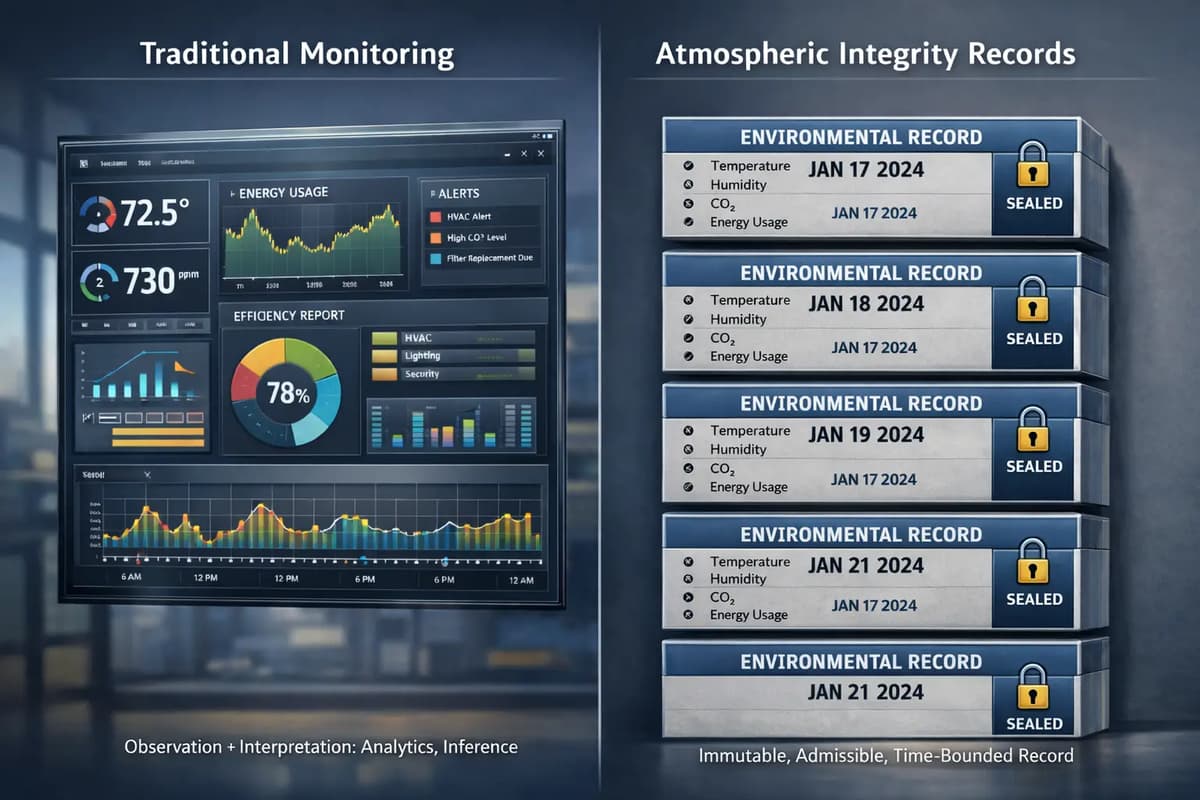
Intelligent buildings have long relied on optimization dashboards that showcase temperature trends, CO₂ levels, and energy intensity. While these tools improve operational awareness, they blend raw telemetry with analytics, making the underlying data vulnerable to alteration and unsuitable for legal or regulatory scrutiny. The industry therefore faces a paradox: sophisticated monitoring exists, yet there is no immutable record that can stand as admissible evidence when performance is formally challenged. This gap hampers transparent assessment of whether a building’s energy consumption truly delivers stable indoor conditions, limiting accountability for owners, utilities, and policymakers.
Atmospheric Integrity Records address the shortfall by establishing a continuous, append‑only chronicle of atmospheric parameters, strictly separated from control actions and interpretive layers. The system enforces integrity gating and governance rules that preserve each measurement exactly as it occurred, creating a verifiable ledger that pairs kilowatt input with outputs such as temperature variance, humidity consistency, and ventilation effectiveness. By quantifying the ratio of energy to environmental stability—termed demand quality—AIR transforms a previously invisible metric into a measurable, comparable figure. Grid operators can now differentiate productive demand from compensatory load, enabling more accurate capacity planning, reduced over‑building, and better alignment with carbon‑reduction targets.
The implications extend across the value chain. Building owners gain early detection of performance drift, protecting capital expenditures; insurers acquire concrete risk indicators for environmental stability; capital markets can assess asset integrity beyond marketing claims; and public‑health researchers obtain longitudinal exposure data to correlate indoor conditions with cognitive and physiological outcomes. As electrification accelerates—through AI‑driven data centers, heat pumps, and EV charging—transparent, admissible atmospheric records become essential for a resilient, efficient grid. AIR thus shifts the narrative from speculative dashboards to evidence‑based governance, reinforcing the synergy between energy, environment, and human performance.
Atmospheric Integrity Records
0
Comments
Want to join the conversation?
Loading comments...