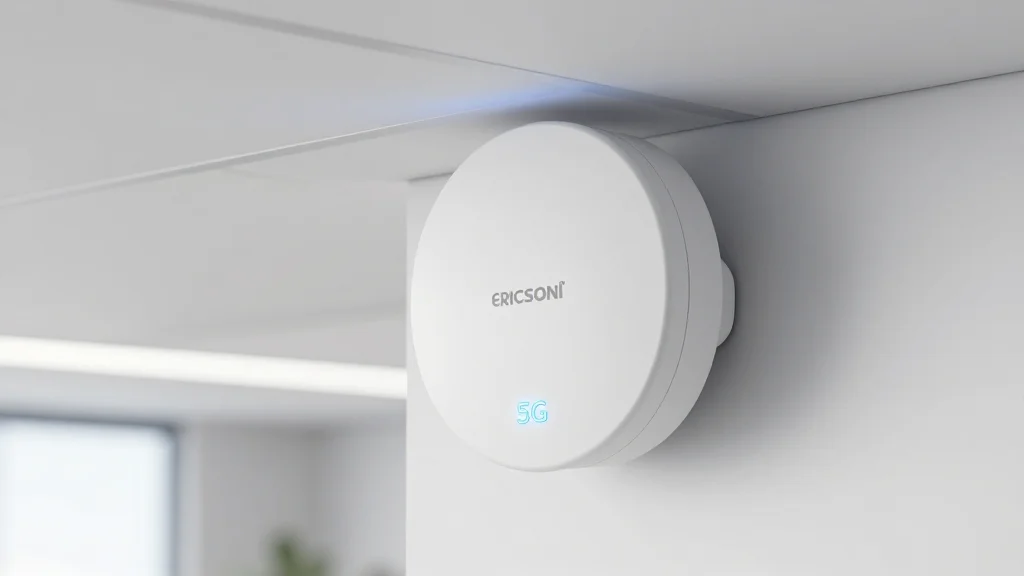
Ericsson and Proptivity Deploy World’s First Fully Digital Indoor 5G in Oslo Office Building

Companies Mentioned
Why It Matters
The deployment proves that fully digital indoor 5G can be delivered through a neutral‑host model, removing traditional barriers of capital cost and fragmented vendor management. For the PropTech industry, this translates into faster, more cost‑predictable connectivity upgrades that are essential for advanced smart‑building services such as AI‑driven energy management and immersive tenant experiences. Moreover, the shared‑infrastructure approach aligns with sustainability goals by reducing redundant equipment and streamlining maintenance. By decoupling network ownership from building ownership, the model also encourages competition among mobile operators, potentially driving better service quality and pricing for tenants. As more developers adopt this framework, we could see a cascade of digital upgrades across office parks, malls, and mixed‑use developments, accelerating the broader digital transformation of the built environment.
Key Takeaways
- •Ericsson and Proptivity completed the first fully digital indoor 5G deployment in Oslo on April 15, 2026.
- •The solution uses Ericsson’s Host Management Control feature and Radio Dot System to create a shared, service‑based infrastructure.
- •Multiple mobile operators can connect to the same hardware while retaining independent control of their services.
- •Proptivity manages the infrastructure, shifting costs from capex to a predictable subscription model for property owners.
- •The rollout enables new smart‑building services such as real‑time analytics, AR maintenance, and massive‑IoT sensor networks.
Pulse Analysis
The Oslo project signals a paradigm shift in how connectivity is provisioned for commercial real estate. Historically, building owners have been forced to negotiate separate agreements with each carrier, leading to duplicated antenna installations and fragmented coverage. By introducing a neutral‑host, fully digital platform, Ericsson and Proptivity are effectively commoditising indoor 5G, turning it into a utility that can be purchased on a pay‑as‑you‑go basis. This mirrors the evolution of cloud computing, where shared infrastructure lowered barriers to entry and spurred innovation.
From a market perspective, the service‑based model could reshape the economics of 5G rollout. Operators, traditionally wary of high upfront costs in dense indoor environments, now have a low‑risk pathway to expand coverage, potentially accelerating the rollout of high‑bandwidth services like private‑network slicing for enterprises. For developers, the ability to offer carrier‑agnostic, high‑performance connectivity becomes a differentiator in a crowded office‑space market, especially as tenants increasingly demand data‑intensive applications.
Looking ahead, the success of this deployment will likely trigger a wave of similar projects across Europe and beyond. The key challenge will be scaling the management platform to handle dozens of operators and thousands of tenants while maintaining the promised neutrality and performance. If Ericsson and Proptivity can demonstrate reliable, cost‑effective scaling, the model could become the de‑facto standard for indoor 5G, unlocking a new era of smart‑building services and reinforcing the convergence of telecom and PropTech.
Ericsson and Proptivity Deploy World’s First Fully Digital Indoor 5G in Oslo Office Building
Comments
Want to join the conversation?
Loading comments...