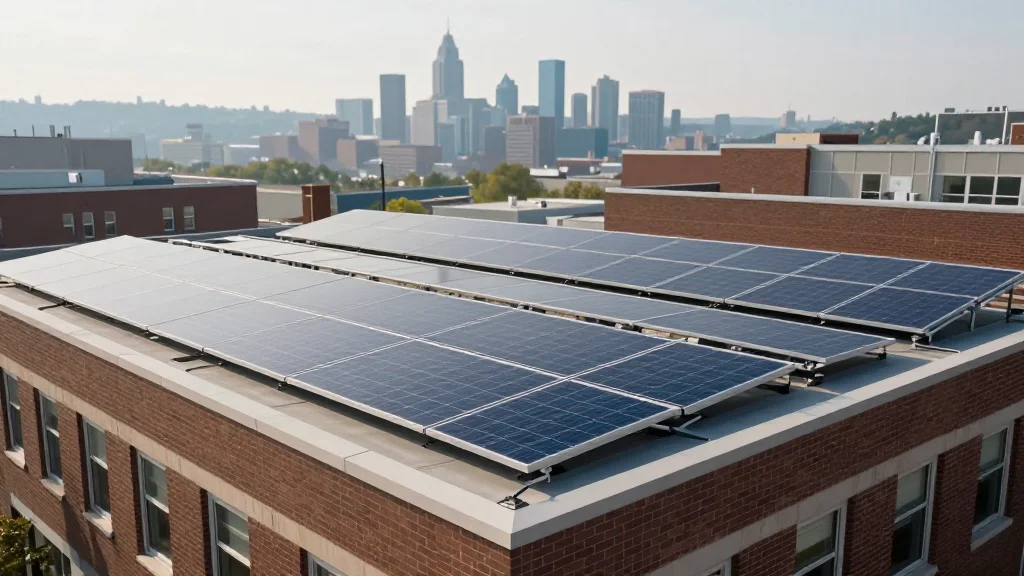
Hill District Solar Array Turns Historic Roof Into Power Hub for 33 Homes

Companies Mentioned
Why It Matters
The Hill District solar installation illustrates how PropTech can intersect with energy‑tech to create financially viable, climate‑resilient buildings. By delivering measurable cost savings and reducing reliance on the grid, the project provides a template for other municipalities and developers seeking to retrofit historic properties. Beyond the immediate financial benefits, the initiative strengthens community stability. The center’s incubator and training programs create local jobs, while the reliable power supply supports affordable housing units, helping to address energy poverty in the Hill District and similar urban neighborhoods.
Key Takeaways
- •530 solar panels installed on a reflective roof at the Energy Innovation Center
- •$1.2 million project financed by Bridgeway Capital despite reduced federal tax credits
- •Annual generation of 350,000 kWh, covering ~20% of the building’s electricity needs
- •Power output sufficient for 33 homes, delivering $50,000 in yearly savings for 25 years
- •Project integrates with existing wind turbine, thermal battery, and CHP generators
Pulse Analysis
The Hill District project signals a shift in PropTech from pure space‑management software toward holistic building performance solutions. Investors are increasingly looking at energy‑efficiency retrofits as a way to de‑risk real‑estate assets, especially in older urban cores where capital improvements can unlock both operational savings and higher occupancy rates. Bridgeway Capital’s involvement underscores a growing appetite for impact‑driven financing that aligns climate goals with community development.
Historically, retrofitting historic structures has been hampered by high upfront costs and uncertain returns. This project demonstrates that, even with the early phase‑out of federal tax credits, a well‑engineered solar array can achieve a compelling payback through direct utility bill offsets and ancillary benefits such as price‑hedging. The reflective roof design, which boosts panel efficiency, could become a standard feature for similar retrofits.
Looking ahead, the Energy Innovation Center’s model may catalyze a wave of public‑private partnerships across the Rust Belt, where legacy industrial buildings dominate the skyline. By coupling renewable energy installations with incubator spaces and workforce training, developers can create ecosystems that attract tech talent, stimulate local economies, and meet ESG mandates. The success of this initiative could prompt municipalities to streamline permitting and provide targeted incentives, accelerating the adoption of integrated PropTech‑energy solutions nationwide.
Hill District Solar Array Turns Historic Roof into Power Hub for 33 Homes
Comments
Want to join the conversation?
Loading comments...