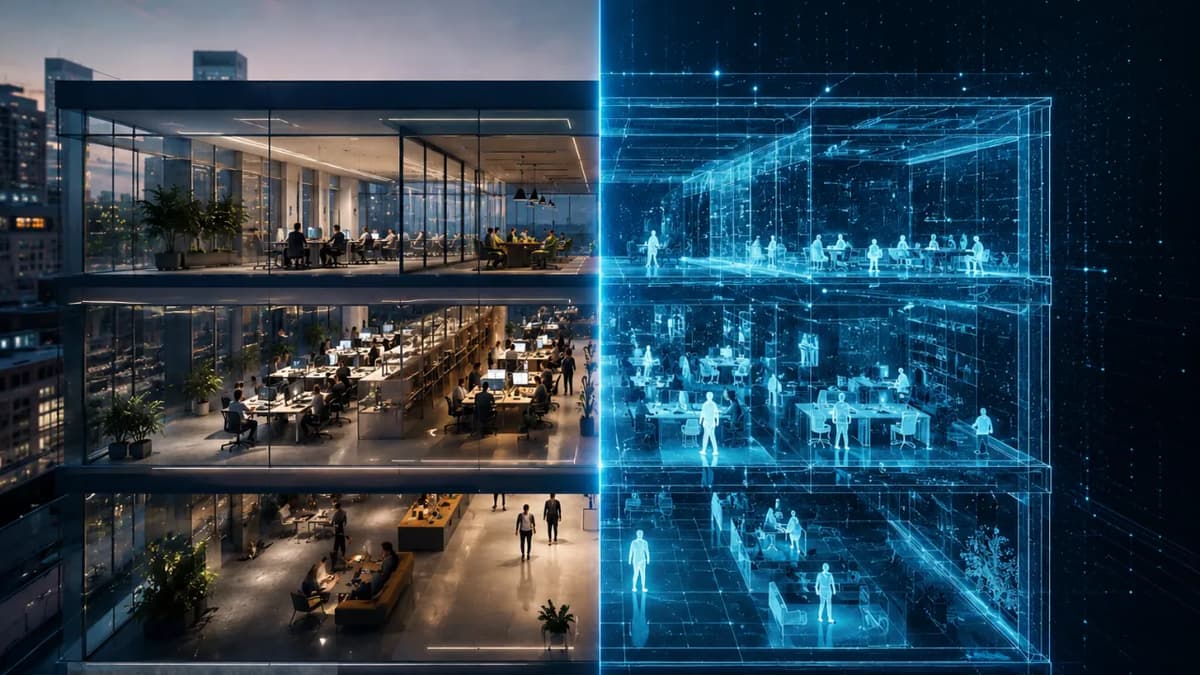
How AI And Digital Twins Are Creating A New Office Design Feedback Loop
Key Takeaways
- •Digital twins market projected $154B by 2030.
- •AI and sensor data create live feedback loop for office design.
- •Autodesk Tandem, Matterport, and OpenSpace connect IoT data to BIM.
- •3D Gaussian Splatting delivers real‑time photorealistic site models.
- •Strong governance ensures data privacy and AI output reliability.
Pulse Analysis
The concept of a digital twin began in the 1960s with NASA’s spacecraft simulations, but today it underpins a new era of office design. By continuously ingesting IoT sensor streams—occupancy counts, temperature, air quality—these twins become living replicas of built environments. When paired with artificial intelligence, the data is not just visualized but interpreted, surfacing patterns that reveal underused meeting rooms or thermal hotspots. Analysts project the global digital‑twin market to exceed $154 billion by 2030, reflecting rapid adoption across manufacturing, healthcare, and the built environment.
Modern design workflows now hinge on platforms that fuse BIM models with real‑time data. Autodesk Tandem links building information models to IoT feeds, while capture tools like Matterport, OpenSpace, and the emerging 3D Gaussian Splatting technique generate high‑fidelity, photorealistic site models in minutes. This seamless pipeline lets architects generate adjacency diagrams, evaluate daylight access, and run generative layout simulations before a single wall is erected. The result is a proactive design process where potential code conflicts or operational inefficiencies are identified early, reducing change‑order costs and accelerating client approvals.
The strategic advantage, however, lies beyond technology. Continuous feedback loops empower facilities managers to reconfigure spaces on the fly, improving employee comfort and reducing energy waste. Yet the reliance on massive data streams raises governance challenges—privacy, data quality, and AI transparency must be rigorously managed. Companies that embed strong oversight while leveraging AI‑driven insights will unlock smarter, more adaptable workplaces, setting a new benchmark for performance‑centric office architecture.
How AI And Digital Twins Are Creating A New Office Design Feedback Loop
Comments
Want to join the conversation?