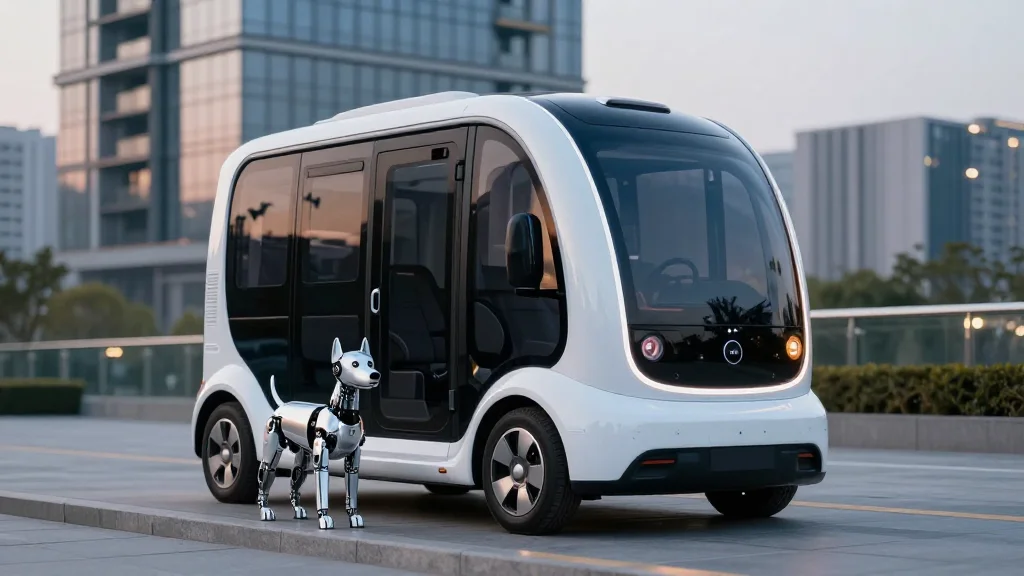
Hyundai E&C Unveils AI Shuttle and Ultra‑Luxury Super‑Penthouse in Seoul’s Apgujeong 3 Redevelopment

Companies Mentioned
Why It Matters
The Apgujeong 3 showcase illustrates how AI and robotics are moving from office‑building management tools to core residential amenities, redefining the value proposition of luxury real estate. By embedding demand‑responsive transport and 24‑hour robot security into a high‑end development, Hyundai E&C is testing a model that could become the standard for premium mixed‑use projects in densely populated Asian cities. If the AI‑driven services prove popular with affluent buyers, other developers may accelerate similar integrations, prompting a wave of PropTech investments focused on resident experience rather than pure construction efficiency. The project also signals a broader trend of Korean developers leveraging domestic robotics expertise—originating from Hyundai Motor Group—to differentiate their offerings in a market where land scarcity and high buyer expectations demand innovative solutions.
Key Takeaways
- •Hyundai E&C unveiled an AI‑based demand‑responsive shuttle that calculates routes in real time for residents.
- •"Apgujeong Hyundai residents can also use it when visiting Somang Church, Kwanglim Church and Dosan Park," said a Hyundai E&C official.
- •"We will create extended routes to Rodeo Street... the DRT assigned to the district will move in front of their building," the official added.
- •The showroom features "The Circle One," a 17 m wide, 3.5 m high indoor community space spanning 1.2 km in total length.
- •Eight river‑front towers will incorporate 10‑metre‑high piloti and crystal‑clad rooftops to maximize Han River views.
Pulse Analysis
Hyundai E&C’s AI‑centric showcase is more than a marketing stunt; it reflects a strategic pivot toward technology‑enabled differentiation in a market where location alone no longer guarantees premium pricing. By bundling AI mobility, robotics and ultra‑luxury interiors, the developer is creating a holistic ecosystem that can command higher price per square metre and attract a niche of tech‑savvy, high‑net‑worth buyers. This mirrors a global shift seen in cities like New York and London, where developers embed smart‑home platforms and concierge bots to justify premium rents.
The demand‑responsive shuttle also addresses a persistent urban challenge: last‑mile connectivity in high‑density districts. If the AI system can reliably route residents across six redevelopment zones, it could reduce reliance on private cars, lower traffic congestion and improve the environmental footprint of the complex—an increasingly important selling point for eco‑conscious investors. However, the technology’s scalability will depend on data integration with city transit systems and the ability to maintain real‑time routing accuracy under heavy usage.
Looking ahead, the success of the Apgujeong project could spur a cascade of PropTech partnerships between construction firms and automotive or robotics companies in Korea. Hyundai Motor Group’s involvement hints at a future where vehicle manufacturers become integral players in residential development, supplying both mobility hardware and AI platforms. As developers race to embed such capabilities, we may see a new competitive axis in the PropTech market: the depth of AI integration versus traditional construction expertise. Hyundai E&C’s early move positions it to lead this emerging frontier, but the real test will be resident adoption once the complex opens its doors.
Hyundai E&C Unveils AI Shuttle and Ultra‑Luxury Super‑Penthouse in Seoul’s Apgujeong 3 Redevelopment
Comments
Want to join the conversation?
Loading comments...