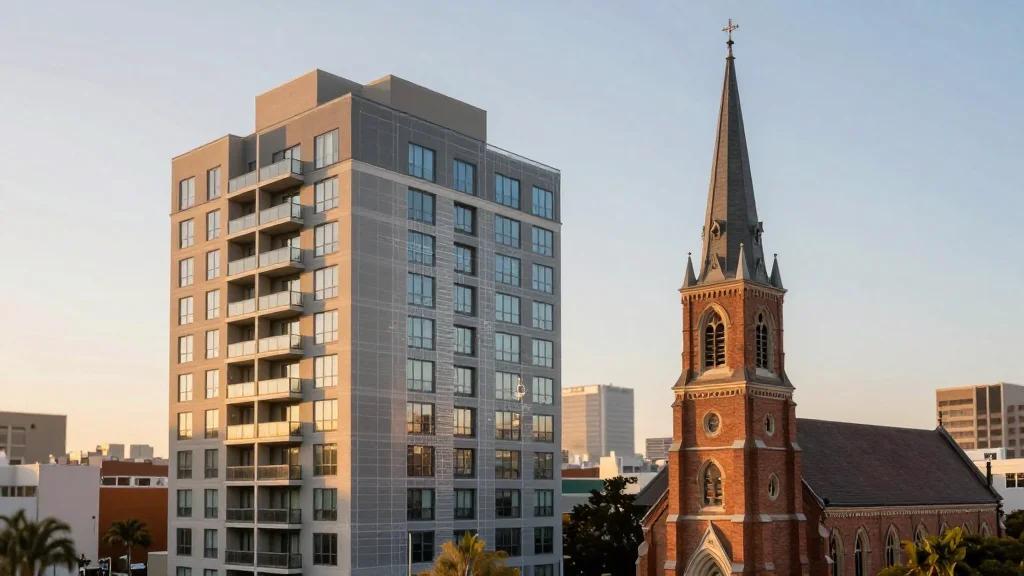
OLOS Impact Deploys AI‑Powered Model to Speed Affordable Housing in LA

Why It Matters
The Los Angeles housing crisis has intensified as construction costs and land prices outpace income growth, leaving low‑ and middle‑income households priced out of the market. OLOS Impact’s AI platform directly tackles the time and cost inefficiencies that have long slowed affordable‑housing pipelines, offering a replicable template for other cities facing similar constraints. By aligning with churches—one of the nation’s largest private landowners—the model also sidesteps the need for costly public land acquisitions, potentially accelerating the delivery of rent‑restricted units. If successful, the approach could shift industry norms, encouraging developers to adopt data‑driven feasibility tools and to seek non‑traditional land partners. This could spur a wave of private‑sector investment into affordable housing, reducing reliance on municipal subsidies and easing pressure on local governments to meet housing mandates.
Key Takeaways
- •OLOS Impact launches AI platform that reduces feasibility analysis from 2‑3 months to days.
- •Founder Christopher Montes emphasizes "attainable housing" as both available and affordable.
- •Partnership model taps churches, which collectively own ~2.3 million acres of U.S. land.
- •Two financing structures: joint‑venture equity sharing and fixed‑rent ground lease.
- •Version two of the platform, opening to agents and lenders, slated for later 2026.
Pulse Analysis
OLOS Impact’s entry into the PropTech arena arrives at a moment when the sector is hungry for solutions that can break the cost‑time spiral of affordable‑housing development. Traditional developers rely on multi‑disciplinary teams—zoning attorneys, architects, financial analysts—each adding layers of expense and delay. By embedding that expertise into an AI engine, OLOS Impact not only trims headcount but also creates a repeatable, data‑rich decision framework that can be scaled across markets. This mirrors broader trends in construction tech where generative design and predictive analytics are reshaping project timelines.
The partnership with faith‑based institutions is equally strategic. Churches own a vast, underleveraged land base, yet they typically lack the capital to develop it. By offering joint‑venture and ground‑lease options, OLOS Impact aligns financial incentives while preserving community stewardship of the land. This could inspire a new class of “community‑anchored” development deals, where non‑profit landowners become equity partners rather than mere sellers. Such structures may also mitigate NIMBY opposition, as projects retain a local, trusted stakeholder.
However, the model’s scalability hinges on two variables: the AI’s predictive accuracy and the willingness of churches to engage in commercial development. If the platform misjudges market dynamics, investors could face unexpected shortfalls, eroding confidence in tech‑driven feasibility studies. Moreover, churches may encounter internal governance challenges when navigating profit‑sharing arrangements. OLOS Impact’s next test will be the performance of its inaugural projects—both in unit delivery speed and in the financial returns delivered to its faith partners. Success could catalyze a wave of similar AI‑enabled, community‑partnered developments across other high‑cost metros, fundamentally altering how affordable housing is financed and built.
OLOS Impact Deploys AI‑Powered Model to Speed Affordable Housing in LA
Comments
Want to join the conversation?
Loading comments...