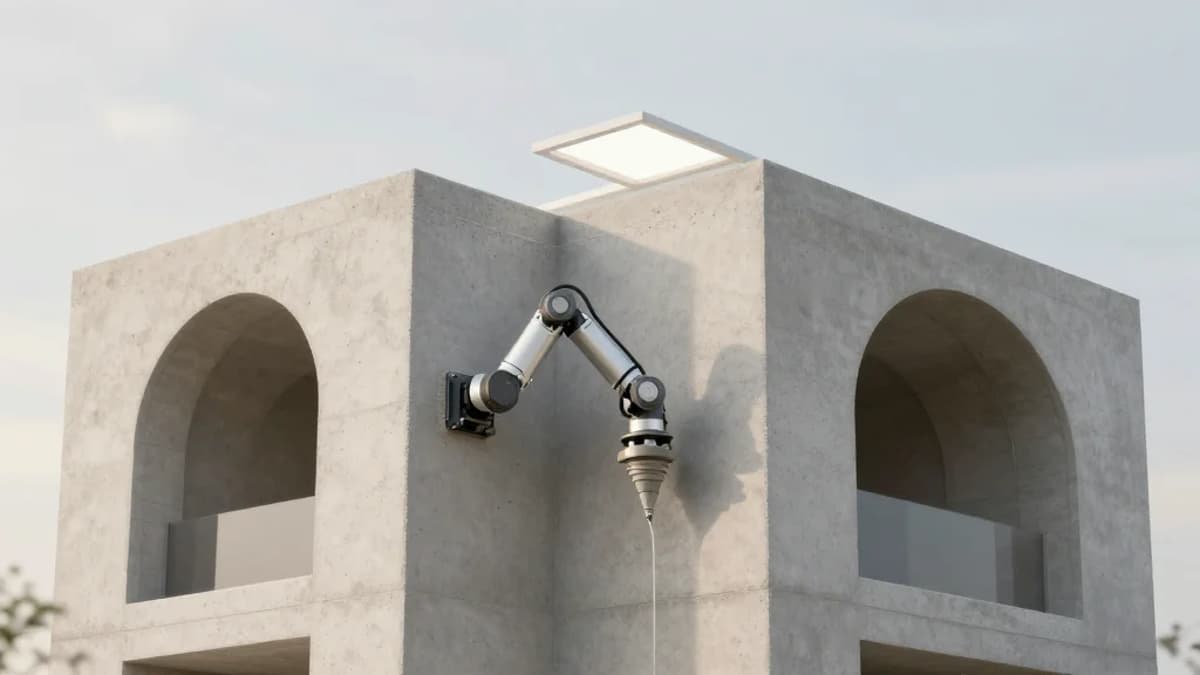
Two-Story 3D-Printed House Withstands Earthquakes with Cave-Like Design
•February 27, 2026
0
Why It Matters
The project proves large‑scale 3D‑printed construction can satisfy the world’s toughest seismic codes, opening new markets for rapid, resilient building after disasters or in defense contexts.
Key Takeaways
- •Japan's first two‑story 3D‑printed house completed
- •Hybrid printing and reinforced concrete meets strict seismic codes
- •COBOD printer built 50 m² structure from below ground
- •Anchored by pile‑supported strip foundation for earthquake resilience
- •Demonstration aims at disaster reconstruction and defense markets
Pulse Analysis
The O House marks a pivotal moment for additive manufacturing in the built environment, showing that 3D‑printed structures can move beyond single‑story prototypes to multi‑level dwellings. By integrating a COBOD robotic printer with a traditional reinforced‑concrete skeleton, the project leverages the precision of digital fabrication while retaining the proven strength of conventional framing. This hybrid approach addresses the biggest hurdle for 3D construction—meeting rigorous safety standards—by embedding the printed shell within a load‑bearing concrete matrix that satisfies Japan’s strict seismic regulations.
Seismic resilience is achieved through a combination of ground‑improvement piles and a reinforced strip foundation, which anchor the house against lateral forces. The arched, cave‑inspired geometry not only reduces stress concentrations but also distributes loads more evenly during tremors. Such engineering solutions demonstrate that 3D‑printed walls can perform on par with, or even surpass, traditional masonry when paired with appropriate structural supports, offering a viable path for rapid, code‑compliant housing in earthquake‑prone regions.
Beyond the technical triumph, the O House serves as a showcase for future applications in post‑disaster reconstruction and defense infrastructure. The ability to fabricate complex forms on‑site with minimal labor accelerates deployment timelines, a critical advantage when rebuilding after a quake or establishing temporary shelters in conflict zones. As governments and insurers seek faster, cost‑effective solutions, the success of Japan’s first two‑story printed home signals a broader shift toward digital construction as a mainstream, resilient building strategy.
Two-story 3D-printed house withstands earthquakes with cave-like design
0
Comments
Want to join the conversation?
Loading comments...