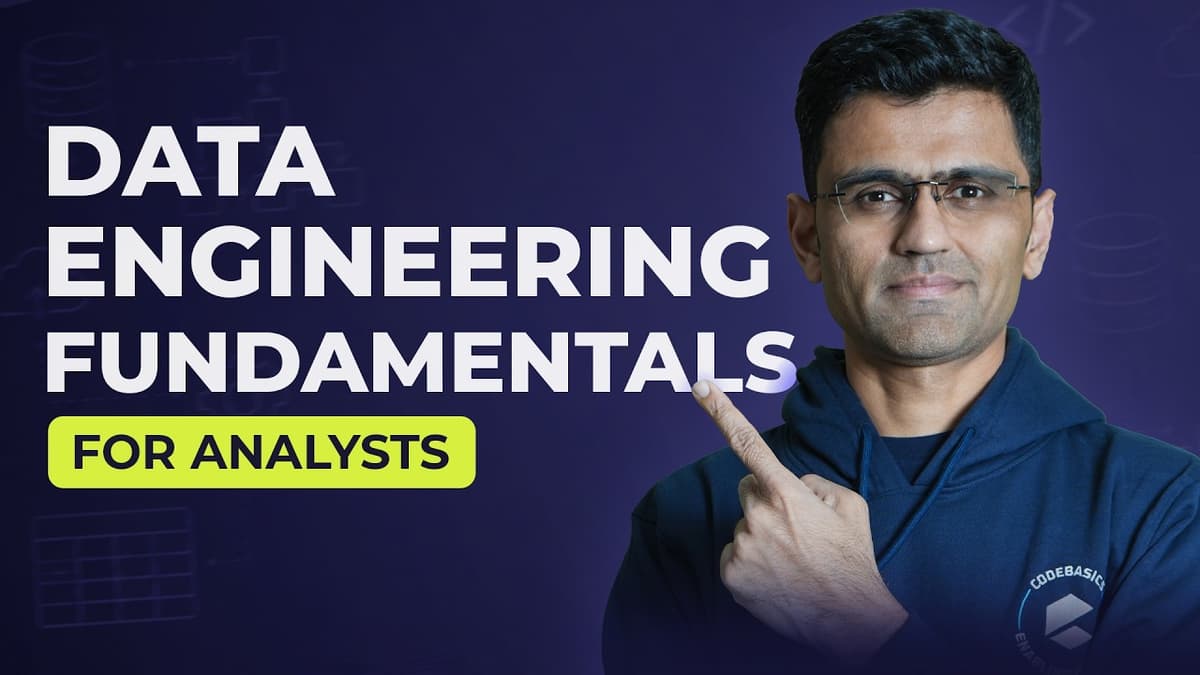
Data Engineering Fundamentals for Analysts
The video introduces data‑engineering fundamentals that every modern analyst must master as AI blurs the line between analysis and engineering. It uses a Blinket e‑commerce scenario to illustrate how orders, inventory, chat logs, and streaming driver locations span structured, unstructured, and streaming sources, requiring a systematic pipeline to become analytics‑ready. Key insights include the necessity of extracting data from diverse sources, transforming it through aggregation, normalization, and cleaning, and loading it into a data warehouse. The presenter contrasts OLTP (transactional) systems with OLAP (analytical) environments, explains why analytics should not run on mission‑critical databases, and highlights the role of predictive analytics powered by AI. Notable examples feature SQL joins to calculate on‑time delivery rates, the vegetable‑market analogy for ETL versus ELT, and a comparison of data lakes (raw, cheap storage) versus data warehouses (structured, performant). The discussion also mentions Delta Lake and Apache Iceberg as lake‑house solutions. The implications are clear: analysts must acquire engineering skills to design ETL/ELT pipelines, choose appropriate storage (lake vs warehouse), and separate workloads to protect transaction performance while enabling BI and AI-driven insights.

Your AI App Should NOT Depend on One Model
The video introduces Zapier’s MCP (Model Connectivity Platform) server, a unified gateway that lets AI applications access over 8,000 third‑party tools through a single integration point. By linking a Claude‑based app to Zapier’s MCP client, developers can manage credentials and...
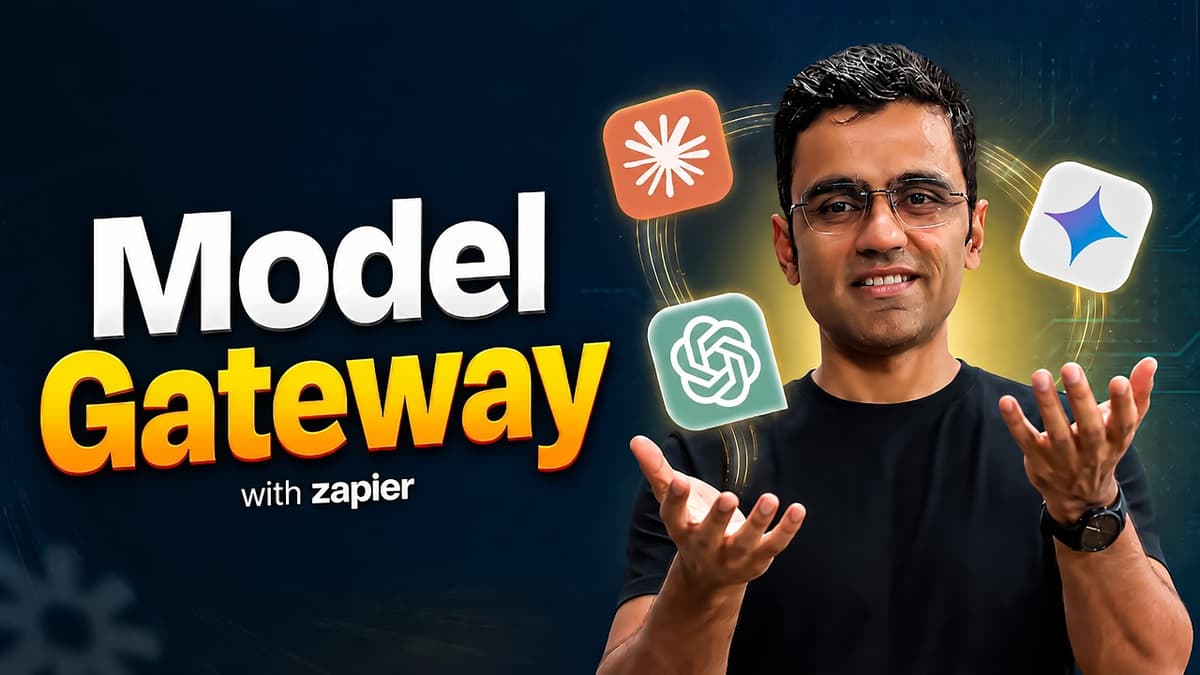
AI Agents with Zapier MCP: One Server, Any Model
The video demonstrates how to build a single AI agent that pulls calendar, email, and Slack data to deliver a concise daily brief, while allowing the underlying large‑language model to be swapped with a single line of code. It leverages...

10 AI JARGONS You Need to Know
The video titled “10 AI JARGONS You need to know” breaks down essential terminology for non‑technical users, positioning AI as an accessible tool rather than a specialist’s domain. It defines language models, large language models (LLMs), prompts, tokens, context windows, hallucinations,...
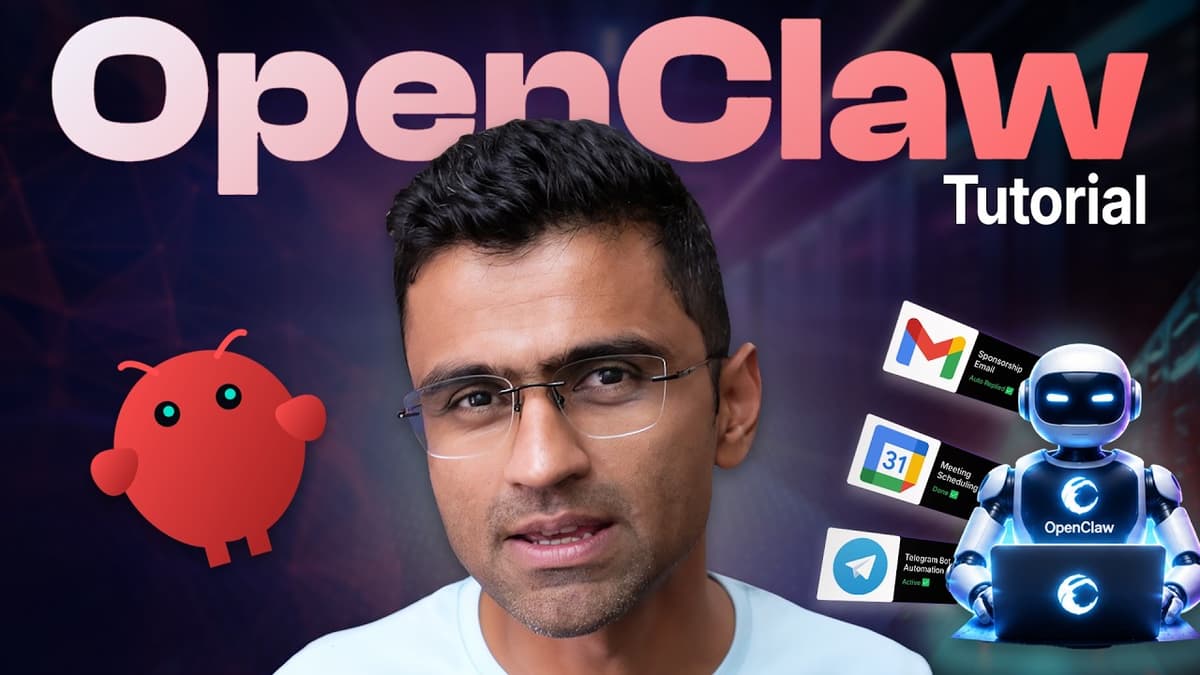
OpenClaw Tutorial
The video walks viewers through a beginner‑friendly tutorial that positions OpenClaw as a “digital employee” – an AI that can read and reply to emails, schedule meetings, and interact with tools, rather than merely answering questions. The presenter recommends deploying OpenClaw...
AI Agent Fundamentals
The video introduces AI agent fundamentals, explaining that an agent is an LLM augmented with external tools, a knowledge base, and memory to act autonomously on user requests. Dul, a veteran AI consultant, demonstrates how these components turn a static...
Ranking AI Tools Ft. Hem
In this informal video, host Hem conducts a blind ranking of popular AI tools, offering a quick snapshot of current preferences among developers and creators. He walks through each tool, assigning positions based on usefulness, cost, and niche capabilities. Gemini secures...

AI Engineer Roadmap for Software Engineers
Software engineers are presented with a structured pathway to become AI engineers, emphasizing that the role blends strong backend expertise with large‑language‑model (LLM) knowledge and system design. The video outlines a two‑month, week‑by‑week plan that assumes 4‑5 hours of study six...

Toy Augmented Generation Project to a Production-Ready AI System
The video walks viewers through turning a toy Retrieval‑Augmented Generation (RAG) prototype into a production‑ready AI system. It emphasizes security, reliability, and demonstrable results as essential pillars for enterprise deployment. Key steps include adding role‑based access control, integrating guardrails for out‑of‑scope...
Workflow Automation with Claude Code & Zapier MCP | AI Automation Project
The video walks through building a production‑ready invoice‑processing AI agent using Claude Code and Zapier’s MCP, aimed at automating accounts‑payable tasks for any enterprise. It outlines the current manual workflow—vendors send PDF invoices, an AP clerk (Helina) cross‑checks PO numbers, amounts and...

About Codebasics AI Pro
CodeBasics has launched AI Pro, a monthly membership aimed at non‑technical working professionals who want to harness generative AI in their daily tasks. The program follows the company’s internal experiment where a cross‑functional team built more than 35 AI applications, 16...

5 AI Projects You Need in 2026
The video outlines five high‑impact AI projects that professionals should prototype in 2026 to enhance online credibility and improve job prospects. First, a Retrieval‑Augmented Generation (RAG) system with role‑based access control, guardrails, and production‑ready deployment, built on LangChain and Ragas and...

Day in the Life of an AI Engineer
The video offers a behind‑the‑scenes look at an AI engineer’s routine at ATL Technologies, a boutique AI services firm. It frames the role as a hybrid of research, software development, and client‑facing responsibilities, emphasizing that traditional Python skills alone no...

Claude Code Source Code Leaked
Today’s AI community was rocked by the accidental public release of Anthropic’s Claude Code “body” source code. The leak, traced to an un‑minified 59‑MB npm package published on March 31, exposed roughly half a million lines of the framework that orchestrates LLM‑driven...

What Is OpenRouter | All About OpenRouter in 10 Minutes
OpenRouter positions itself as a “Zomato‑for‑LLMs,” offering a single gateway to over 600 language‑model APIs, from open‑source offerings to premium services like GPT‑4. The platform’s web console lists each model, its provider, pricing per million tokens, and real‑time performance metrics,...