

João Moura on Multi-Agent Systems, Autonomous Workflows & AI Entrepreneurship | Teaser
João Moura, reflecting on building CREI, argued that startups often must build complete systems in-house because partial solutions fail to reach production—teams expose the wrong data, lack deployment and monitoring, and ultimately don’t trust their models. He advised first-time AI founders to make a compelling case that they are the right person to back, noting early investor checks often bet on the founder more than the idea. Moura warned that competition is fierce and founders need the stomach for an uphill battle, but framed the process as highly rewarding for those with the right mentality. He also expressed a belief in striving for perfect systems from the outset.

Understanding Basic Vector Search With KNN | Vector Databases for Beginners | Part 12
The video introduces the K‑Nearest Neighbors (KNN) algorithm as the core of vector search, explaining how each query and document is transformed into a numeric embedding that lives in a multi‑dimensional space. By measuring the distance between these vectors, the...
Search Systems & Why Keyword Search Falls Short | Vector Databases for Beginners | Part 11
The video introduces vector search as a modern alternative to traditional keyword‑based search systems, explaining why the latter often fails to capture user intent. It outlines how keyword search relies on exact token matching, requiring precise terms and extensive synonym...
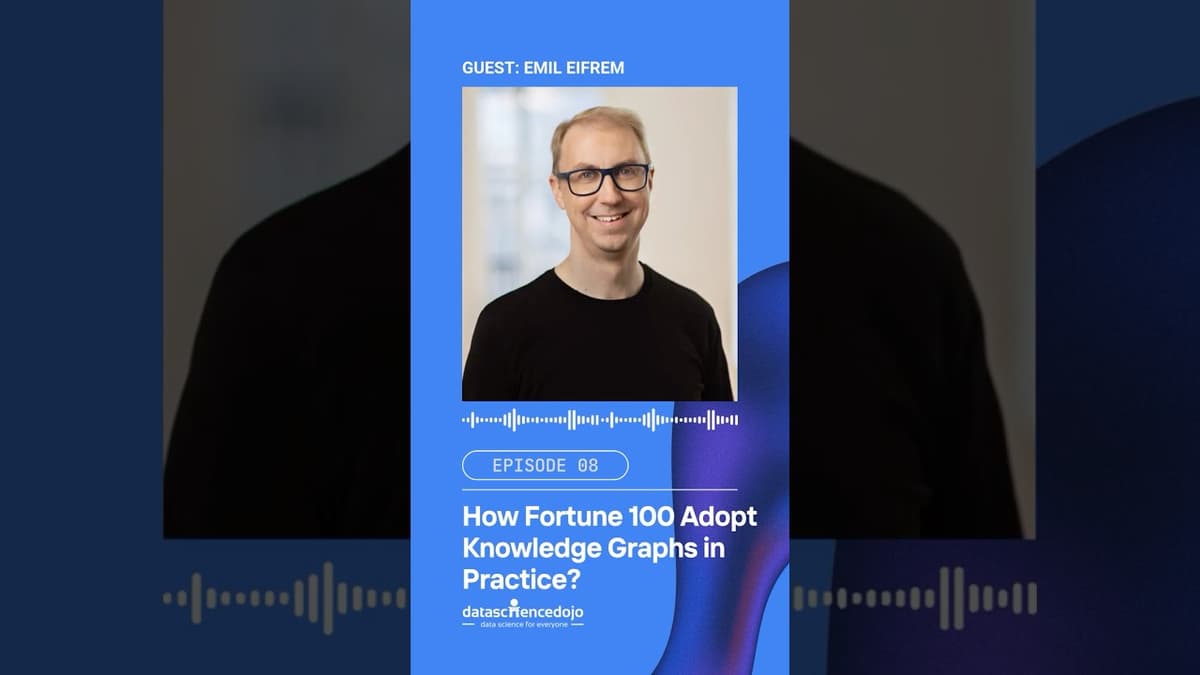
How Fortune 100 Companies Adopt Knowledge Graphs in Practice | Emil Eifrem X Data Science Dojo
The discussion centers on how Fortune 100 enterprises are actually implementing knowledge graphs, contrasting idealized, organization‑wide visions with the pragmatic routes companies are taking today. Two adoption patterns emerge. Large firms often build an “enterprise knowledge graph” that mirrors portions of their...
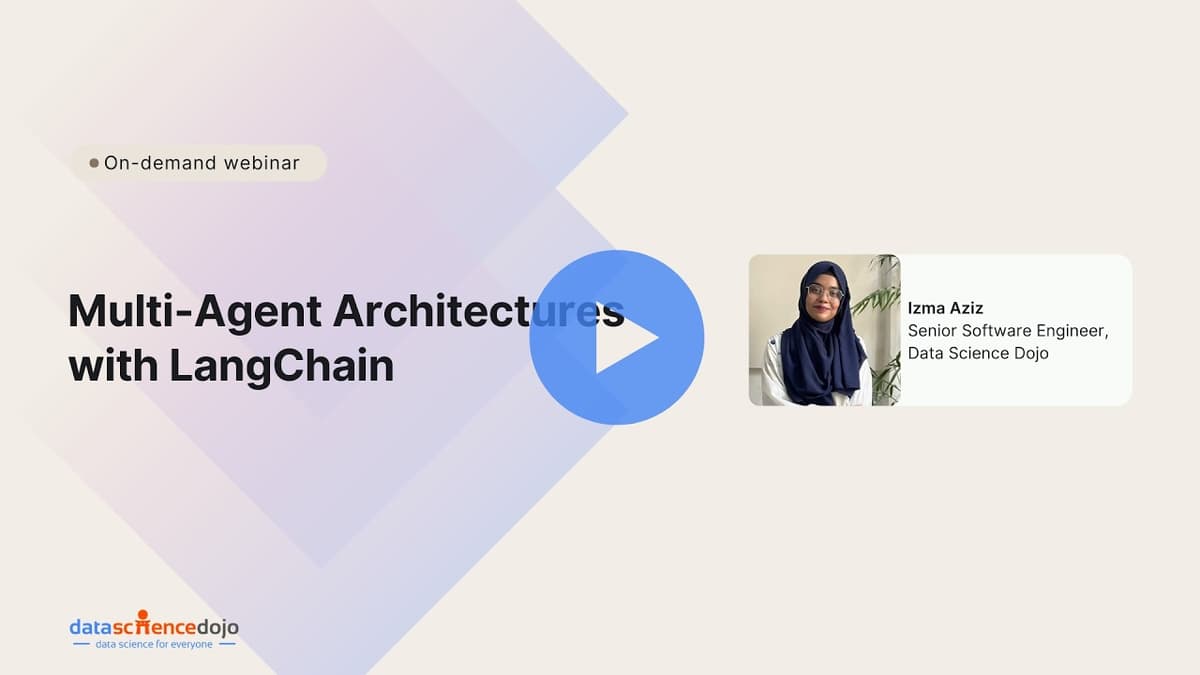
Scaling AI Beyond Single Agents: Multi-Agent Architectures with LangChain
The webinar hosted by Nabeha and Isma discussed scaling AI beyond single agents, focusing on multi‑agent architectures using LangChain. It outlined fundamentals of AI agents—LLM brain, tools, memory—and why monolithic agents struggle as tasks grow. The presenters highlighted token‑bloat, context‑window exhaustion,...
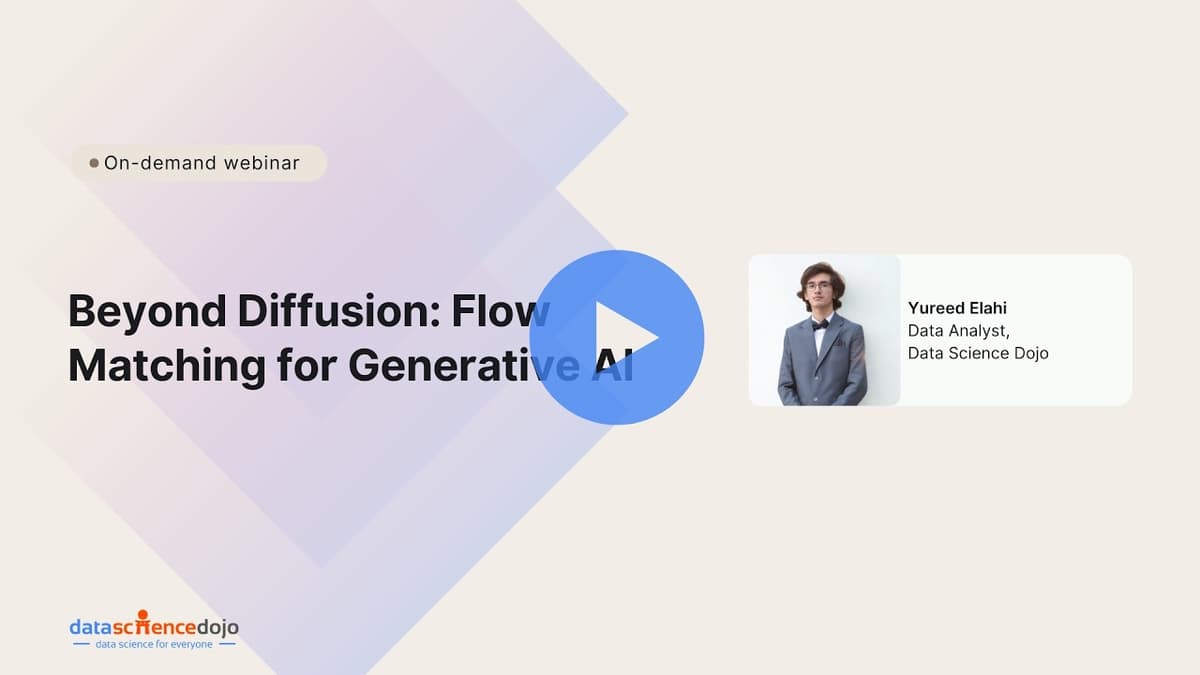
Beyond Diffusion: Flow Matching for Generative AI
Yuri Zilai’s webinar introduced flow matching as a next‑generation alternative to diffusion‑based generative AI. He outlined the agenda—reviewing fundamental generative models, dissecting diffusion, explaining flow‑matching mechanics, showcasing real‑world deployments, and a live 2‑D notebook demo. All generative models map Gaussian noise...
Creating & Ingesting Your Own Embeddings in Weaviate | Vector Databases for Beginners | Part 7
The video walks viewers through building custom text embeddings with a SentenceTransformers model from HuggingFace and loading them into a Weaviate vector database. The presenter demonstrates the workflow in a Google Colab notebook, pulling a subset of 100 arXiv paper...

How To Explain A Concept Without Dumbing It Down | Joshua Starmer X Data Science Dojo
The video features Joshua Starmer discussing how to explain complex data‑science concepts without "dumbing them down." He emphasizes a constant self‑check: can the idea be presented more simply while staying true to the original algorithm and its intent? This mindset...
A2A Protocol Workshop: Build Interoperable Multi-Agent Systems
In a Data Science Dojo webinar, Zaid Ahmed led a workshop on the Agent-to-Agent (A2A) protocol, positioning it alongside Model Context Protocol (MCP) as a solution for building interoperable multi-agent systems. He recapped MCP’s role in wrapping APIs for LLM...
Exploring the MTEB Leaderboard | Vector Databases for Beginners | Part 6
The video walks viewers through the MTEB (Massive Text Embedding Benchmark) leaderboard, positioning it as a practical guide for selecting open‑source embedding models and tuning modules for vector‑search applications. The presenter highlights recent UI changes—new benchmarks, language options, and domain‑specific...

AI Still Hallunicates Can We Trust It, And To What Extent | Joshua Starmer X Data Science
The video centers on the persistent problem of AI hallucinations—instances where large language models generate plausible‑but‑incorrect information—and asks how much trust users can place in these systems. Joshua Starmer, speaking alongside Data Science, argues that while the technology will improve,...
Choosing the Right Embedding Model | Vector Databases for Beginners | Part 5
The video walks viewers through the decision‑making process for selecting an embedding model, a critical component in building vector‑database‑driven applications. It contrasts two concrete examples—a modern open‑source BERT‑base model and a proprietary OpenAI offering—while acknowledging the overwhelming variety of alternatives...
From Word2Vec to Transformers | Vector Databases for Beginners | Part 4
The video “From Word2Vec to Transformers | Vector Databases for Beginners | Part 4” walks viewers through the historical shift from static, word‑level embeddings to context‑aware transformer‑based models. It opens by recapping the shortcomings of early techniques like Word2Vec—namely their...
Why Josh Always Asks, “Can A Topic Be Any Simpler Than This?” | Joshua Starmer X Data Science Dojo
In a candid conversation with Data Science Dojo, Joshua Starmer explains the guiding principle behind his instructional videos: constantly asking, “Can a topic be any simpler without dumbing it down?” He frames this question as a litmus test for clarity,...
Exploring the Origins with Word2Vec | Vector Databases for Beginners | Part 3
The video "Exploring the Origins with Word2Vec | Vector Databases for Beginners | Part 3" walks viewers through the historical breakthrough that introduced word embeddings, focusing on the Word2Vec model and its role in turning raw text into numeric vectors....
What Are Vectors? | Vector Databases for Beginners | Part 2
The video provides a beginner‑friendly overview of vector embeddings, tracing their academic roots back to early 2000s research and highlighting the watershed 2013 Word2Vec paper that brought vectors into mainstream industry use. It then connects that breakthrough to the later...
Why Your Brain Learns Better With A Good Story Story? Joshua Starmer X Data Science Dojo
The video featuring Joshua Starmer and Data Science Dojo argues that storytelling is not a peripheral flourish but a core pedagogical tool, even when the subject matter is as technical as mathematics or machine learning. The speakers contend that a...
Deep Agents with LangGraph: From Planning to Persistent Reasoning | Community Webinar
The webinar introduced Deep Agents built on LangGraph, positioning them as the next evolution in multi‑agent AI systems. Presenter Sajir Heather Zaddi, a senior software engineer specializing in LLM fine‑tuning and agentic workflows, framed the discussion around a recent tweet...
Introduction to Vector Embeddings | Vector Databases for Beginners | Part 1
The video serves as an introductory tutorial on vector embeddings, presented by machine‑learning engineer Victoria Slocum in partnership with Data Science Dojo. Slocum frames embeddings as the bridge between raw media—text, images, audio, video—and the numerical representations that power modern AI...

How To Stay Ahead In A World Where AI Can Possibly Replace You? | Jay Alammar X Data Science Dojo
The video features a conversation between AI educator Jay Alammar and Data Science Dojo on how knowledge workers can stay ahead in an economy where generative AI threatens to automate many tasks. The hosts frame the discussion around the age‑old...
Workshop: Transformer Models with @SerranoAcademy | Future of Data and AI | Agentic AI Conference
The workshop hosted by Luis Tirano at the Agentic AI Conference provided a deep‑dive into transformer models, focusing on their architecture, practical strengths and weaknesses, and emerging techniques such as Retrieval‑Augmented Generation (RAG) and autonomous agents. After a brief introduction...

Running the Workflow & Final Output | Multi Agent Workflows for Beginners | Part 10
The video demonstrates running a multi-agent workflow where a supervisor routes tasks to specialized agents: a coder agent that generates complete HTML/CSS/JavaScript portfolio code and a researcher agent that produces a structured, iterative research report on radiology. The presenter runs...
Should You Trust ChatGPT With Your Data? | Jerry Liu X Data Science Dojo
Speakers argue that for most individual users, uploading personal or mundane documents to ChatGPT (or similar tools) poses minimal risk because OpenAI does not broadly use such data traces for model training. However, companies and users handling highly sensitive, classified,...

Workshop: Building Smarter Agents, Faster with Arize | Future of Data and AI | Agentic AI Conference
Arize hosted a three-hour interactive workshop at the Agentic AI Conference to teach practitioners how to build and deploy smarter agents quickly. Product and community leads walked attendees through core concepts—RAG, tool-calling, model composition and evaluation—and provided hands-on Python labs...
Building the Agent Graph | Multi Agent Workflows for Beginners | Part 9
The presenter walks through constructing an agent graph for a multi-agent workflow, demonstrating how to define nodes (researcher, coder, supervisor), import required libraries, and instantiate a class to set up the workflow. They explain adding conditional edges that route decisions...
Setting Up the Supervisor Agent | Multi Agent Workflows for Beginners | Part 8
The video demonstrates setting up a Supervisor Agent as part of a multi-agent workflow. It walks through helper utilities, the agent’s message block and system prompt, and a prompt template that decides which agent should act next. The presenter names...
Setting Up Tools for Your Agents | Multi Agent Workflows for Beginners | Part 7
The video walks through setting up tools and a supervisor agent for multi-agent workflows, using slides and screenshots to explain architecture rather than live coding. The instructor shows creating two tools—a web search tool and a Python REPL tool—importing and...
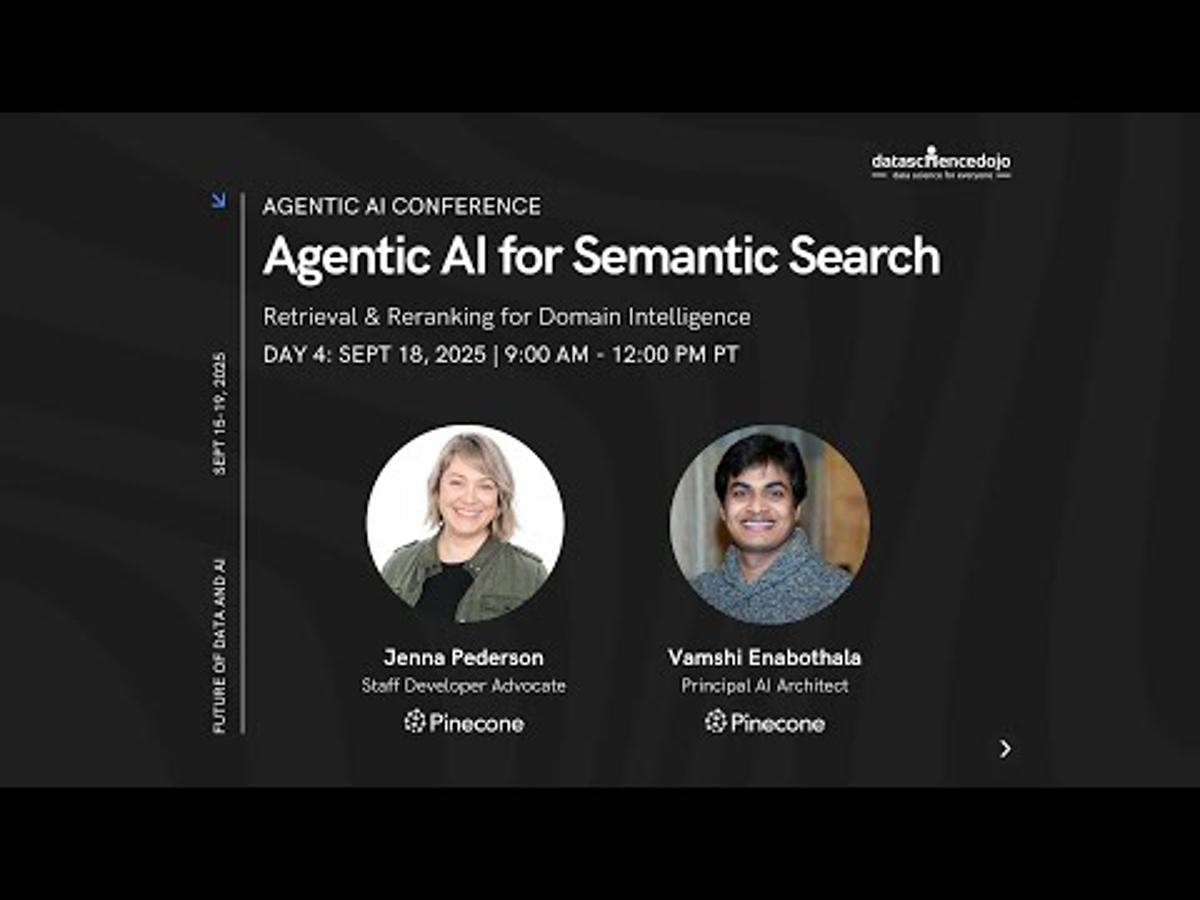
Workshop: Agentic AI for Semantic Search | Future of Data and AI | Agentic AI Conference
Pinecone hosted a three-hour workshop titled “Agentic AI for Semantic Search” that walked developers through the theory and hands-on construction of agent-driven semantic search applications. Hosts from Pinecone introduced agentic AI concepts, detailed Pinecone’s vector database architecture and differentiators, and...
Coding & Environment Setup | Multi Agent Workflows for Beginners | Part 6
The video walks through a hands-on notebook that builds a multi-agent supervisor: after installing required Python packages (langchain, langsmi(th?), pandas, etc.) and setting environment variables, the instructor creates a supervisor agent that can route queries to two specialist agents. The...